Información y entrevistas a Carlos Slim Helú

Carlos Slim Helú

Information and events

Interviews

Question and aswers

Information and Events Featuring Carlos Slim

n39
The Montevideo Circle will hold its 18th Plenary Session on the 26 and 27th July in Mexico City.
Read more >>
00
TELMEX and TELCEL announce phone numbers to make donations for Haiti. The Carlos Slim Foundation will contribute the equivalent to the public-contributed whole amount.
Read more >>
foto_slim_fund_inbur03
Mr. Carlos Slim announced the establishment of Fundación Inbursa, which will jointly operate with its similar La Caixa of Barcelona. The foundation will begin to operate with an one-thousand million pesos endowment, so enhancing the social responsibility aims that Fundación Carlos Slim has embraced since more than 20 years ago.
Read more >>
foto_slimalas
Carlos Slim donate to Fundación ALAS, 110 million dollars to support childhood.
Read more >>
foto_ics_firma
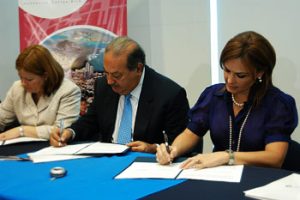
Vivian Fernández de Torrijos, First Lady of Panama, and Carlos Slim Helú, supported by the Instituto Carlos Slim de la Salud, signed agreement to increase health programs.
Read more >>
n99
Grameen Trust and Fundacion Carlos Slim announced an alliance to create Grameen-Carso which will start operating with resources of 45 million dollars for giving microcredits to the neediest in different states with higher rate of poverty in Mexico.
Read more >>
00
Press release of eng. Carlos Slim Helú, Plan 2009.
Read more >>
00
Carlos Slim Foundation communicates that donations for Haiti’s victims through TELMEX and TELCEL will conclude next January 31.
Read more >>
00
Grupo Carso Plan 2010
Read more >>
foto_bio_53g
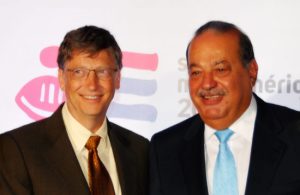
The Carlos Slim Foundation, the Bill & Melinda Gates Foundation, the government of Spain and the IDB, launch the Mesoamerica Health 2015 Initiative. The aim of this Initiative is to reduce the gap in health equality faced by the poorest 20% of population living in Central America and Southern Mexico.
Read more >>
00
Carlos Slim Foundation publishes the book Centro Histórico. 10 años de revitalización (Historic Center. Ten Years of Revival)
Read more >>
Grupo Carso. Investment in Mexico for the year 2015
Read more >>
00
Mr. Carlos Slim participated in the Global Markets Discovery Series Forum México, organized by the Business Journal in Phoenix, Arizona.
Read more >>
slim-accesolatino2015
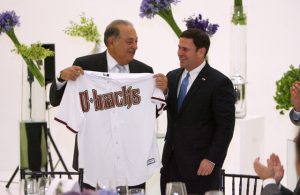
Carlos Slim Foundation presented to Doug Ducey, Governor of Arizona, its Latino Access initiative, supporting the development of the Latino community in the United States.
Read more >>
n37
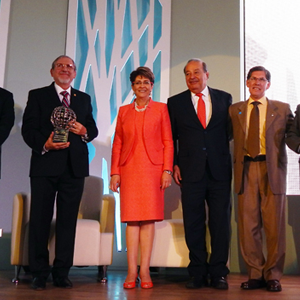
Outstanding professionals receive the 2015 Carlos Slim Health Awards in recognition to their innovative solutions in health matters in Latin America and the Caribbean.
Read more >>
n55
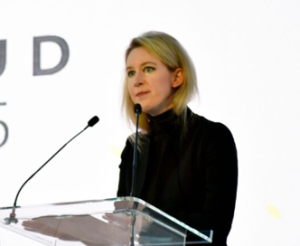
Carlos Slim Foundation announces its partnership with Elizabeth Holmes and her Theranos Company to promote the proactive prevention of diabetes and related ailments
Read more >>
slim-aldeadigital2015-01
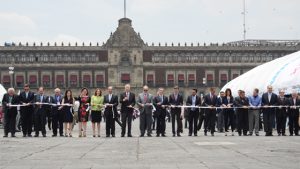
Mr. Carlos Slim opened the 2015 edition of Telcel - Infinitum Digital Village, the largest digital inclusion event in the world, held for third consecutive year in Mexico City's Zocalo Plaza. He was accompanied by representatives from the federal and city governments, as well as by other distinguished personalities.
Read more >>
n66
Mr. Carlos Slim participated in the international Conference on Inclusive Capitalism 2015, organized by the Coalition for Inclusive Capitalism, a non-for profit organization based in the United Kingdom
Read more >>
00
The Carlos Slim Foundation signed an agreement with Autism Speaks to provide online information and tools in Spanish to treat autism.
Read more >>
n30
The Montevideo Circle Foundation held its 21st Plenary Meeting in Alicante, Spain, with the topic “Governance Crisis of the Representative Democracy. In this event, Mr. Carlos Slim, Business Chairman of the Foundation, participated with the conference entitled, “The Value of Democratic Efficiency in Development.”
Read more >>
not_slim_salud-empleo_1
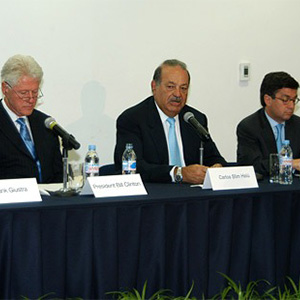
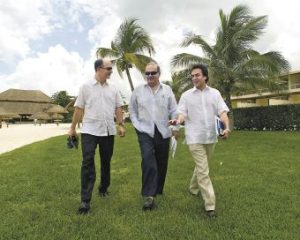
During a trip to El Salvador and Peru, Mr. Carlos Slim, former US President Bill Clinton and philanthropist Frank Giustra visited local communities where the Carlos Slim Foundation, the Clinton Foundation and the Clinton-Giustra-Slim Enterprise Partnership develop important health and employment initiatives, benefitting vulnerable populations.
Read more >>
00
INBURSA Financial Group turns 50.
Read more >>
not_slim_convenio_sedesol_interna
The Carlos Slim Foundation and SEDESOL sign a partnership agreement.
Read more >>
not_slim_convenio_honduras_fundacion2
The Carlos Slim Foundation and the Government of Honduras sign a cooperation agreement.
Read more >>
not_slim_salud_2016_2
Winners of the Carlos Slim Health Award 2016.
Read more >>
slim_salud_2016
Presentation of 2016 Carlos Slim Health Awards.
Read more >>
slim_aldea_digital_2016
Telcel Infinitum Digital Village Inaugurated in Mexico City's Zocalo Square.
Read more >>
e6
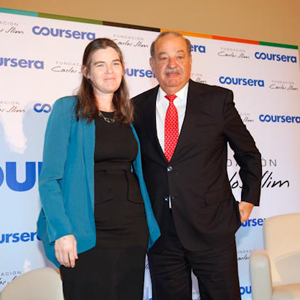
Carlos Slim Foundation and Coursera seal an alliance to provide free on-line world-class graduate studies in Spanish to millions of individuals.
Read more >>
e35
The Carlos Slim Foundation grants the "2014 Carlos Slim Health Awards" to individuals and institutions with outstanding research credentials in the health sector.
Read more >>
e34
Mr. Carlos Slim inaugurated the Telcel – Infinitum Digital Village, the largest digital inclusion event in the world, and he announced the creation of the "Train for Work" platform, which offers online courses to learn 20 different trades and professions.
Read more >>
e19
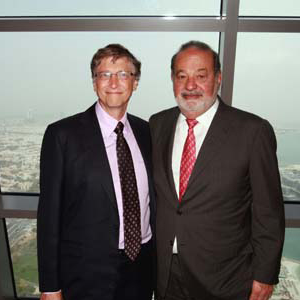
Bill Gates y Carlos Slim support food-production research.
Read more >>
e21
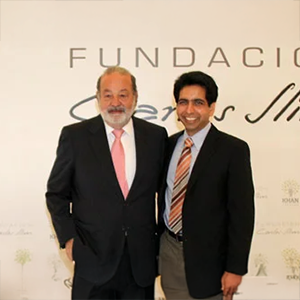
Alliance Between Fundación Carlos Slim and Khan Academy.
Read more >>
e20
Mr. Carlos Slim participated in the first Global Education and Technology Forum at Twitter's San Francisco offices
Read more >>
e18
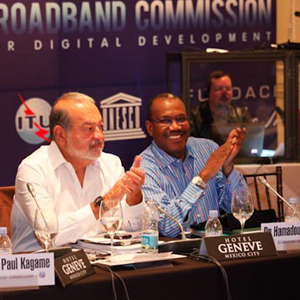
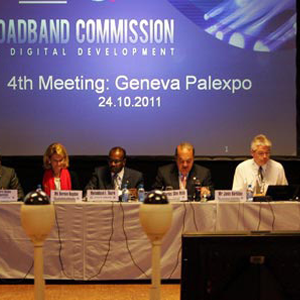
Mr. Carlos Slim hosted the International Telecommunications Union's (ITU) 7th Broadband Commission for Digital Development Meeting. Mr. Slim is the commission's co-chairman.
Read more >>
e17
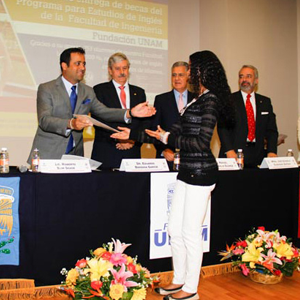
The UNAM Foundation and the Carlos Slim Foundation granted 753 scholarships to learn English to studies of the School of Engineering of the National Autonomous University of Mexico (UNAM, as per initials in Spanish).
Read more >>
e15
Carlos Slim Foundation will donate $100 million to the Global Polio Eradication Initiative´s (GPEI), which with the Strategic Plan 2013-2018 has the objective to end this disease in the world.
Read more >>
00
Mr. Carlos Slim and Mr. Ángel Aguirre Rivero, Governor of the state of Guerrero, did attend the initial building work of the Acapulco's Macro-Tunnel, to be the biggest in México.
Read more >>
00
Inauguration of the 10-kilometer Orient Emitter Tunnel to improve management of rain and residual waters in the Valley of Mexico.
Read more >>
e14
Speech of Mr. Carlos Slim Domit, Chief Executive Officer of Telefonos de Mexico, on the occasion of the Telmex Foundation "21th Century Mexico" Event
Read more >>
e13
Fifth anniversary of the WWF - Carlos Slim Foundation – SEMARNAT partnership supporting biodiversity conservation and sustainable development in Mexico.
Read more >>
e12
Opening of the Telcel Theater: the best in Latin America
Read more >>
e10
Mexico's National Commission for the Knowledge and Use of Biodiversity (CONABIO), the Carlos Slim Foundation and TELCEL launched the "NaturaLista" digital platform, innovative scientific tool that fosters knowledge about nature and its preservation by means of social media.
Read more >>
e8
Mr. Carlos Slim, Co-chairman of the ITU's Broadband Commission participated in the 11th World Telecommunication/ICT Indicators Symposium (WITS) organized by ITU. He stated that "in order to achieve universal access to information technologies, the private sector must invest, innovate and guarantee coverage; the regulating authority should, on its side, demand investment and coverage commitments from operators".
Read more >>
e7
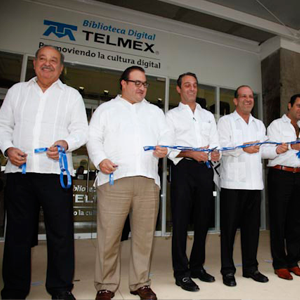
Mr. Carlos Slim opened the TELMEX Veracruz Digital Library, located in Plaza Nuevo Veracruz, a real estate development built by Grupo CARSO, which was also inaugurated on the same occasion. Mr. Slim was accompanied by Dr. Javier Duarte de Ochoa, governor of Veracruz; Mr. Carlos Slim Domit, president of Grupo CARSO, and Mr. Héctor Slim Seade, director general of TELMEX.
Read more >>
slim_biblioteca_digital_morelos
"Faro del Saber Morelos" TELMEX Digital Library was inaugurated in Reforma Pensil, in Mexico City's Miguel Hidalgo Delegation.
Read more >>
00
Public Education Secretariat and Carlos Slim Foundation Present Train for Work Diplomas to Graduates in Information Technology.
Read more >>
n2
Mr. Slim submitted the Progress Report of the Carlos Slim Foundation, as of September 30, 2019, on the reconstruction works after the 2017 earthquakes in Mexico.
Read more >>
e5
Mr. Carlos Slim inaugurated the Inbursa's Aquarium, the largest in Latin America. In the ribbon-cutting ceremony, he was accompanied by the Mayor of Mexico City, Dr. Miguel Ángel Mancera and by Inbursa's Aquarium President, Mr. Alejandro Nasta.Inbursa's Aquarium was created with the mission to inspire passion for marine life and to contribute to protect the marine world.
Read more >>
E4
Mr. Carlos Slim, accompanied by Dr. Javier Duarte Ochoa, Governor of Veracruz and by Mrs. Petra Nemcova, President and Founder of the Happy Hearts Fund, inaugurated the "Juan Maldonado Pereda" elementary school, donated by Grupo Carso and equipped by Happy Hearts.
Read more >>
e3
Mr. Carlos Slim’s speech, entitled “Growing together. State and Corporations”, was delivered during the 20th Plenary Session of the Montevideo Circle Foundation, where Mr. Slim is Corporate Chairman.
Read more >>
00
Carlos Slim Foundation Launches Free Online Site for U.S. Latino Community.Acceso Latino: Offering Education, Job Training, and Information on Healthcareand Culture in Spanish.
Read more >>
Información y entrevistas a Carlos Slim Helú
Carlos Slim and Best Buddies International Founder Anthony K. Shriver Call on Employers to Pledge "I'M IN TO HIRE" Individuals with Intellectual and Developmental Disabilities (IDD).
Read more >>
E2
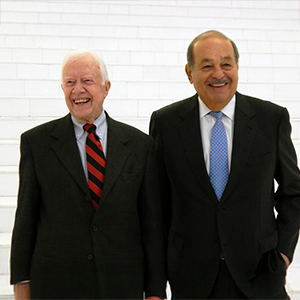
Jimmy Carter and Carlos Slim Announce New Partnership to Help Eliminate Last Vestiges of River Blindness in the Americas
Read more >>
THUMB
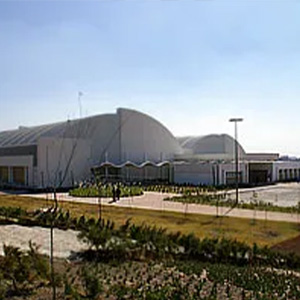
Mr. Enrique Peña Nieto, Governor of Estado de Mexico and Mr. Carlos Slim Helu inaugurated the Sports Center Ciudad Jardin TELMEX Bicentenario, an ambitious project of ecological rescue that was built on the surface of an old city dump known as Bordo de Xochiaca, in Nezahualcoyotl.
Read more >>
thumb171
The World Wide Fund for Nature (WWF) and Fundacion Carlos Slim announced an initial investment of $100 million dollars to support the conservation of biodiversity and promote sustainable development in Mexico.
Read more >>
00
Carlos Slim signed as witness of honor the Commitment to Liberty of Expression, Mexico 2009, convened by the Foundation for the Liberty of Expression AC, (FUNDALEX).  The ceremony was held in the presence of the press, experts and researchers from different disciplines.
Read more >>
00
Eng. Carlos Slim participated in the event: “The Renaissance of Ethics,” in the 27th Plenary Meeting of the Montevideo Circle.
Read more >>
Carlos Slim attended the ceremony in which the Federal District’s Legislative Assembly (ALDF)   awarded journalist Jacobo Zabludovsky with the  Citizen’s Merit Medal 2009 in recognition of his professional career and his personal contribution to life in Mexico City.
Read more >>
00
Carlos Slim Foundation and Grameen Trust have launched the Grameen Carso microfinancing program with 45 million dollars on September 24, 2009.
Read more >>
n1
Participation of Eng. Carlos Slim Helú in the Nearshoring Summit Mexico, Productivity with a Vision for the Future, Mexico City.
Read more >>
00
The Alliance WWF-Carlos Slim Foundation and ConcentrArte project present the book “Cuatro Ciénegas: La mirada de sus niños” An invitation to preserve the richness of the valley, natural laboratory for the evolution of species.
Read more >>
00
Mr. José Luis Luege, general director of National Water Commission (Conagua), and Mr. Carlos Slim did sign a contract for building the Atotonilco Waste Water Treatment Plant past January 7, 2010. The plant is designed to be one of the biggest hydraulic infrastructure works in México.
Read more >>
240701-conf-di-27
Eng. Carlos Slim Helú, President of Grupo Carso, delivered the conference entitled, “Prospective in the efficient application of Mexican engineering to establish investment conditions in our country,” framed within the Engineer’s Day, convened by the Mexican Union of Engineers Associations (Unión Mexicana de Asociaciones de Ingenieros, A. C.) (UMAI).
Read more >>
thumb162
Participation of Mr. Carlos Slim Helú and Mr. Felipe González, Former President of Spain, in the Telmex Foundation Interns Event: “Mexico, 21st Century.”
Read more >>
00
Carlos Slim
Read more >>
thumn
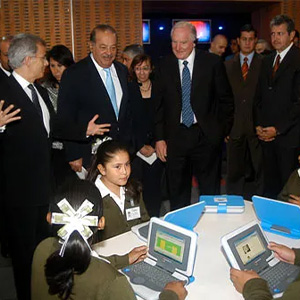
Engineer Carlos Slim announced the donation of 100,000 computers to more than 1,400 public schools in Mexico, during an event in Casa TELMEX Centro Histórico.
Read more >>
thumb
President Clinton, Carlos Slim Helú Announce $50 Million in New Projects in Mexico, Colombia, and Peru.
Read more >>
thum-157
Telmex, Claro and Museo Soumaya, from Fundación Carlos Slim, for first time ever presents thirty sculptures in Lima Peru in the exhibit Del mito al Sueño. Rodin…. Dali (From Myth to Dream. Rodin…Dali) conform to his commitment to the integral developing of the society of Latin America.
Read more >>
00
Engineer Carlos Slim Helú offered a press conference in which he presented the business history of Grupo Carso, its investment projects, the regulatory condition of Telmex and Telcel, its position regarding the national and international economic situation, which ended with a question and answer session.
Read more >>
e33
Carlos Slim Foundation donates Plaza Mariana to the Archdiocese of Mexico City and hands over a more-than-one-thousand-stands market place to Mexico City’s authority.
Read more >>
e32
Mr. Carlos Slim participated in ITU’s Broad-Band Leadership Summit on industry’s current global problems
Read more >>
e11
Mexico-US genomics partnership launches second phase
Read more >>
e31
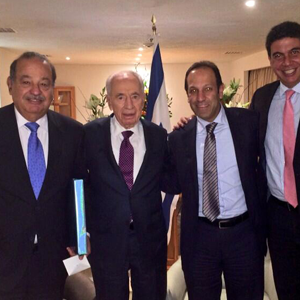
Mr. Carlos Slim met with Mr. Shimon Peres, President of Israel. Before the meeting, and framed in the visit of Mr. Peres to México, Mr. Slim held a press conference with Israeli executives.
Read more >>
e30
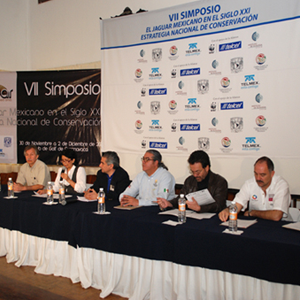
“Mexican Jaguar in XXI century: Conservation National Strategy” VII symposium concluded.
Read more >>
e29
President Felipe Calderón Hinojosa and Mr. Carlos Slim Helú made a joint oversight tour to Atotonilco's waste-water treatment plant in the state of Hidalgo, Mexico. This public-private financed plant is a huge infrastructure work to solve water problems of Mexico City's metropolitan area and to benefit Hidalgo's farmers and inhabitants as well.
Read more >>
e28
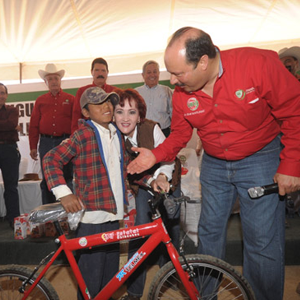
Carlos Slim Foundation, Frisco Mining Company and the Government of Chihuahua have donated 10,000 bicycles for the benefit of schoolboys living far from school, plus 8,000 bedcovers for poor people in Sierra of Chihuahua. The donation is part of “Ayúdame a llegar” program.
Read more >>
e27
Mr. Carlos Slim and Mr. Angel Aguirre Rivero, governor of Guerrero, set up the first round of Vuelta México TELMEX 2012, the most important cycling tournament in México. Internationally-rated cyclists participate
Read more >>
thumb-155
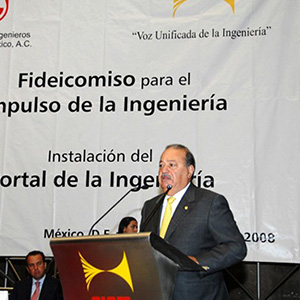
Eng. Carlos Slim participated in the opening ceremony of the event Fideicomiso para el Impulso de la Ingeniería organized by the Colegio de Ingenieros Civiles de México (Civil Engineers College) in which the new web site iNGENET was introduced,  created and sponsored by TELMEX.
Read more >>
e26
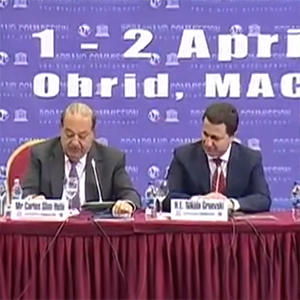
April 1-2, 2012. Ohrid, Macedonia.
Read more >>
thumbb
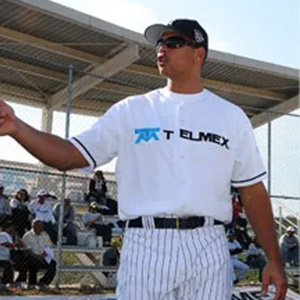
Eng. Carlos Slim, along with Alex Rodriguez, baseball player of the New York Yankees, visited the new "Sports Center Ciudad Jardin TELMEX Bicentenario", the biggest sports center in Mexico located in the old waste dump of the Bordo de Xochiaca, in Nezahualcóyotl.
Read more >>
e25
Carlos Slim Foundation Announces $3 Million Donation to Broadband Efforts to Connect Latino Households
Read more >>
00
Eng. Carlos Slim Helu was nominated member of the Executive Board of RAND Corporation (Research and Development), a nonprofit research organization in the United States, which offers assessment and solutions about commerce and politics, among other aspects, throughout the world.
Read more >>
00
Mexico City Major Mr. Marcelo Ebrard and Mr. Carlos Slim, inaugurated both a underway via in Ejército Nacional/Moliere streets, and Parque Lineal Ferrocarril de Cuernavaca, first step.
Read more >>
e24
Mr. Carlos Slim participated in Geneva Conferences, organized by the United Nations Office at Geneva (UNOG) and the United Nations Institute for Training and Research (UNITAR).
Read more >>
e23
Mr. Carlos Slim participated in the International Telecommunications Union's (ITU) 6th Broadband Commission for Digital Development Meeting. Mr. Slim is the commission's co-chairman.
Read more >>
00
América Móvil Joins (RED)
Read more >>
00
Mr. Roberto Slim participated in the name of Mr. Carlos Slim in the official launching of EDUCATION FIRST initiative in the United Nations’ General Assembly in New York.
Read more >>
thumb333
NEWS BULLETIN
Read more >>
00
International Businessman and Philanthropic Leader Carlos Slim to Fund Scholarships for Graduate Students at the George Washington University The Carlos Slim Scholars Program to Cover Full Tuition for Business, Engineering and International Affairs Students
Read more >>
e22
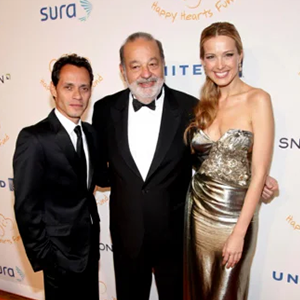
Petra Nemcova's Happy Hearts Fund Land of Dreams Gala: Mexico with Special Guest Carlos Slim & Honoring Howard Buffett.
Read more >>
thumb222
News release
Read more >>
00
The Carlos Slim Foundation is jointly working with UNICEF in supporting Haiti emergency crisis alleviation and then to uphold reconstruction.
Read more >>
00
The Carlos Slim Foundation doubles “Unidos por Chalco” concert’s earnings in support of Chalco’s flood victims.
Read more >>
thgum-15
About two thousand million pesos will be invested in environment projects in priority areas of México. Investment capital will come from an agreement between Semarnat, WWF and Carlos Slim Foundation in support of environment protection actions.
Read more >>
00
UNITED BY HAITI
Read more >>
tunm
President Bill Clinton, Frank Giustra and Carlos Slim Launch a 20 million Dollar Fund for Small and Medium-Size Firms (SMFs) in Haiti
Read more >>
thumb
TO ENSURE UNIVERSAL ACCESS TO MODERN ENERGY SERVICES FOR 3 BILLION PEOPLE IN ENERGY POVERTY AROUND THE WORLD REQUIRES A GREAT COMMITMENT OF ALL SECTORS
Read more >>
00
Mr. Carlos Slim took part as a guest of honor and speaker in the act of acknowledgment to Emergent Leaders of the Puerto Rico’s College of Engineers and Surveyors (CIAPR in Spanish) during the Conference & Expo Meeting CIAPR 2010 in Puerto Rico.
Read more >>
00
Fundación TELMEX bestows life pension to retired boxers. August 26, 2010, México City.
Read more >>
00
A constellation of stars, The National Council for Culture and the Arts, National Auditorium and Carlos Slim Foundation in solidarity with Veracruz.
Read more >>

Interviews

00
Engineering Carlos Slim Helu's interview performed by Francesc Relea, published by El Pais magazine number 1607, Sunday July 15th, 2007.
Read more >>
00
Engineering Carlos Slim Helu's interview performed by Estela Caparelli, published by Epoca Negócios magazine, number 6, August 1th, 2007.
Read more >>
foto_slim_washington
Carlos Slim Interview, Financier and Philanthropist, Mexico’s Telecommunication Tycoon. December 2, 2007, Washington, D.C . Published on www.achievement.org
Read more >>
001
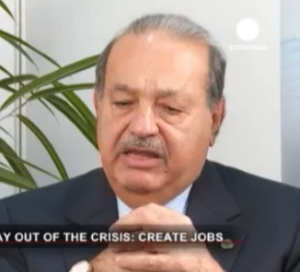
INTERVIEW: Foreground CARLOS SLIM Founder of Grupo Carso and second richest man in the world.
Read more >>
z41
Carlos Slim Helú interview by Eric Schmidt, Chairman and CEO Google.
Read more >>
z40
Interview with Carlos Slim for CNBC, performed by Michelle Caruso.
Read more >>
00
Interview realized to Carlos Slim Helú, performed by RogelioCárdenas Estandía, published by El Financiero Dialy. October19, 2009.
Read more >>
34
Interview with Carlos Slim performed by Maria Bartiromo for the CNBC Network.
Read more >>
33
Interview with Carlos Slim performed by Maria Bartiromo for the CNBC Network.
Read more >>
32
Larry King interview with Carlos Slim in CNN's Larry King Live.
Read more >>
Z30
Interview with Mr. Carlos Slim performed by Martyn Warwick from ITU TelecomTV, in the Broad-Band Leadership Summit, organized by the International Telecommunication Union (ITU).
Read more >>
Z28
“Against economic crisis, development, not austerity”: Carlos Slim, the world’s wealthiest businessman
Read more >>
elpais-csh01
Interview to Mr. Carlos Slim Helú for Leaders magazine.
Read more >>
z28
Interview to Mr. Carlos Slim Helú performed by Bettina Bulgheroni for the argentine show "Puentes de Esperanza".
Read more >>
philanthropy-csh-wwf
Interview with Mr. Carlos Slim performed by Caroline Preston from The Chronicle of Philanthropy newspaper.
Read more >>
z27
Entrevista realizada al Ing. Carlos Slim Helú por Salvador Camarena y publicada en el periódico El País, de España.
Read more >>
z26
Interview with Mr. Bill Gates and Mr. Carlos Slim Helú about the Mesoamerica Health Initiative 2015, framed in the Annual Meeting of the Board of Governors of the Inter-American Development Bank (IDB) March 2013. Panama City, Panama.
Read more >>
z25
A Conversation with Larry King and Carlos Slim, in the Global Conference 2013 of the Milken Institute.
Read more >>
z23
Carlos Slim interview with Larry King. Ora. Tv
Read more >>
z22
Talk between Carlos Slim and Carlos Salazar in the Seminar, "Vision of the Future: #Mexico2042”.
Read more >>
z20
Interview to Mr. Carlos Slim Helú performed by Lic. Arturo Elías Ayub in the Telmex Foundation Event: “Mexico 21st Century”.
Read more >>
f-02
Eng. Carlos Slim Helú delivered a Master Conference to ITAM alumni in Mexico City, framed in the Economic Perspectives Forum 2024.
Read more >>

Question and Aswers

This section includes statements made by Mr. Carlos Slim Helú when basically he answers the most frequently asked questions in the national and foreign media.

Let me highlight several important things.  It is surprising and may seem strange that so many different activities were carried out, namely: bottling soft drinks; construction, housing sales, brokerage house, stone slabs, growing flowers for export, printing, production and sale of cigarettes, flexible packaging as is manufactured, bicycles, copper, ceramics, tires, paper, capital goods, cellulose, bond paper, sweets, Hershey’s chocolate plant, called Nacional de Dulces, but it is Luxus and Nacional de Dulces; Sanborns, mining, hydrochloric acid, hotels; and also the collection of what today is Museo Soumaya. This was frankly a very important activity, although quite diverse,.

This first stage covers 26 years.  These were very important years for the creation of human capital, and this human capital can compete with the best one in the world.  And it has definitively proven it is a great human capital.

The group’s work philosophy was also created in these first years.

I made a list to give you a clear idea of how things were,  that is, what was the value of companies in December 1982.  It all collapsed, the trust of investors, the rate of exchange, and of course, prices.  All this, led to these inexplicable, punished prices of very valuable companies, that did not have financial problems.

At the beginning of the 80s the extremely severe crisis faced by the country caused major distrust in Mexico’s economy and a massive flight of capitals; the value of many companies was extremely low.  For example, Cemex was worth 26 million U.S.Dollars and today it is worth close to 28 billion U.S. Dollars; Teléfonos de México was worth 172, it was one of the most expensive ones; Grupo Condumex was worth eight and a half million; La Moderna 4.8 or 5 millions (this company had 75% the cigarette market; it was British American Tobacco of which we owned 40%, and since we controlled the other company, Cigatam, we sold it for approximately somewhere around 80 or 90 million U.S. Dollars; the purchaser sold his share for 1.7 billion U.S. Dollars to British American Tobacco). These are appraisals of 100% of the companies, , Alfa was worth 5,700,000 dollars (today it is worth more than 4 billion dollars), Bimbo 12 million (today it is worth 7 billion dollars), Apasco 15, Sanborns 23, it was one of the expensive companies, Kimberly 27 (and today it is worth almost 5 billion dollars).

Grupo Carso’s principles: simple structures, organizations with minimal hierarchies, personal development and internal training for executives.  Flexibility and quick decision-making; operate with small company advantages, those that make great companies grow large; also maintain austerity in good times instead of expanding, restructuring, creating corporate companies, etc.; companies grow stronger if they are austere, capitalize revenues, accelerate development and avoid bitter adjustments that also impact the morale of personnel in times of crisis.

We were always active in modernization, growth, training, quality and trying to simplify and continuously improve the production processes; increase productivity and competitiveness; reduce costs and expenses by using global benchmarks. Then, not letting the company be limited by the owner or manager, nor be a big fish in a small pond and minimize investment in non-productive assets.

I have to say that today, Grupo Carso does not have a corporate building, although we are planning to build one.  This is Grupo Inbursa’s building and I think it is four years old, but Grupo Carso does not have its own building because as they were basically industrial companies, the offices were and are at the factories.   Now, for the first time we are about  to have a company building because Carso has evolved into a more service-oriented corporation, starting from commercial services that are part of the construction industry and also perform several other activities.

We are also confident that there is no challenge we cannot meet if we work together, with clear objectives and knowing the tools we have at our disposal; money that leaves the company evaporates.  That is why we reinvest profits.

The entrepreneurial creativity and business experience does not only apply to business but also to the solution of problems.  The entrepreneur is constantly confronted by resource management, facing problems, finding solutions, innovating, etc.

Firm and patient optimism always yields its rewards; this is also one of my father’s principles.  All times are good times for those who know how to work and have the tools to do so; this is also from my father. What I learned is to always bear in mind that we leave with nothing, that we can only do things while alive (así está en los principios en los otros documentos) and that we must be efficient, careful and responsible in the managing our wealth to create more, and we believe that wealth has to be managed efficiently to generate more wealth and distribute, not wealth itself but its revenues, distribute the revenues which are the fruit of wealth, is the return of wealth.

A favor in exchange for what? Some said that and it was repeated quite insistently.  Let’s see.  They said he was a partner.  I think that if someone is going to do business it is absurd to buy an over-priced company at 8.600, when he can buy it for one thousand.  Do you agree?.

First there were four or five bidders, and then only three, three Mexicans because Mexican majority was a must and there were approximately 14 foreigner bidders; then we, the Mexican partners, were lucky to choose the foreign partner, because we were three and they were 12.

At the end we were actually two Mexicans who chose four foreigners After meeting with almost all of them, we chose two,; I think we met with probably eight or ten and we chose two, the French and the Americans.  The French because they had had a very old plant in France, in very poor conditions and had turned it into a highly efficient company.

And the American partners, because of their marketing experience.  They had had mobile telephony for several years, and we felt highly complemented; this was part of the selection process.

The bid summon reads:  In order to pay the price balance in U.S. Dollars of Series AA shares, the control shares, under a Trust Fund, the winner bidders, by entering a mandate contract with Banco Internacional, may deposit thereunder the Series L shares it owned, so that they could be subsequently sold.

Then, you could pay with money or with L Shares, Who could pay with L Shares,? that is, the party that had L Shares, because we did not have them, we paid cash. I believe, that it was also considered that payment to could be made in six months with an interest payment plus three-percentage points. (Este párrafo está muy confuso, por ello no se puede hacer mucho al respecto).

I do not remember when it was, but instead of paying in January, we paid at the end of December and we decided to pay, I believe 80 per cent, plus three percentage points, and SBC and France Telecom decided otherwise, they paid cash.

Telmex was a private company for many years, until the 70`s President Echeverrìa had the State buy the majority of the shares. In fact, The stock was worth approximately 70 or 80 pesos, but was bought for 115 or 120.  At that time  there was not too much information control,, actually there was information was regulated, but this was the way in which the majority was bought.  Despite the fact that a year and a half went by before the telephone was provided, users were forced to buy shares or bonds.  That is why the shares were punished for so many years.

The government bought many of those packages of shares.  Telmex was nationalized without a decree or anything else; the government simply bought the shares; it also owned preferential shares it turned into common shares.

Telmex was nationalized but stayed in the Stock Exchange; it continued to give  shares for the records, and there continued to be a market for them in the United States; arbitrages continued, it was the most important stock in the Stock Exchange, where there were more arbitrages. (no se puede hacer nada con este párrafo pues es lo que dice el original)

There was a purchase-sale arbitrage with the United States; there were also many buyers here who bought the shares, even outside the offices, , and ads in the newspapers.

This happened in the first half of the 70s.  Then Telmex  was managed as a mixed company, with management, with a significant private ownership until it was decided to privatize it; almost half the company was outstanding in the markets.

In December 87, Telmex was worth a little more than 600 million dollars.  Its value increased significantly in the year it was privatized, actually since 88, and in 89 it practically doubled and the following year it increased more than two hundred and twenty percent and it continued to increase in the 90s.

When the bid was made the company’s market value was 1.387 billion U.S. Dollars and the bid price was 8.615 billion dollars, 16.6% higher than that day’s the market price.  In November we still saw a slight increase from 7.387 to 7.552.  After the bid, in December, it dropped to 7.273 despite the fact that during the year the entire company increased 95%, from 3.730 billion to 7.273 billion dollars

Thus 20.4 per cent, the company’s control, was privatized.  Therefore 1.710 billion dollars were paid.  People say that Telmex was bought in 1.720 billion dollars when actually 20.4 per cent of that price was bought. It was the company’s control, 20.4 per cent.

We have to mention several things:  20.4 per cent was bought and that is why 1.7 billion dollars are mentioned, when the amount is 8.6 billion.  By the way, at that time Telecom Brazil was worth 800 million dollars, all of it was worth ten times less than Telmex.

When we took over the company we prepared our three-year plan, Telmex started to change.  There was a tremendous change not only in the company but also in all the market.  The share price rose.  It was the only emerging market stock; there were emerging markets’ papers, it even opened emerging markets to emerging markets’ companies; it opens equity markets for them, and they are still open today; the big stock exchanges, the big investors and above all, the big funds.

Grupo Carso bought a little more of that 20.4 per cent; it bought close to 5 per cent of the total and approximately two or three of the investors decided not to buy anymore, not to invest, not to support, because they were paying more than the share’s price at the Stock Exchange.  They said,  “I better buy at the Stock Exchange”.  Grupo Inbursa had to buy the half percent.  Then it bought approximately 5.8.  In net worth terms, we bought 3.5 per cent of the entire Telmex.

 First, the buying group was perfectly defined; at that time we controlled series AA, although there has been an evolution.  The French owned 5%, although they have already sold; SBC has been merging and has acquired, has taken over AT&T’s holdings; and I am told that Grupo Carso and Grupo Financiero Inbursa bought close to 5.8 and 4.6 the other Mexican investors.  The list was disseminated at the right time, it is of public domain and very well known.

What has happened? Obviously those that bought shares in 87, 88, 89 and 90 made very good money; doubled it versus 89, but if you compare it to December 87 they multiplied it by 12.  What is very clear is that in the privatization we bought at a 16.6 per cent higher price than its price on the day the bid was made, which was 18 per cent more expensive than in December 90.

There is suspicion, “no, they bought it very cheap and they did this and the other “, there are the figures and numbers do not lie.  There was a significant period of time during which, by the way, one of the big buyers of shares was the government itself; the government reappraised the value of the company by recalling its shares through several institutions, I say, this is how it was, so much so that a top officer of those companies when he won, called me to tell me that he was a very happy to own stocks, that he had been buying and had many Telmex shares; that is how I know that there were institutions that bought company shares, besides the fact that there could have been private investors.

Let’s see, of the 20.4, France Telecom bought 5 per cent, SBC, today AT&T 5 per cent, Grupo Carso and Grupo Inbursa 5.8, and other Mexican investors 4.6.  The list of the latter was disseminated at the right time; it is of public domain and is very well known.  We Mexicans bought 10.4 and foreigners 10.

No, the Mexican group had majority, 10.4 versus 10. An Executive Committee was formed with the presence of foreign partners, two weeks before we had a big discussion and we almost did not come to an agreement on how to set majority.  Fortunately everything was decided by consensus.

But what we agreed and accepted was that I would chair the executive committee on the Mexican side, that if the executive committee did not reach an agreement the two of them and myself would meet to discuss resolutions whenever differences arose.  However, it was always done by consensus; no meeting was ever held and this is how we solved the issue.

I believe that the worst scheme was the American, which at the end was carried out by Brazil.  The American scheme was the AT&T monopoly.  It was divided into eight or nine regional monopolies; then several small monopolies were created from the big monopoly. 

In the case of Mexico, they did not consider mobile telephony.  Today Telmex has less than 25 per cent of the lines.  We will go into that later, less than 25 per cent of the total lines in Mexico and less than one third of total revenues in the sector.

Any way, I believe that a complete competition model could probably have been better.  I believe they should have created three or four companies in the United States, because it is a very big market.

 When Telmex was privatized, only the long distance service remained as an exclusive service, local service stayed open to mobile competition.

Actually the competitor was the mobile monopoly.  The competitor started in 88, before Telcel started.  The complete service model showed that it was the best, as has been proven by its return to consolidation in the United States, to be a full service national or regional company.

The following should have been done.  Allow the cable companies to start to compete from the onset.  They took too long; the cable companies are more than 40 years old.  Then, I would say that they are better than the American model; and the American model is regionally reintegrating again .  Before it was only local service, today it is long distance and mobile; they are already into convergence because previously there was no triple play and cable companies historically lagged behind too long with services, they should have started before, there and here.

It has always been open, local service was never closed.  The long distance service was the only exclusivity given to Telmex until August 96, so that it would finish balancing its rates.

What happened was that the companies that came into Mexico to compete with Telmex only got into long distance, because it was the most profitable segment, but they did it at very high prices, it was the chicken breast, and well, AT&T and MCI were so mistaken that the same thing happened to them throughout the world.

Local service has always been open.

Here is the interesting part since Telmex would not provide video because it does not send images; it sends data, because Telmex carries data and not video in its network.

Perhaps videos were done in the 80s of 90s.  What happens is that Telmex takes an image, turns it into data, and then there is a little device at the client’s house that converts that data into images.

In my opinion and in the opinion of many lawyers, Telmex is working with data and not video, which means that the concession itself is debatable in that it does have some kind of prohibition to send data.

In any transmission line, fiber optic, etcetera, today it is an image that turns into data, is carried as data and the customer with a little device turns it into images.

I imagine that convergence was not clear, although a lot had been said about it, the technological development was mentioned, and we even heard about a telecommunications and not a telephony company

Telephony is phones, it is voice, I already knew that data was very important and that technological development was coming very fast.

Not at all.  Privatization was closed, then, there were no give and tale negotiations such as: I do this and I take this away from you and I do this and take that away.  As I was saying, video is sent as a package through the network; numbers and not images are sent, only numbers are sent, yes? They are not debatable.

And well, it was sold 12 times more expensive than its value three years before, 16 per cent higher.  Then I think there was not that kind of thing.

As you can see, many of the companies I mentioned at the beginning and which I mention now, are no longer part of Carso.

Let’s move on to the following page; it is still part of the history; this is Telmex. Here, I believe that in this part we have made several innovations in the group.  One of the interesting things that is different from what other companies do, if you follow me, is that a company that has a group of stockholders, dilutes with time.

Then, if a stockholder has three per cent, and the company is listed in the Stock Exchange, then it has gone down to 1.5 per cent; it merges with god knows who and it is down to 0.5; etc., or who has 20 per cent, merges and drops to 10, and the stock percentage continues to dilute.

I have to say that in the case of Telmex, instead of dissolving it has concentrated.  Why?  For several reasons:  instead of distributing cash dividends from the beginning, we reinvested them, and thus cash dividends represented a very low percentage of the cash flow generated.  If my memory does not fail me, approximately 12, 15 per cent.  .  Right?  .  This means that out of 100 pesos generated 15 per cent was distributed as dividends.  Therefore what was done specially in the first three years was to follow the three-year plan, that is, to invest heavily in upgrading the network, upgrading everything in order to grow, in order to be able to meet the demand.

When I speak of modernization, I am saying that there were many records kept manually, because I do not know who, did not authorize the purchase of computers.  Vehicles were constantly in the repair shop because they had been in service 15 years or more — 17 years — I believe there were 17 year old vehicles and they spent the entire day in the workshop.  Then the entire vehicle fleet was modernized.  And of course, also the network, was in very poor conditions.  There were only non digital switches, only a minority were digital; there were some analog and there were still electromechanical switches; they belong to a museum, they were switches, and I do not remember if 350 thousand lines were in those conditions.

Modernization was very important.  Therefore a program was prepared together with the union and the workers, to try to detect the areas that had too many workers after Telmex was modernized, and with the commitment of not reducing their number, analyzed what areas lacked and what areas had excessive personnel, in order to train employees in the new activities.

What followed was a very important training program.  We have to boast that besides in-house training, today our employees have approximately 15 years and not 5.5 of school education.

This program was also very well accepted because there were three workers that performed very closely related functions; therefore they were trained so that one single person could carry out the three functions and the salaries were compacted at a higher tier.  The outcome of this was that the other two individuals performing the other functions not only received their salary or the corresponding increases to their function, but were also promoted to a higher salary tier.

It was a very thorough training and upgrading program that brought about a major change in three years.  Of course this method was followed subsequently. 

This takes us to 94, 95 where Telmex as a policy … you will understand, that when a company starts with a dividend policy, it is extremely negative for it to lower dividends or even to freeze them.

The policy followed by Telmex and that we have followed, is a careful, conservative, growing dividend policy, but that rewards the investor through the buyback of company shares. Telmex has maintained a combined program and so has America Móvil, as they distributing moderate, low dividends but buyback company shares.  This means that the buyback can be adjusted depending on the financial conditions of the company in order to maintain sound company public finances, or of the investment or acquisition programs implemented.

Thus, in both Companies we have been able to maintain a growing dividend policy with significant company investments in their modernization and growth, in new services, but also in acquisitions with the same funds without having to merge or dilute the stock.  Do you follow me?

For example, we have the companies Telmex has acquired, and it has bought large companies such as Embratel, AT&T Latinoamericana; well this was a bargain but it also bought it, and subsequently it acquired the yellow pages companies in the United States, Cobalt Publishing; and it has also bought cable companies in Brazil, Colombia and Peru and a concession in Ecuador.

Then, it has been important, because it has continued to maintain significant buyback levels, and it has also been able to grow.

I was telling you that we had approximately 3.5 per cent of Telmex when it was privatized.  We have also invested the dividends generated and therefore today we own approximately 30 percent.  That means that instead of diluting the company, it has concentrated because of the reinvestments and buybacks.

Internationalization accelerates when competition arrives.  This means that competition has always made us better.

When long distance came into México we tried to do likewise in the United States.  It was very complicated.  We could not do it.  But both America Móvil and Telmex have accessed Latin America very quickly due to Telefónica coming into the Mexican market.  Telefónica was the leader in Latin America due to the number of mobile telephony customers.  As you know it operates in Sao Paulo, Argentina, Chile, and Colombia; and probably it is also present in fixed telephony.  Of course it is no longer present in mobile telephony.

I would also like to state that for example, so that you can see how these things work, the president of Spain called the president of Mexico to merge Telmex and Telefónica.  This happened in 99 or 2000 and the president of Mexico answered that we were a private company and the government had nothing to do with the company.

We stated that probably something could be done so we could access the United States market together, but they did not show interest there.

And now they say we are dominant and we are everything, but previously they wanted the two of us to merge.  This is how things change.  Of course, with the CEO of Telefónica himself, who came here to discuss this business.

There are two factors.  Number one, there should be appropriate competition  when there is one company competing in many markets and attacks one that is in its place; it can corner it.  Instead if they compete in several places, competition is in a more leveled field.

In summary:  The truth is that if you have seen the group’s history, when we do better is when we start competing because the truth is that competition makes you better, always, always makes you better, even if the competitor wins.  It’s as if you run 200 meters and do not want to compete with anyone, well, you are never going to be better; you practice sports and then do not compete against anyone, it’s the other way around.

When I was talking about the group’s philosophy, I mentioned that we had in mind the world’s benchmarks, not only because you have to compete with those present, but you also have to raise the bar for benchmarks as much as possible.

And undoubtedly, competition not only benefits consumers, it also benefits stakeholders.

We are the two competitors.  We are competitors in other countries.  I believe it is in Venezuela and Panama where we are not present, we are in another country in which perhaps Telefónica is not, but basically we are both in the same places.

Competition has been open in some places, and in most of them we started after Telefónica.

Then, we are competing in the Latin America market and as far as I know, we do not fight too much there; I do not understand why we do in Mexico. For example, they had 72 per cent of the Peruvian market and we came in with approximately twenty percent.  In another place they have fifty some percent, in Argentina also fifty some per cent.  Then in some countries Telefónica has more and in others less.

What I do say is that there is close competition, it is tight and, well you do not like it when the other one wins in a month or in a year, when you lose …, but then you have to get back somehow, and this is what competition is all about. Of course, there is also competition in statements and before the courts, but basically we feel competition for the markets is more interesting.

In how many?  We are competing in 15 countries; it will be competition with a tie, without a tie.  They did not allow us to come into Spain.  It was interesting there because Telefónica started to advertise it was the leader in Latin America, then in the quarterly reports it saw this was no longer so, and now we are ahead of them with 30 million customers … 30 million when they were the leaders.

Yes.  We wanted to go into Spain.  Why?  Because although the market share of competing companies is very important, prices are very high in Europe.  You can verify this in the OECD reports.  Our proposal was to enter with low prices, for the price to the public to be considered as an assessment element in our bids.  However, the decision was to benefit the three largest companies already operating in that country and the one that offered to invest more in rural areas, and since were not already in Spain, those already in, won.

Let’s continue with the following table of América Móvil.  This is a table that shows more or less how value has been created, for example, in this company.  This company was practically non-existent in 90; it had 35 thousand customers; it had started after the competitors did, after Iusacell, and it bought Telefónica in the northern part of the country, it had 35 thousand customers.

In the first column we have the number of customers, the years, the annual growth, the number of customers with cell phones in Mexico, growth in México and the company’s market value.

The company’s market value is only valid as of 2001 because the other one is an estimate.  We simplified it, just for the sake of it, we simplified it.

We want to encourage everything.  What we have seen, and besides this is something else that happens with competition and with our main competitor; isthat the market is going to grow and also when you are rendering two services, the price can drop, and when you provide three services, prices decrease even more.  Then, it has never been our strategy to discourage competition.

Here, what we have always thought, and these are our innovations; what we innovated, is pre-payment.  We believe we invented it, but the Portuguese say the same thing and I believe also the Italians and the Greeks.  We started to study it in 92, , but I believe we launched it into the market and was already working, in 95 or 06.

Actually, probably after China, we are the number one company in the world that has more pre-payment customers, that is, proprietary, after China.

At least we are one of the first three companies.  I do not know if Vodafone, but it has a lot of post-payment.  The thing is that we have many pre-payment customers.  But not only pre-payment customers, this is what allowed us, for example, as of 96, when we really push it hard, to experience a 64.7, 69, 90 growth.  Because it is very easy to grow from 35 thousand to 70 thousand.  I am going to grow 90, 145 to 149  , 110; 2002 was the year we experienced the bubble.

It is also interesting to point out that when Telefónica came into México, in the second semester of 99, the total market was not even 10 million customers, eight or ten million customers.  This means that since then, and I am talking about Mexico, here what we do, is that this is América Móvil’s market value, then here is the average value per customer.  Obviously it is not correct, we got 497 dollars per customer, then we multiplied 497 times the number of customers; but this is not right either. This was just to see the evolution.  And if it had been so and if América Móvil had been worth 17 million dollars at 500 dollars per customer, the appreciated América Móvil market value would be 69 per cent a year.  If instead of 17 it is 35 to one thousand dollars per customer, well then probably the percentage is less.  But the spectacular issue about the company’s growth and the creation of value that has happened in this company cannot be debated; there is no doubt about it.

A factor that contributed to the internationalization of América Móvil and Telmex was the so called Internet Bubble of March 2000, Markets started to fall,  and severely affected prices and markets; .  Hence the possibility to become international and grow significantly became very attractive, specially in the case of América Móvil, because many companies were available and in good conditions.

And in cases like Brazil and Uruguay we went in with a license and several licenses were sold.

Here you can see which companies are the competitors and as you can appreciate, there are many one by one operations.  Here Telefónica bought four companies to operate cellular telephony; it had Motorola at that time – 1999 or 2000 – it had majority in that market.

That is what I was saying previously, technologies should not be blocked.  If there is a technology, regardless which one it is, everybody should be allowed to enter.

For example, what happens here is that in China there are many rural areas, with an approximate 800 million Chinese and they are trying to develop equipment, and with those millions in India and China, that are so big, they become economies of scale; equipment and technologies can be produced and their price can be decreased significantly.

Then, what we are using here is a technology in a frequency that was not being considered, but that has been developed in China and allows us to be more efficient in 450 megahertz because more scattered and broader areas are included.

We are going to continue developing this service and as that Chinese equipment and technology evolves, we will continue covering all areas and services.

That is why I was saying that one of our future objectives was more broadband, more market share, universalization of the service and allow the entire world to have access to broadband.

For example, we have worked very hard, well, talked more than worked because we have not worked at all, with Negroponte for the famous 100-dollar computer he already has.  It is a laptop and the idea is to disseminate it especially in rural schools, and he says that will probably happen in the summer, and we were able to hear from him that he was going to place one million computers in every country.  There are small and very poor countries and also small countries that cannot buy so many.  Then supposedly they will start breaking it down, I do not know if next year, but the dissemination is going to be permanent. (no se puede completar la idea de “breakdown” porque no se si se refiere a la distribución entre países, o a reducir y hacer más entregas de menos computadoras cada vez del número asignado a un país determinado)

This is another highly criticized factor:  the rates.  It is a good thing that they published that data in Reforma today (March 2007); that we are the most expensive ones, or one of the most expensive … why don’t they mention the true dollar parity?

Well, there is an important thing here.  When they compare our prices, we believe that they should compare the sales price, without adjustments because that puts us at a disadvantage, , and thus we shall never be comparable to any one.

As you know, underdeveloped or developing countries such as ours, have smaller per capita revenues, less purchasing power and if adjustments are made based on that factor, we are never going to be comparable to anything.

The article published in the paper and that some government officials and some publications have also used, is based on comparing by purchasing power and by purchasing power we will never be able to be compared to anyone.

There is the purchasing power. To adjust it  in this table they use a 7.19 exchange rate instead of today’s which is 11.15.  So then they compare us at a 7.19 per dollar parity, and thus we are going to be the most expensive ones in everything.

Now, neither equipment nor systems are sold to us at lower prices, and our customers do not have the capacity to generate revenues per line as high as their customers; the famous ARPUs (Average Revenue Per User).

In the United States the ARPU is 50 dollars, here it is 15, that is 70 per cent lower, then we not only have the unfavorable factor of having a lower purchasing power and thus a smaller market and less buyers and a smaller dimension for the same investment, but we are also punished because of that, that is the 7.19 parity.

When you think that the dollar is worth 7.19 pesos, Telmex is number 26 in the low consumption rate, 24 in the middle, 24 in the high, 27 and 28, then we are one of the last ones.  Let’s see the nominal price, the true price.  What is the price to the customer with an 11.15 to the dollar parity?  There we are number 3 in the high consumption, 5 in the middle and 8 in the low and 11 and 15 in the commercial.  Well, then it is different to say that we are the last ones of the OECD member countries as some officials and the newspaper today have stated, than that at nominal prices where we are number four, six or 11, or whatever it is.

I would like to insist on the prices because not only have they said it, they will continue to say it and for non-sanctum reasons.  , They will continue to repeat and repeat that we are the most expensive ones for all, etc., that is what the OECD published.

If you wish let us move on to another price comparison table, the América Móvil, the Telcel table.  Here too, when data is published one should also check to see if it is  based on purchasing power.

The United States is at 5 cents, Finland at 11 and we at 11. Two things should be discussed here:  One that in the United States the incoming and outgoing calls are charged and the subsidy on the equipment is not so big; but the discussion would not be on all that.

Also in the comparison with the United States, one should consider that in Mexico it is basically pre-payment, 93 per cent pre-payment and in the United States it is basically post-payment.

Then the other rate, the calling party pays rate.  As you know, it was 2.50 ten years ago, obviously it has dropped in real terms and today it is 1.80 and 1.84.  Calling party pays, how much is it? How much in dollars?  It is 18 cents.  There is a reduction process there.

Then, in Mexico 12 US dollar cents, Argentina, 9 cents, it is cheaper, Colombia 14, Brazil is more expensive, Chile is more expensive and Peru is more expensive.  Almost everywhere thoughout Europe it is  more expensive.

The due date was December 18.  The authorities were probably working very hard to obtain the best results.  I understand that they have to work only on one or two more issues in order to finish the portability issue.  It has already passed Cofemer. We are already working very hard. But the fundamental investments cannot be made until they define the specific requirements needed to have portability.  Then this delay affects all the process.

The second issue is the interconnection.  They should have approved a framework of reference.  However Telmex did not wait.  It has already entered interconnection agreements with more than nine cities or concessionaires with Cablemas and it is now negotiating with other Cablevision concessionaries to be ready for interconnection.

The possible compensation issue derived from the amendment of the concession title to which some of you referred to a few minutes ago, has been going back and forth among the authorities.  Cofetel is once again giving a detailed analysis to the Secretary of the Treasury through its De-incorporation Comisión to prove that no payment is due and to prove to it that it is possible to amend the concession title.

By their nature, concession titles may be amended, especially when the authority granting them and the concessionaries agree to it.

But they are really very late.  Perhaps you could invite Cofetel to hurry because to the extent that Cofetel hurries, we will all be able to both have portability as well as convergence.  Anyway interconnection is already happening.

The truth is that I believe that it should be opened to foreign investment.  I wish they would reciprocate to us.  For example, let’s think that a Chinese company comes into Mexico and the Chinese open their market; and if the Spanish come and they open their market; and the same thing if the French come.  But even if they do not open their markets, I believe it is better for the law to accept this than to have them beat around the bush and manipulate things through a neutral investment fund.

Therefore, it is absurd to manage things in this manner; there should be an authorization to do it.  I believe that it is all right if we do not get into cable, because it is the competitor’s.  Previously when I was asked if things should be done independently, I would say yes, just like cable TV, electricity and telephone get to households, the famous autonomy.  I believe that is convenient or reasonable that we do not buy cable companies and that they are our competitors, consolidate and get together and I wish that two or three competitors could be derived from them.  But they should really be competitors; true competitors that have advantages over Telmex.

It is easier to move from the difficult to the easy issues, than the other way around; it is easier to go from video to voice than from voice to video.  This can be more easily done where there is already plenty of broadband to carry video, than when the band is narrow, that is the opposite, from narrow to broadband.

I think it is all right that Telmex does not to participate with cable companies.  As a matter of fact, in Latin America we are doing the opposite and we do not complain, quite the opposite.  We are competing with local telephone companies by buying cable and we are not asking for special treatment, or to be given space and payment.  Conversely, the fact that they have image with content and they have everything, makes it easier  that they have access.

Regarding Wi Max, I believe it is an error.  I believe that it is wrong to stop spearhead technologies beforehand; they should not be stopped, and they should allow all competitors to provide new technologies.  There should not be exclusive technologies for us or for others.  We should be able to access with new technologies, and the competitors should also come in with new technologies so that we may all have access to the new technologies and then, let there be competition.

The investment made in Televisa is an entirely financial operation that has even been reduced.  Therefore it has no corporate factor, no corporate reason, and no corporate element, similar to what could be established with Cablevisión.  It has been reduced.

Regarding the third question on contents, I do not think it is a matter of alliances.  I believe that Telmex’s idea is to be a content distributor.  Its intention is to give its customers whatever they want, at the time and when they want it. Telmex’s idea is not to exclude content, to have as much content as possible and if Televisa is one of the most important Spanish producing content companies, undoubtedly we are very much interest in it.  Our customers are going to be interested in having Televisa’s and Azteca’s content just like everybody else’s content, just like other companies’ content.

The important thing here is that there are going to be more customers, with a more diverse content choice, of schedules, quality, some free of charge, others for a fee, available for our clientele; a video clientele that has been small until recently.  I believe cable has been around for more than forty years, and I believe it has approximately four million customers.

But well, there are 25 million households.  The presence of restricted TV is very low and very big of open TV.  Almost all the households have coverage.

I am leading to having more homes covered with better voice, video and data services.

We are going to provide this service when we are authorized and the network is ready.  We are going to invite customers to this service.  Now, the interesting thing is that cable companies started to do this two years ago.

The important thing here is that customers have more diverse options.  I believe that the ideal thing would be to have three or four groups.  One of them is Televisa; another is Axtel with Avatel and whatever cable companies come in later.  How many cable TV broadcasters are there?  There are many; I believe 6000.  Well, so let them get together to also create several options, two or three cable options.

That is public TV and we do not provide a public service.  Do you see the difference?  Let me make this very clear.  Telmex has the obligation to provide a universal service.  For example, other telephony concessionaires have a telephony business, but they do not provide public service, they are not bound to provide a universal service.  We have some rates that have to be approved, they just have to register their rates and they start running their business.  In telephony we provide public service.

There are two different reasons why Telmex could provide video service.  The first one is technical.  We have a concession to transmit voice and data; video is only data: zeros and ones.  Then, from the technical point of view we have authorization and there is an express prohibition with it, in clause 1.9, that has no reason to be in the Concession Title, unless it is there to protect the interest of the people that had the TV business.  And this clause says that we cannot provide TV to the public.

Cablevisión has a public service, that is to broadcast TV signals.  You call it restricted television.  Channel 2 or channel 13 broadcast TV to the public at large.  According to their law they perform an activity of public interest, but they do not provide a public service, their rates are not regulated, they are not bound to provide universal service, etc.

From that point of view, the wording in Article 1.9 is more like a prohibition to broadcast open television, than a ban to provide the public service of broadcasting television signals.

However, Telmex’s Board of Directors decided to interpret it by the book and to follow the procedures demanded by administrative authorities so as not to adopt a different interpretation; we are just going to comply with this.

In the case of IDEAL, the acronym means: Impulsora del Desarrollo y el Empleo en América Latina (Promoter of development and employment in Latin America) and as the name implies, we shall promote development in Latin America through infrastructure, household and employment development, highlighting the training of technicians, Mexican engineering and investigation.  This means that Grupo Carso believes and accepts that basic activities are the construction and part of the development of human capital, in engineering, research and development, in the energy and environmental sectors.

Modernity is emphasized in telecommunications, much more activity for connectivity than for broadband and well, I think that in the case of mobile telecommunications, we have achieved a higher than 55 per cent penetration.  We now believe that it will be higher than 60 per cent.  In less than a year, or a year from now two out of every three Latin Americans will have a wireless telephone with everything that this implies. Two out of every three will have a mobile handset and obviously our approach will be connectivity growth.  Thus we have to continue investing in Telmex and to keep promoting the digital culture as we have done for the past six or seven years.

We started financing computers in the telephone bill.  We were the main distributor of computers in Mexico and every day we are going to try to have more people own a computer, but also a broadband connection.  This is one of the important objectives of telecommunications.

We are going to try to increase penetration in telecommunications: in convergence, in connectivity, in broadband.  How will the market take it? First it will see how successful we are going to be and second, how the investor is going to rate it.  América Móvil at one-third the price of Telefónica MoviStar; Telefónica Móvil has already been absorbed.  But when growth starts and its expenses are controlled and there is an efficient, operative structure and as I said, with low levels, few managerial tiers, with austerity, etcetera, and when we saw the company expenses, well they are low.

So what will happen now? How much will the company continue to grow?  What are we going to say if Latin American economies have tomorrow or in twenty years, I do not know in how many years, a 15 thousand per capita revenue? Wouldn’t it be wonderful?  It would be a big arch for the companies; we would have one hundred per cent penetration, etcetera. But, if underdevelopment continues and becomes a chronic situation, well then things would be different.

What is the future of the group’s companies?  We shall continue to invest; we shall continue to pursue more penetration, more broadband.  What will investors think about this?  Are they going to like it, to appreciate it properly?  Obviously we will have to reward stockholders.

I was saying that for example in América Móvil and Telmex, we had approximately 3.5 per cent.  This means that there was another 96 per cent that had done very well with the América Móvil and Telmex shares; this was in 91.

For example, in América Móvil today, we have approximately 30, because the other 70 per cent has been doing very well.  It has been fixed and mobile telephony because this can be sold and people buy the shares.  We do not know who they are, to us they are anonymous, and they have done very well.

And then in the purchase of 3.5 to 30 they have also made a lot of money, another one.  What is going to happen now?  Am I worried about its ranking, where am I, up or down?  No, that is not a concern to me.  I am concerned about the companies being efficient, that grow and have appropriate strategies, are competitive, may compete with anyone, and their value will be assessed by investors and analysts.

We started with the left foot in CompUSA.  The computer margins dropped significantly and then we were wrong about its management.  We erroneously left management there too long.  Normally two or three of the highest level executives join the companies we invest in and run them, stabilize them and stay and operate them, and we did not do that in this case.

Then, we had an erroneous startup beginning with a very unfounded famous lawsuit, with a definition that ended in the Supreme Court and recently, after five years, the judgment passed  was in our favor.  Five years of litigation due one person having American lawyers who earn their living from lawsuits and manipulation of the juries.  And we made a mistake by keeping on board inappropriate management.  Now, we’ll see, we’ll see if we can do better.

Well, I do not know but do not believe it will be one of the five economies; we already reached eight thousand dollars per capita, although income distribution is poor.  Modern economy, the new civilization is very positive because it is supported by the well-being of others; it is very easy to create wealth, production is very easy, productivity has increased significantly, technology has made production very cheap, in large volumes and at very low prices.  Globalization has made this even cheaper.

This new civilization allows leaving underdevelopment behind.  When we see what has happened in Europe, and it has also been experienced in Asia; when one grows and let’s assume that we could grow at that 7 per cent, it would double every ten years.  Then, this means we would fourfold in 20 years, with a GDP four times larger than today’s, and twofold in ten years; this means that we would be talking of approximately 16 thousand dollars more than what Korea has today, four times are 32 thousand dollars, more than what other developed countries have.

What do we need?  Growth with employment; pay attention to the domestic economy, form human capital.  This new civilization requires an everyday better human capital, that is health and education, and every day better education. Better education.  We have to move from literacy to the digital culture plus science, more engineers, more research, more development; people not only prepared for humanism,  we also have to train them, but  also in science.

Then, we have a very good start with eight thousand dollars.  I believe that is last year’s per capita income.  China had 300 and India was close to that.  We are already at eight thousand.  Then we just have to grow consistently, in a sustainable manner with employment, and at the same time forming human and physical capital.

We have to combine resources and go beyond what the government has.  And we have to invest; we need investment, in order to grow; invest in infrastructure, housing, tourism development, etc.

We have many elements, even to substitute today’s revenues.  For example, we have 82 billion in trade surplus with the United States and an 85 billion deficit with countries outside the free trade agreement. Well, we are going to try to get those countries to buy from us since the 85 billion represent approximately ten percent of GDP, and if we do so, our deficit will be curved.

How? Negotiating with them, talking to them, inviting them to produce here instead of selling to us.  For example, we previously imported oilrigs, some of them were imported from Cadiz and in view of the competition from Mexican companies that are building them here, the rig had to be placed here.

Then, it does not matter if manufacturers are Mexican or foreign, the important thing is that manufacturing is done in Mexico.  Let us say that is the ideal and not the important thing.   There are 12 yards and 12 companies building rigs.  There are ten or eight Mexican companies building oilrigs when previously all of them were imported.  Why was everything imported?  Because there was no financing capacity in Mexico, etc., but in the last five years 85 to  90 per cent were built here.

First, I believe the largest tax problem the country has is that we retire very young and with little work.  I mean, it is a problem if we can retire at 50 having worked 25 years.  I believe one should retire at an older age, work more years and also retire better.  I mean that people should work more, a longer period of time and also retire at an older age and retire under better conditions.  Then, I would say this is the first and I think a very important issue.

And of course a lot would be gained if in the tax reform all the special regimes were eliminated.

The stock exchange.  Stock exchanges have been bullish for several years, after the severe fall in March 2001; a very harsh destruction of value that seriously affected American pension funds, etc. that fortunately did not contaminate the banking or the real estate sectors.

The medicine they applied then was very efficient; the rates were meaningfully reduced.  When rates drop significantly, stocks increase their value, and thus these assets are not affected.  I also believe that this came due to the surplus of money and the companies’ bottom line was not hurt and markets recovered.

The stock exchange has experienced a major increase; there is a lot of money in the world; there can be many reasons for this, but nevertheless there is still a lot of money; the American deficit, oil, petrodollars, there are many factors; mandatory savings in pension funds are being deposited everywhere; Chinese, Asian savings, etcetera.

The thing is that stock exchanges have been markedly bullish, and there is no recession in the United States, I believe that the entire world is wondering what is happening in the United States.

And the decrease in growth in the United States is not bad, because instead of growing … I believe it grew 4.5 last year and it will be alright if its growth is moderately slow.

I would say that yes, stock exchanges have increased significantly.  We have seen América Móvil.  But América Móvil is not the company that has grown the most in México.  The index has increased more than forty per cent in the last four to five years,  since 2003.  It is important that this is backed up by results, growth of companies, cash flows, and that interest rates do not change suddenly, right? because at the end of the day interest rates change things.

If you remember, in December 82 governments were abusive as their tax deficit was significant and bankers irresponsibly lent money to everybody.  At that time we had the famous petrodollars, etcetera, and rates rose to 22 per cent.  Then I would like to see what happens with a 16 or 18, or ten or an eight and not a 22 per cent rate.

Therefore the monetary policy is also a culprit as at the time it raised the interest rates too much.  That was the medicine then, to eradicate the pain and perhaps it was useless.

We have already seen a similar case.  Mexico has also undergone some crisis; I cannot see the reason for the 87 crisis, there were more reserves that Cetes (CDs).  The 87 crisis was caused by some erroneous decisions made; I believe the same thing happened in the world in 82.

The oldest one is Centro de Estudios de Historia de México Condumex (The Condumex Center for the Study of Mexican History).  Then the Fundación Carlos Slim Helú, A.C. that is approximately 23 years old, and the Telmex Foundation that has taken up some of Carso’s functions.  Fundación Carlos Slim Helú, A.C. has basically engaged in cultural activities, specially at Museo Soumaya and the Mexico City Historical Center Foundation that is a small foundation created to supplement all issues related to the Historical Center.

These are some of the Condumex Center for the Study of Mexican History figures:  it has close to one thousand collections of documents.  Each collection safeguards a series of historical documents. All together they include more than 2 million original manuscripts plus the private archives that have been rescued on microfilm or digital media, like those from the Metropolitan Cathedral, the Cathedral in Morelia and several other documents.

There are copies of these documents at the Center.  The most outstanding documents and books have also been reproduced.  We should highlight that there are of course, special and rare books.  There are approximately 80 thousand titles.  We shall give you copy of all this.  The library from the viceroyalty period is outstanding, one of the finest, it has 18 sixteen century Mexican publications.  We shall give you this information.

The Museo Soumaya is part of the Fundación Carlos Slim Helú, A.C. and also the Condumex Center for the Study of the Mexican History programs that is also part of Carso. I think the name should be changed to a combined name.

I would also like to tell you that Museo Soumaya opened its doors to the public in December 94.  Obviously the collection was older and will continue to be in its location, but a new museum will be opened.

This Museum includes the Rodin’s sculptures currently exhibited in several places; there are European masters, old New Spain masters, Mesoamerican art, medals and bills, popular art, dresses, oil paintings, etcetera, etcetera, photograph files among other collections and equally relevant pieces. The Museum works with schools that go there to study and in a playful manner enjoy the exhibition.

Actualmente, Fundación Carlos Slim Helú, A.C., extiende a Latinoamérica proyectos filantrópicos que ha operado Fundación Telmex y que han funcionado en México, uno de ellos es el programa “Arranque Parejo en la Vida”. Asimismo Fundación Carlos Slim Helú, A.C., se ha comprometido a contribuir a combatir la pobreza en esta zona. El patrimonio de Fundación Carlos Slim Helú, A.C., es de cerca de 4 mil millones de dólares y de Fundación Telmex de más de mil 500 millones de dólares.

Como comenté anteriormente, cuando Fundación Telmex inició operaciones, hace más de diez años, retomó varios programas que Fundación Carlos Slim Helú, A.C., venía realizando en el país.

Así, Fundación Telmex continuó con la labor orientada a ayudar a grupos vulnerables de la población, a través de programas que operan a nivel nacional en los ámbitos de la educación, salud, nutrición, justicia, cultura, desarrollo humanos y deporte, así como en situaciones de desastres naturales.

Fundación Telmex ha otorgado, de 1996 a marzo de 2008, 186,771 becas a estudiantes, apoyó la realización de 297 mil 408 cirugías extramuros, 4 mil 914 trasplantes de órganos y tejidos, 62 mil 211 Fianzas Sociales y 27 mil 842 toneladas de ayuda humanitaria a población afectada por desastres naturales. cifras que refrendan el compromiso de esta institución con los mexicanos.

Es importante señalar que los programas de Fundación Telmex se realizan a nivel nacional, que el grupo que los opera es pequeño numéricamente, pero trabaja como una verdadera red de apoyo, y la labor se realiza con eficiencia en la aplicación de recursos.

Our activities in Latin America, are fewer as they are just incipient and starting.  We are going to create a Carso Health Institute.  Here we are going to decentralize a little bit the health functions that we currently perform and will do more research to find some solutions to health problems, and from the technological and also operative standpoint, we are also going to develop and improve the solutions we already have.

We will more generally apply the existing solutions and in other regions, and will disseminate them regionally and throughout the country.  We are also going to work on health engineering.  And we are also going to work more in order to inform, disseminate, monitor and assess the performance of the funds allocated to health, starting with pregnant mothers up to adults’ health.

We shall also prepare health maintenance manuals.  They will be simple, clear and explanatory manuals like an automobile manual.  We are going to make general, maintenance and specific diseases manuals.  We have already made and distributed close to 400 thousand of the latter manuals during the past 15 years.  However, the idea is to disseminate them further.

We are also going to create Sports and Education Institutes.  Therefore, we are now considering these three institutes and we are also supporting environmental and energy activities and we want to give additional support to the Centro Mario Molina and to some of the other environmental institutions, besides what we can do ourselves.

We are working with several foundations.  We plan to support the entire ALAS project.  Are you familiar with it? It means América Latina en Acción Solidaria (Latin America in Solidary Action).  Here a renowned group of artists and some businessmen, including ourselves, will promote health, and especially in children to try to reduce the truly alarming mortality rate in Latin America.

Some of the participating artists are: Shakira, Miguel Bosé, Alejandro Sanz, Emmanuel, Maná, Aleks Syntec, Ricky Martin and Juan Luis Guerra, among other.

I said it from the beginning, I believe that businessmen, due to their experience, vocation, talents, etcetera, etcetera, are individuals that should participate in solving problems; doing more than giving.  Then the concept is do and solve more, than give.

I believe it is fine that Gates did it.  That is good and above all that he will now be engaged full time in this job.  That is wonderful because he will not only give support, but will be thinking on how to solve malaria, aids, nutrition problems, which is what we do.  The issue is not to give, but rather to do and to solve.

Warren Buffet’s approach is also very interesting, as he will be donating a very significant amount in 20 years, I believe it’s 20 years, right?  One point five billion a year.  I believe it is interesting from different points of view.  First, he leaves in the hands of the people who will manage his things, the responsibility to be highly profitable if they want to continue managing something important.  Because, if they are inefficient, at the end, they will manage nothing.  And number two, because of the regulations in the United States.

Then, I would say that when businessmen of some age or at any time engage in studying society’s problems, they are going to collaborate a lot.  I believe that what is absurd is to bequeath in your will than when you die a big museum should be built or a foundation should be created, and these things will be managed by people who do not have the slightest idea of how to solve problems.

Now, regarding amounts, there is a problem with foundations here in Mexico, namely, Mexican foundations cannot donate outside of Mexico.  Therefore the strength of Mexican foundations until the law is amended will be to do things for Mexico.  We shall do things outside Mexico, in Latin America with other means; we are already doing it differently.

Previously foundations post mortem decreed the construction of a museum, such as the Getty Foundation.  Getty was a very clear person.  When you read things, you know how he thought, what he did, etcetera; he was very clear as to what and how things had to be done, he had a great instinct.  You can see and interview in Play Boy in 65 that later on was turned into a book.  But I do not understand that when he dies he leaves everything to a museum.

Churchill said that democracy was the worst system, with the exception of all the others.

I think it is the best.  I think there is no other.  Now, democracy does not guarantee a good government and it is not an economic model.  It only guarantees that if we do not like the person governing us, when his period is over, we change him.

The democratic system is the best or the only one.  To live in a rule of law democratic system, with freedom, that accepts plurality, other people’s way of thinking and acting; I believe this is a basic issue.  I have no doubt that democracy is the best system.

Rightly so, in democracy you need education, the thoughts of those in power have to be known by the public.

Now they say that voice, since: vox populi – vox dei, I do not know who said it, but that is what democracy is.  Whether we are convinced or not, does it think like us or not, what the majority of the population thinks has to be respected and the ruler should govern not for the people that elected him, but for the entire society.

I say that we have to educate with freedom and responsibility, for people to be free and responsible, live in conviviality, to produce and create and that school education should be oriented to students so that they continue to learn throughout their entire life.

I believe that if society is more educated, is educated, its judgment will have to find the best solutions.  Also, we should not think that power has to be exercised and that the population will think exactly like we do or that the ruler should do what we think should be done; that is a true fact of life.  I believe that it has to be respected, as we should respect religious ideas, I believe that the lay should also be respected.  We believe in a space shared and it is difficult to rule.  A friend says that the art of governing is a space shared with different identities, plurality of ideas and conflicts of interests and well that is what society is.

We have to find ways to solve this.  How is this done? Well, first in a rule of law democratic state, where we settle our disagreements with laws, arbitrages, and etcetera.

I believe that the democratic Nation-State is undoubtedly the best political and civilized social convivial alternative.

Now, when people lived in an agricultural society, there was a feudal lord who had no education, and socially could not be moved.  He only engaged in producing and working, as the case may be, he became the raw material for wars or conquests, turned them into slaves.  If we think about the nineteen and prior centuries, people were born and died in the same place, in the same village, which was a little bigger in that bigger place.  Printing was a wonderful discovery.  I believe it was not more effective because society only learned to read in the nineteen century but in the eighteen century it did not know how to read, and therefore Edicts and the reading of the Edicts was born.

But I have no doubts that the best political organization is democracy and I believe that it was  one of the great breakthroughs at the end of the twentieth century because the truth is that the twentieth century political, social and economic systems experiments; those experiments made with society and the confrontation that caused world wars and the destruction and the lack of freedom in big countries, was terrible.

Experiments were made with people, with society, with political and economic projects and one of them is communism that had so many countries under its rule without freedom and there under the population could not choose as it pleased. Well, I believe that for things to work better there has to be training and education.

Education is a midlle and higher education and no longer a primary education problem,.  It is essential to expand our education capacity first, and of course, if this population can get a job, then it becomes a tremendous bonus.  However if it is unemployed, it becomes a problem if it has nowhere to go.  It could be a delicate problem if we do not grow with jobs.

But if the population, as I was telling you is growing arithmetically, and actually the pyramid is becoming a rhombus and there are many people old enough to work that have to be educated, that have to receive as much higher education as possible and that should have a job.

This is happening a lot in China. They had to stop having children, – remember? – they could only have one child.  They also have a large working age population, because in many years, this will become a problem there, lack of population, as it happened in Europe.

There problems were generated because there were not enough jobs and there was no economic growth that could take in so many people that need work.  It is better for them to be part of the informal economy than be part of the criminal groups.  Unfortunately, and this is another problem, informal trade is managed with corrupt systems and they sell stolen, contraband and pirate goods.  Therefore, this is socially unwanted, and that is why the rule of law is so important.

It would not be such a serious problem if the goods sold were produced in the country, because two things should have to happen:  first, they should not sell stolen, smuggled or pirate goods, and second they would have to work in an orderly and regulated manner.

We go to other countries and we also see peddlers, except that they do not take the streets.   This is a problem that goes back to colonial times.  That is the reason Porfirio Diaz as well as Uruchurtu built markets. Markets or areas where they can work, even in the downtown area have to be created.  Perhaps some streets could be devoted to this during the weekends and there could even be pedestrian streets without traffic, but they would have to be orderly and sell domestic goods.

A large part of the population can represent an opportunity, but at the same time, this becomes an important social, political and safety program if they are not offered a job.

The solution is employment; it is investment and employment, better organization and take better care of the economic situation.

I am going to tell you a story that approximately 15 years ago one of my sons got me thinking about.  I was talking to them about the German and Hungarian inflation.  After the First World War and the Treaty of Versailles, there was a brutal economic disorder in which inflation was almost 40 per cent.  They said that they were paid and there were wheelbarrows of bills.  This is a story I am not fully familiar with, but anyway, this happened in 1932.  Suddenly a brutal regime with Adolfo Hitler gets into power.  I believe he got there in 1933.  How is it possible that although things were so bad at that time, by 1938 or 1939 they were already declaring war to the world?  What did he do?  He built a war economy in an educated society with industrial culture, where there were people who know how to manage, produce steel, chemistry, and also, Germany was a self sufficient country in many areas.

We have to do the same.  We have to declare war, but instead of a military war, a war against poverty, with uniforms, households, apparel, roads, etc.  We have to get the economy moving.  That is the only solution I can see, that we grow and have jobs, and take care of the domestic economy.

We concentrate on the fact that we export too much or that we import too much.  We should do the opposite; see what we have to do internally, because here we do not have the limits that mandate external savings, namely, that we do not have foreign currencies to do many things.  For example, for housing, I believe that you need ten workers per house.  Well, if we build 800 thousand houses, we are talking about eight million temporary workers and jobs.

If we build roads, we are not importing, we hardly import anything to build houses, the imported content is very small, to build low income housing or roads or hydroelectric stations, well there you have to invest 20 or 30 per cent perhaps on imported goods.  Then that is the investment that we need.   For example, water treatment plants.  There is nothing to import there.  We do there something similar to what was done in Germany, mobilize national funds to put people to work and then to educate your feedback.

Then the people that are receiving that salary act.  The construction industry impacts many other industries.  I believe that globalization is simply one of the new civilization characteristics.  Globalization has always been the result of communications.

If you remember, historically the Mediterranean was globalized, just to give it a name, when navigation started, approximately three thousand or three thousand and some years ago.  The Phoenicians, the Greeks, the Egyptians, the entire Mediterranean, North Africa, Southern Europe were globalized, hence this entire western culture, and from them we receive all our education and culture.

Now globalization is the result of communication.  Telecommunications are also moving at the speed of light and the speed of sound.  Previously they moved by sailing at wind speed, and horsepower and steam power.  People were generally born and died in the same place.

Now, I believe that we are going to be integrated in the same period of time, much more globalized.  I believe that families, people, society or the country have to see how they negotiate with other countries.  We can have free trade whereby we open our door and others do not.  For example, with the United States a free trade agreement was entered, and it has been very good, it has been very positive for Mexico and for the United States, but unfortunately we were able to negotiate only trade and finances but not labor also, so that as in Europe, in the European Union, Spaniards can work in Italy and Italians in Germany; they move freely, but unfortunately that treaty was not contemplated.

However we believe that the Treaty is very good although not all the counterveiling duties were taken into consideration.  But it includes an agricultural problem, that in 2008 when the agricultural sector is opened, we are going to have many and serious problems with the corn and bean producers, and they account for 80 per cent of our production.  Maybe this can be negotiated because they are subsidizing agriculture.

But from there to our doing free trade with any country with nothing but a negotiation in between … I sometimes say that they should have an expert negotiator, and not only open the country, but have a good negotiator.  Look, here is a very impressive table and that is partially related to that lack of negotiation.

With the United States we have a 61 billion trade surplus, this means that each year we export 61 billion more than what we import and that is very good.  Then the Treaty was good, but despite the fact that in the last two years we have accumulated a 61.332 billion surplus with the United States, at the end of the day we had a 9.4 billion deficit because we buy everything from other countries without negotiation.

For example, part of what China sends is smuggled and we export 997 million, we export 1 billion and we buy from China 16.6 billion.  It is all right to sign a Free Trade Agreement, and I will open my markets, but what will you give me in exchange?

And what happens with these commercial deficits.  Well that they spoil everything and damage the production mechanism.  Regarding trade, free trade, it is quite favorable for consumers, but not necessarily sustainable in the long term, because we have to finance our purchases and they exceed our sales.  Then suddenly we can buy everything and suddenly we run out of money.  This happened to us in 76, 82 and 95.

If we already have such a significant surplus with the United States, we should negotiate with the other countries, because what happens is that on one hand we are importing 70 billion dollars, on the other hand we are supplying the labor.

Of course, we have to import and we have to be efficient and we have to be competitive and this is very good for consumers and the national productive process and employment give us 70 billion dollars.  Then we have to be careful when we enter free trade agreements.  Another example is the automotive industry that is importing heavily; we are consuming more cars in Mexico, producing less and importing more.  Well, all of these issues should be studied.

In discussing these issues of opportunities and situations in Mexico, our country has a 70 billion dollar deficit with all countries except the United States and Central America.  Then, if we look at México, the United States and Canada together, we represent a very good natural block.  We have done very well, but as a commercial block we have a trade deficit with all the countries of the world amounting to 743 billion.

Now, the deficit with China, 217 thousand, with Europe 150 thousand, with the rest of the world 150 thousand, with Japan 95 thousand, etc. Then we have to be careful with free trade, because what is going to happen or could happen is that at present we can import 70 billion dollars from other countries, because we have a trade surplus with the United States, because oil is expensive, because Mexicans working in the United States send 20 billion dollars to Mexico and because e our revenues from tourism amount to 12 billion dollars.

What would happen if the U.S.A economy comes to a halt?  We are going to have problems, right?  This money instead, 70 billion produced here, to create more jobs here, well then we should not open completely and we should carefully monitor the domestic economy.  If we used 70 billion, let’s say half of that, 30 billion in public works, we would experience tremendous growth in the country and many jobs would be created.  Then, we need investment and jobs and obviously education to solve this problem.

Social Security and ISSSTE (Social Security Institute for Government Employees, as per initials in Spanish) represent very severe problems derived from the retirement age.  It was established that workers would retire while still very young, and then life expectancy increased from 50 to 85, or 80, right? When you are born your life expectancy is 76 or 77 years old, but when you turn 60, you have made it and then life expectancy is 85 years. 

Therefore when a worker retires from the Social Security at 45 years old, I believe they retire after 25 years of work, they are supported 35 or 40 years and it is too much for a person to live 35 years without working, but besides that, they do not pay fees from 45 to 60 years of age.

Then, I believe that an important step has been taken at the Social Security and I believe that this is not only an important problem for Mexico, but for the entire world, including the United States and the developed countries, namely changing the retirement age, that is that people continue to retire and even better off than before, but at an older age.  This means, I believe that the time will come when we should retire at 70.  I believe we should retire at 65, maybe 70, but let’s say 65.

Social Security members retire at age 65, yes at 65, but I believe that the solution is to change the retirement age.  It is not possible to make tax reforms to solve the retirement problem, it would be very foolish, and it would be an aspirin but would not cure the disease.

The important thing is that the country does not have a limited public investment capacity.

Yes, you invest 10 to 15 per cent with private investment.  I do not know, I will try to get the data of how much should be invested for each growth percentage point in the economy, right?  I believe that structure wise it should be approximately three or 4 per cent, in investment so that it grows that percentage point.

If we could invest for it to grow two more percentage points, we could have a 3 per cent growth.  How can this be achieved? Well, with private investment.

Public services can be financed with public investment, they are the PPPS, (as per initials in Spanish), and they are Public-Private Associations, right?  Then, when are you going to build public services, a jail will cost 20 million dollars, so instead of taking this money from the budget, you pay it in 20 years and then you invest one twentieth, because it can do 20 things.

Or for example, if the water problem is managed efficiently, even if it is a public service, the public or private sector can provide it.  Most of the population has to be subsidized, but big consumers should be charged with a profit.  For example, let us assume that the cost of water per cubic meter is ten or 12 pesos, and you charge nothing to the person for the first 15 cubic meters or you charge a peso or two per meter, and all those consuming more than 15 cubic meters are charged 20 or 25 pesos per meter.

I believe that Pemex is self-sufficient and can be managed as a company.  I also believe that Comisión Federal de Electricidad can be more efficient, with the investment that is going to be financed by the markets it does not require tax revenues and then Pemex and CFE become taxpayers and they are not a burden.

The ideal in some things is to subrogate services a little.

There is another health problem asides from retirement that is very serious and can be very important, and it is that there are no more cheap diseases.  Vaccination; it is cheap to inoculate the entire population; gastrointestinal, etcetera have been extinguished and now diseases are the result of longevity, heart, kidney disorders, cancer.  Then the public health services will be very expensive.  Hence the project to have specialized medical units that give private and public service, or the public medical units that can also provide other kinds of service to generate revenues.

Well, first talk to the people who know and have them make a project.  We know that a large part of the security problems lie in the police force, that there are education, training and corruption problems.  This is a serious problem, but there are experts in security.

Give funds to the National Public Security Program; enough money, honest and trained human resources in the law and justice enforcement agencies and also in the police corps, modernize the communication systems and have advanced research and intelligence mechanisms with a national database in order to facilitate the coordination of actions.  Amend, expand and upgrade the penitentiary system.
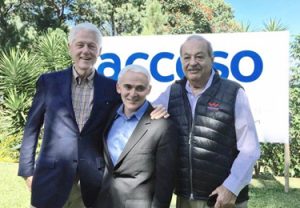
I would say that experts should be called, to work with national and other nationality experts, and let them be in charge of security because conflicts between security institutions do not foster safety and security.

Security should have a very important and defined mandate with trained people.  If you realize, suddenly, they have been arresting all the kidnapping gangs, well because the person doing it knows how to do it, so let them work, support them.

Then we hear that perhaps the policemen’s salary is little, that they do not make enough money and then they commit crimes.
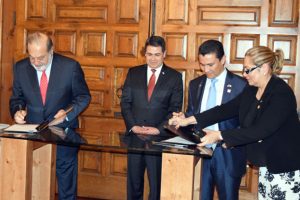
I believe that there should be a fight against internal corruption, improve the existing police systems, and let those that know how, operate the safety and security systems.
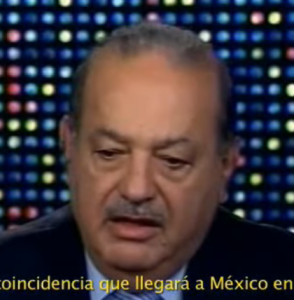
I believe that several kidnappers have been arrested.  There are figures.  We even hear a little bit less about this and we constantly see that this is what they have to do and also to make sure that there are no innocent people in jail, not even because of minor offenses and make sure that real criminals are behind bars. We have to reform these things because there are approximately 160 thousand people in jail and many,  we hear that 15 or 20 per cent may be innocent people.

What examples can we find? Colombia, I was told that in Bogotá there has been only one person kidnapped this year and zero in Cali and well this is Colombia.  In El Salvador they were coming out of a revolution, of a civil war and nevertheless they organized, reached an agreement, took the appropriate measures, improved the police corps and I believe that there has been a major improvement in security and safety in El Salvador.

In New York, what Mayor Giuliani did was after they attacked the series problems in the police force itself as it had very high corruption levels.  Then the structures have to be cleaned and act efficiently and with knowledge.

I believe free trade is important, because to trade is to negotiate with the other country.  Well, conditions that are convenient to both parties are negotiated, not that are convenient for one and not for the other, and negotiations have to be acceptable to both parties.  For example, perhaps trade for investment, well, you have to be careful, to negotiate an opening is like saying:  “I am wide open and anyone who wishes, may export into my country “.

For example, in Brazil, I believe that there is a 35 per cent tax on electronic equipment.  Now, it is different for a one million inhabitant country than it is for a 110 million country like Mexico, or 190 like Brazil, or 1.3 billion in China, a big country with a big market and major expectations, that can invite everybody who wants to sell into the country.

The one who wants to sell electronics has to go or does not compete with the one already in the country and that is what you have to do in these negotiations.  What do Chinese do?  If anyone wants to sell to China they say “Como do it here” and not only for the “domestic market, for also for the export market and train my people”.

Someone asked me one day if I was going to leave money to my sons.  I believe that when you leave them a company you leave them work, responsibility and commitment and when you leave them money, I do not know how much, one hundred, 50, 30 or 20 million, you leave them that for them to be bums, right?   It is different because when you have a company that you have to manage, even if there is a CEO, it is a job, a responsibility, an effort and a commitment with the company, with yourself and with the country to generate wealth.  The issue is not to have, I do not know how much cash, to spend and just be idle all year round, the rest of your life.

This is no competition for me and much less in this kind of categories.  I will take nothing with me when I die and much less this kind of ranking.  When I die I will take nothing with me, the creation of wealth and the attempt to distribute its revenues will stay here. I am convinced that economic, social, education, and malnutrition marginalization are obstacles in the development path of the country Asides from fighting these problems due to ethical and moral conviction, we have to also understand that it is an economic need to try to develop it.  We have to incorporate all of these marginalized people to the economy and modernity society.

From my position as a businessman I have always felt deep responsibility towards my country and have thus acted.  Grupo Carso’s philosophy, that I have applied in each and everyone of the companies that form the group, includes a series of efficiency, austerity, honesty, modernization, reinvestment of profits and development among other principles, trying to always render the best service possible, promote job creation and strengthen the internal market.  This can only be the result of a growing inclusive economy, for the benefit of society and the country.

Mi challenge is to improve health conditions, education and generate jobs.

Success is not to do things well or very well and obtain recognition from others; it is not an external opinion, it is an internal well being.  It is harmony of the soul and its emotions that needs love, family, friendship, authenticity, and integrity.  (Letter to Youth. June 1994. See (Letter to young people. June 1994.)

Quality programs and higher education projects have to be developed and create employment with investments and economic activity.

Quality programs and higher education projects have to be developed and create employment with investments and economic activity.

I have no political vocation.  I prefer to work from the entrepreneurial and foundations world to form more and better human and physical capital.