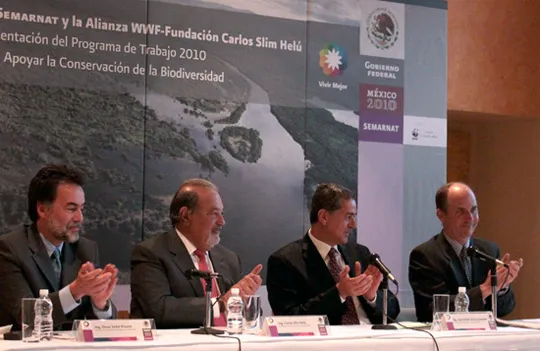


La Secretaría de Medio Ambiente y Recursos Naturales (Semarnat) invertirá 2 mil millones de pesos para desarrollar proyectos de conservación de la biodiversidad y promoción del desarrollo sustentable en seis regiones del país, monto que se suma a los 200 millones de pesos que aportarán el Fondo Mundial para la Naturaleza (WWF por sus siglas en inglés) y la Fundación Carlos Slim.
Juan Rafael Elvira Quezada, Semarnat’s secretary, declared that Semarnat is going to invest 2,000 million pesos in biodiversity projects and sustainable development in six priority regions of Mexico. Mr. Elvira Quezada was accompanied by Mr. Carlos Slim, president of Grupo Carso, Mr. Carter Roberts, WWF’s chairman, and Mr. Omar Vidal, WWF Mexico director.
Mr. Elvira informed that “the Federal Government has laid out 334 million pesos in protected natural areas, plus 414 million pesos in forest protection in 2010.”
This amount will be added by 200 million pesos from the World Wild Foundation and Carlos Slim Foundation, he informed. The agreement was signed the Environment Day in Cozumel, Mexico, last year.
The areas to be benefited are Monarca Butterfly Biosphere Reserve, Mesoamerican Reef, Gulf of California, Desert of Chihuahua, Lacandona Forest, El Triunfo in Chiapas, and Los Chimalapas and Central Valleys Mountain Range in Oaxaca.
The targeted fields are as follow: water and watershed integrated management, protected natural areas, woods and forest ecosystems, wild life and climatic change. Specific animal species to be protected are the following: Gulf of California porpoise, purple snail, tapir, toucan, sea lion, clubbed finger coral and monarch butterfly.
Mr. Elvira Quezada appraised federal government and Mexican society joining efforts in preserving ecosystems, recovering soils fertility, storing rainfall, and preserving native plants.
Watershed management and conservation models and ecological critical flow methods and studies will be developed, he added. In respect to ANP, scientific research and market growth will be developed, conservation models will be strengthened, and ecological tourism will be promoted.
Deforestation and avoided forest erosion mechanisms will be implemented; forest ecosystems will be restored in a sustainable way; wild life will be managed in order to make it profitable and sustainable while priority species will be recovered.
GEI emission levels in agriculture, cattle raising, industry and energy will be lessened. Ecosystems and population vulnerability will be assessed; climatic change mitigation and adaptation plans will be implemented, he said.
Mr. Carlos Slim’s remarks in Semarnat’s announce of investments in biodiversity conservation and sustainable development in six regions of México.
México City, April 15, 2010
It is about one and a half year that we and World Wild Fund (WWF) were talking about creating an alliance aimed to setting down a national agenda in support of biodiversity conservation. After consulting several outstanding scientists, José Sarukhán, Mario Molina and Julia Carabias among them, and once the agenda was settled down, we both signed an agreement about a year ago.
The agreement was publicly announced in the Environment Meeting on June 5 last year and immediately started to operate. The main idea was to initially invest 100 million dollars and link our actions to those of Semarnat and other institutions and persons in order to multiply their effects.
We had many meetings with more than one hundred experts in many places of the country to specify the agenda and define the work programs. I would like to remark some of them.
The targeted areas stand for conservation and sustainable development top priorities. These are Mar de Cortés, the Mesoamerican Reef, the Desert of Chihuahua, the Monarch Butterfly area and some regions of Oaxaca and Chiapas.
We have avoided inventing lukewarm water; instead we looked for ongoing working projects and people in charge, including Semarnat’s, to join efforts with them.
Some of the projects have already been funded and we expect to invest 200 million dollars during the present year, which, added to Semarnat’s programs (more than 300), will amount about 330 million dollars.
These are specific actions. One of them is to consolidate the conservation of Cuatro Ciénegas, Coahuila, with Semarnat, UNAM and other institutions and persons.
Other actions are the conservation of Chihuahua’s pastureland, Tarahumara’s watershed and ecosystems, Mar de Cortés sustainable fishing with appropriate technology, mainly in the northern part, where Semarnat has been working during several years.
Conservation and restoration of the Lacandona’s ecosystems in Chiapas, rehabilitation of Central Valley’s aquifer, forest and spring conservation in the city of Oaxaca, conservation and development of Los Chimalapas region and improving both fisheries and marine ecosystem conservation in the state of Oaxaca.
We are also working in strengthening the protected areas of Chinchorro and Yum-Balam in Quintana Roo, and supporting forest conservation and sustainable development of rural communities in the Monarch Butterfly area. In this last project we have been working during the last seven years along with WWF and the Mexican authorities.
We have also joined efforts with Mario Molina Foundation in studying climatic change adaptation and mitigation measures in several sites, and with Comisión Nacional de la Biodiversidad (Conabio) and biologist José Sarukhán in surveying biodiversity of the priority regions.
These are some of the projects we are already working on since the last past year with the goals above mentioned. A very important objective is to achieve sustainability with the human communities in the targeted areas.
I thank Secretary Juan Elvira Quezada because of his interest and commitment with these priorities and his support to this alliance, and I fully appreciate all of the experts and organizations who are helping us in developing this Mexican agenda.
Last but not least, I thank World Wild Fund because of its big interest in working in the six areas we have commented.
Thanks.
PRESS CONFERENCE
QUESTIONS AND ANSWERS
- Question: What is the message of all of this? I mean your emphasis on the economic and social interests of the projects. I would also like to know your expectations about the COP 16 to be realized in Cancún.
Mr. Slim: Surely, the working projects we are talking about look not only for biodiversity conservation; they are also aimed to be compatible with sustainable development.
We are committed to make secure that human communities living in the targeted areas become aware that resource conservation can be more income-producing than depleting them.
In respect to the next Cancún meeting, we know that some agreements are very difficult to achieve, yet President Calderón and Secretary Juan Elvira are working hard to make secure that the Cancún meeting will go on the right path.
By instance, the idea of charging a carbon tax on GEI emissions is already accepted by many people in many countries. As a first step, we would look to make secure that a part of this tax be invested in the countries collecting it in order to avoid distrust about financing other countries responsibility.
To sum up, I would say that responsible authorities are already working on that. Obviously, it is an intricate process for which there are not fancy solutions, yet the Cancún meeting could open the way. - Question: The Cancún meeting will be attended by leaders from many countries. What are the stakes not only about biodiversity, but about economy?
Mr. Slim: Indeed, Cancún will gather the leaders of the biggest countries. United Nations is also working on that. What is at stake is a new paradigm for the emergent civilization: that environmental care becomes an important source of economic activity and employment, not dead weight.
Carbon bonds are already on the making. We are now required to finding broader agreements on them. The Cancún summit proves a growing awareness about this problem, even for governments that have been reluctant to reach out international agreements in other areas.