BOLETÍN INFORMATIVO
México, D. F., January 20, 2010.
With Plan “TELMEX 2010 – Technology-Innovation Drive”, Telmex undertakes far-reaching steps in order to provide broader connectivity, strengthening both educational and digital culture, and developing information technology for the country during current and ensuing years.
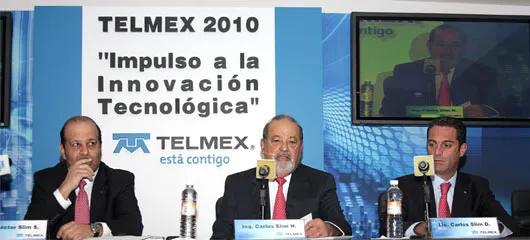
Mr. Carlos Slim Helú, Mr. Carlos Slim Domit, Telmex’s executive board chairman, Mr. Héctor Slim Seade, Telmex’s general director, and other top Telmex’s executives did announce today a set of decisions to reinforce Telmex as the main connectivity, digital education and culture, and information technology provider in México. These actions will be supported by the reliable, overflowing and world-class technology Telmex’s network, being operated by its highly-qualified human capital.
Connectivity measures are as follow:
- Increased Broad-band Internet access. During the next three years, Telmex will contribute to increase broad-band access up to 12 million accesses, including all of the available technology, so opening Internet access for more than half of the Mexican population.
- To multiply Infinitum-access fastness during the current year, so enhancing Infinitum already-proven quality, continuity and consistency.
- To double Infinitum-mobile connection sites up to 3,000 across the country in airports, educational institutions, hospitals, restaurant chains, bus stations, and public places.
A Digital Education and Culture strategy aimed to:
- Increasing TELMEX Digital Libraries up to 3,300 during the current year. This newly service will allow our customers to obtain free-loan computer equipment in the traditional library book-loan usage.
- 1,000 TELMEX Digital Classrooms during the current year. These are highly-equipped broad-band access spaces offering information-technology training.
- Grants
To accomplish 50,000 Digital Grants during the current year in order to provide computer equipment and Internet broad-band access to Grupo Carso’s workers families. During the current year, Fundación TELMEX will amount 225,000 grants for both undergraduate and graduate meritorious students. These grants include Infinitum-access computer equipment and a printing machine plus economic stimulus.
Information technology strengthening strategy is based upon:
- Inauguration of Instituto Tecnológico de Teléfonos de México en Tecnologías de la Información (INTTELMEX IT). This institute is authorized by Secretaría de Educación Pública and the Massachusetts Institute of Technology. Its first-year goal is to graduate 1,000 professionals able to provide solutions for the productive sectors needs.
- Data Centers. Our Data-Centers hosting-capacity has been enlarging, so strengthening its operation for the benefit of our corporative customers. Likewise, we are on the path of providing application solutions for small and medium firm access.
- Software Development. Thanks to the accumulated experience of our own software plants, a bigger support will be offered to domestic software programs and solutions.
Mr. Carlos Slim Helú, Mr. Carlos Slim Domit, Telmex’s executive board chairman, and Mr. Héctor Slim Seade, Telmex’s general director, have announced “TELMEX-2010 – Technology Innovation Drive” program.
Good afternoon. I am pleased in participating in this event. It is an apt occasion to recall some facts, not only of the last 19 years, since the privatization of TELMEX, but to make an account of some facts about the history of telecommunications in México.
Telecommunications have lasted more than 130 years in our country. The first phone-call was made about 1878. Since then, telecommunication progress slowly began. More than a remembrance centenary, telecommunications stands for a service. It was about more than fifty years ago that several telephony firms got merged into Teléfonos de México, which got owned by Mexican entrepreneurs then.
This was about 1958, when Teléfonos de México was mainly owned by Mexican owners. In 1972, the Mexican government acquired 51 percent of the firm assets, so Teléfonos de México became a state-owned firm. And it was almost exactly 19 years that the enterprise got privatized and a new administrative board took charge.
Obviously, this is not my address-motive, but I would like to make some remarks about these last 19 years and then to talk about the future of Telmex, of Teléfonos de México.
After Second World War, technological development speeded up all across the board, and it acquired a revolutionary trend during the 1980s. You will recall the Moore Law, which describes a long-term trend in computing hardware, in which the number of transistors (chips nowadays) that can be replaced inexpensively doubled approximately every two years. Nowadays, speed has increased the more, while costs have dramatically lessened.
The Moore Law proved to be right for most of the new technology, mainly telecommunications and computing.
At the time we entered to Telmex, January, 1991, we did find many lags, a condition not exclusive of it, at all. Yet, Telmex’s lag was accentuated since it was 40 percent private-owned.
Telmex was not only delayed in respect to digitalization and optical fiber, it was retarded in respect to analogical technology even. Many central stations were then electromechanically operated, an obsolete technology many years ago.
Operator posts, equipment and vehicles were obsolete. Service-vehicles were junk in shop most of the time, yet they were rated as full-service unities.
Scarce investment impeded modernization. Most of it hardly did attend growing demand. An urban phone-line request did should wait almost two years. Lack of service in rural areas was generalized. Public phones were scarce, and many of them were out of service. Phone covering was limited, service faulty. The then recently-initiated optical-fiber network had scarcely more than 300 km.
Cell-phone service had about 30,000 customers, lagged behind competitors who had already entered into the market by the time, let us Internet and broad band, which were out of the firm’s scope. This was the picture we found when entering into the firm. Besides, we acquired a commitment for not firing workforce. It was supposed that Telmex had personnel in excess. Workforce was upset about eventual firings, since modernization would turn phone operators redundant.
I don’t want to discuss this point. Instead of firings, we devised an ambitious three-year program, working together with the personnel and even the trade union, to performing a full transformation of the firm. I am proud to say that this program has been a complete success, so positioning us to launching ambitious plans for the development of México.
Nowadays, Teléfonos de México is a big telecom firm, as good as it gets in the whole world. Its highly-qualified workforce has more-than-double scholarly degree in comparison to those achieved 19 years ago. Telmex’s workforce has a 16 scholarly degrees range, not to mention the many training specialized technical programs. Telmex’s human capital is fully service-committed to the country and telecom industry.
In achieving this goal, many ideas and resources were put on the table, mainly human capital training, both trade union and private. Large capital investment was critical in shutting down the technological gap. The three-year plan I have mentioned did reduce the 18 month-line-connecting-period to a matter of days. And that counts for the telecom service we already have.
I am not saying that we are inaugurating the technological age. Technology stands for a critical factor in the new global society, a new civilization, in fact. Modern civilization is based on a technology that is engendering behavioral and social transformations. New paradigms are emerging.
The economy we are already creating is no longer a zero-sum one, no more an agricultural society depending on war, slavery, land or human exploitation. What we need now is human welfare. As better the many, better we all. As many deprived people enter into modernity, the fastest and sustainable country growing pace.
Such a pace can be now seeing in China, India and Brazil. México did experiment such a huge change during 50 years, when it transited from a rural society to an industrial one. Our present challenge is to transit to a technological society. Human capital is the key.
During the prior transitional age, literacy was the key. No longer. Both compulsory primary and secondary school have now superseded by digital culture and knowledge society. Such is the main aim of the project we are now presenting you, its name its technological innovation. Telmex assumes such a challenge and it enumerates the following steps:
The actions to undertake are many, the concepts are few. First, we will take a thorough impulse for diffusing information technology. I am pleased to announce you the creation of the Instituto Tecnológico de Teléfonos de México en Tecnologías de la Información. Its antecedent is IINTTELMEX, created in 1991 to upgrade Telmex’s employers. The new institute’s aim is to educate people for being employed and developing its abilities in a promissory field.
This institute will demand huge investment in networks, data centers and software. Telmex is very interested in developing this field in order to bring the many to the emerging civilization. All of this is centered in human capital. So, we are going to augment technology investment and promoting our Telmex digital libraries.
We are committed to accrue more than 3,000 digital libraries during the current year. We don’t know if this service is already available in any other country. Perhaps we are not the first ones. This is not just a matter of providing Internet access. It is about free-loan laptops for a 15 days period, as traditional libraries use to loan books. The purpose of this idea is that users learn to use computers.
Our digital-classroom program will be enlarged. This program is focused on primary school to provide broad-band access and training in using modern equipment. The program is already fully-operational in Casas Telmex across the country.
Telmex digital grants will be accessible for all of the Carso Group employees. All of those having a determined working years and sons coursing school years will apply for these grants, which consist in computer equipment and broad-band access to get them and their sons able to navigate in the information society.
Telmex grants have grown from 11,000 to 16,000 per year, and they are still growing. Since its inception, Fundación Telmex has distributed 200,000 grants, and it is able to give more for students in the digital technology field.
As I have said, this meeting purpose is to announce you our own commitment to face the digital society challenges. One thing is Telmex institute for human capital, networks investment, and data centers for accruing and strengthening capacity of enterprises and individuals able to contribute to this field.
Another thing is Telmex aim for forming human capital outside the technology institute, I mean, creating human capital in society. One of the goals we are now announcing is a growing access to broad-band Internet. To my knowledge, Telmex broad-band access growth is top in the world.
Future growth will be lesser, yet a 12 million access growth and more than 50 percent broad-band access are still huge. Telmex is not limited to its own goals. It pushes for broader access, including that of its own competitors. Our commitment is transforming our country.
Remember that we started with 54 or 56 dial-up. Nowadays we are 200 times faster. This pace will grow. In the short term we are planning to step five-to-ten megas. I suspect that the technological pace will force us to go faster.
Technology change cannot be foreseen, so figures are movable. Instead of giving you figures, I would like to talk about our commitment for multiplying speed access. This trend will turn Internet the more attractive, along with powerful applications that Teléfonos de México is able to offer, this includes training courses and, overall, Mexican applications.
Finally, we are committed to double Infinitum-Mobile WiFi sites up to 3,000 sites across the country. These are connected areas for our Infinitum service. They are designed to include public universities, main airports, restaurant chains, bus stations, malls, hospitals and many other public spaces, more than double than the available not-wire waiting-spaces, too much already. Consider that these goals are envisioned to be met this current year, not 2012, as officially fixed.
The current year will be decisive for Telmex’s phone innovation.