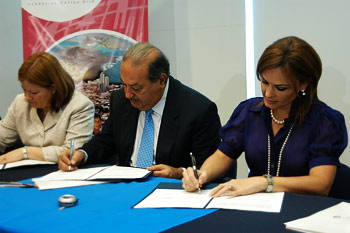


- Mrs. Vivan Fernandez de Torrijos, First Lady of Panama and Engineer Carlos Slim Helu, signed today an agreement to apply maternal and infant health programs in that country, through the Carso Health Institute (CHI).
- The CHI will launch in Panama this novel program for maternal and neonatal care based in technological connectivity and innovation.
Today, Mrs. Vivian Fernandez de Torrijos, First Lady of Panama, and Engineer Carlos Slim, met today to sign an agreement that will allow Carso Health Institute and the Government of Panama implement joint actions in matter of health.
In Latin America, every year 22,000 women die during pregnancy or delivery, 4 million children die before reaching the age of five by causes that could have been avoided and 335,000 of these children survive with some disability. This carries disrupted families, orphanhood, and school desertion, conditions that constitute painful outcomes. The Carlos Slim Foundation contributes today to diminish these problems through the Carso Health Institute and its AMANECE Program, which objective is to improve health and development conditions of women, girls and boys in Latin America.
In Mexico, through the “Arranque Parejo en la Vida” Program, since 2001 the Telmex Foundation has delivered more than 2,376 specialized medical equipments to clinics and hospitals in the 32 states of the country; and, with an investment higher than 80 million dollars, it has been possible to reduce maternal and neonatal deaths, as well as to opportunely detect malformations or health problems during pregnancy and at birth.
The major contribution of AMANECE will be the establishment of strong links through technology, between pregnant women, their children and the community where they live, and the specialists and health units, to reduce the risks and give opportune and efficient attention to the obstetric and neonatal emergencies.
At signing this agreement, the ALAS Foundation (Latin America in Solidarity Action) is also participating. ALAS is a movement dedicated to the welfare of children in Latin America and will join the labor of AMANECE to attract the population toward the Program and promote the adhesion to its benefits.
AMANECE, which already operates in Mexico, will initiate operations in two districts close to Panama City (La Chorrera and Capira), where twelve communities with a mainly rural and marginal suburban population will benefit. In this network, 512,000 inhabitants are concentrated, which corresponds to more than 15 percent of the total population of the country. During 2008, the Carso Health Institute will contribute with 2.5 million dollars in technical and humanistic assistance and training as well as top technology equipments. Thus, along with the Health Ministry of Panama, the CHI will aid more than 3,500 deliveries and shelter around 750 newborns with complications. The support given by the Carso Health Institute will continue at least for the next three years.
The twelve beneficiary communities have Health Posts, a Center for Integral Health in El Espino, the Regional Hospital of La Chorrera and the specialty hospitals for maternal and infant health in Panama City. They all are part of the AMANECE Network, which as soon as it is operating; it will allow this Model to replicate to other regions of the country.
With the AMANECE Network, every pregnant woman of the region will be directly monitored by community agents who will have the necessary equipment to closely watch the development and risk level of the pregnancies, including alarm signs and symptoms. These community agents are prepared to refer the woman in risk to the health unit that will be waiting for her thanks to the previously established communication. The strength of the social network connected to the services network, will allow women and their families to walk through an easier path in order to reduce the risk of death and allow them to live their pregnancies in healthier conditions.
Early diagnoses performed with top technology will allow knowing the health conditions of the future mother –to reduce the risk of a complicated pregnancy by hypertension or eclampsia, or even death- as well as taking care of problems for possible prematurity, low birth weight or some other birth defects. Innovative screenings or tests will also be performed to the newborns to give opportune care to problems such as deafness, blindness or autism, among others. Thanks to early detection, the best mechanism to bring them the adequate treatment will be sought.
Since the beginning of their life –and even since their gestation- to five years of age, children subscribed to the AMANECE program will be able to attend early stimulation services to help their psychomotor development, strengthen their affective, social and intellectual functions and prepare them for life.
Another CHI collaboration Projects – Panama
- Tomatelo a Pecho
In Panama, the Carso Health Institute is planning to launch its successful program Tomatelo a Pecho, mainly focused to promote early detection of breast cancer, a disease that has turned into a serious public health problem in Latin America and the Caribbean. Breast cancer is today, compared to 15 years ago, one of the diseases with most incidence in the adult women of Latin America; at the same time, it is a disease that can be easily attacked with information access and interventions related to opportune detection and treatment.
“Tomatelo a Pecho” has four lines of action based in the main strategies of Carso Health Institute: Information, Investigation, Strengthened Institutions and Innovation. - Health Observatory
Another program that will benefit by this Letter of Understanding between the Government of Panama and the CHI is the Health Observatory, the result of an alliance between the Institute and the Fundacion Mexicana para la Salud (Mexican Foundation for Health). For its regional character, the Observatory requires the will of various countries to join this endeavor, which objective is to collect and communicate relevant metric information that allows the strengthening of health systems in Latin America and the Caribbean. Joint collaboration with Panama in this Project will be the key for its launch to the other countries of the region.
PARTICIPANT ORGANIZATIONS
- Carso Health Institute
www.salud.carso.org
The Carso Institute for Health is a non-lucrative organization, established in Mexico, City, that mobilizes private funds to finance social welfare projects that focuses in health, nutrition and environment. The objetive is to contribute to solve health challenges un Latin America and the Caribean by identifiying problems and designing initiatives to face them; chooses partners to coordinate and execute these initiatives; trains, advises and supervises participants and evaluates the results. It can also finance programs presented by other institutions, groups or persons, within the selected priorities. - Presidence of the Panama Republic
interceding by their Health Ministery
www.presidencia.gob.pa/ministerios/minsa.htm - ALAS Foundation (Latin América in Solidarity Action)
www.fundacionalas.org
The ALAS Foundation (Latin América in Solidarity Action) is a non-profit organization formed by artists, businessmen and prominent members of the civil society engaged in improving health and education levels of Latin American children. It creates awareness and promotes social programs. The ALAS headquarters are in Del Saber City, en Panama City. - Carlos Slim Foundation
www.carlosslim.com