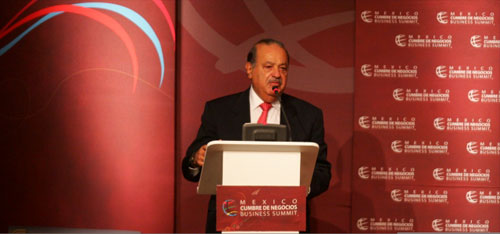
Toluca, State of Mexico, October 24, 2010.
This new civilization has new paradigms. The economic paradigms, we know, are globalization, competition, innovation, productivity, flexibility, medium and long-term vision, flexibility in decision-making processes, large investments and efficiency to execute both projects and programs; all of these new paradigms, all of these new features, are appropriate for both civil society and private sector, rather than for governments.
What we are looking at, in my opinion, is that all those countries having a huge tax collecting, like Spain by instance, which collects about 40% and has a deficit about 11-12%, means that the Spanish State controls about 52% of the Spanish economy. That state is loaded, besides, with huge liabilities, a high unemployment rate, and costly welfare policies. It affords about 1,000 or 1,200 monthly euros for each of the unemployed against 800 euros as average monthly wage, so the unemployed refuses to accept jobs and the economic situation becomes more pressing.
The United States is not better; it has huge deficits and liabilities. What I want to stress as a thesis is that the way out of these problems lies on a biggest involvement of the private sector and even civil society. How civil society is called for? NGO’s and other social institutions should become more engaged in environment care, human rights, public safety, etc., that is, we should work more actively with social society for solving these problems.
On the other hand, big investment and employment challenges are in the face of us, of course. This is a private sector task. Here I want to stress another point that could sound a bit harsh, yet it counts for the lesson of all of the developed countries: tax-collecting increases ─many of them being made for political reasons and welfare policies while ignoring long term sometimes─ are allotted to run current spending, not public investment.
Many countries run very costly retirement, universal health care or early retirement policies. Such programs are highly compromised, exceeded in fact, so they are unsustainable. Fortunately, both the Mexican federal government and the State of Mexico have introduced reforms for balancing their own social policies.
Job creation is a pressing question. It appears clear nowadays that poverty cannot be viewed as a social justice or ethical issue any longer. Big charity and aid works did play an important role in the past, but poverty has now acquired a pressing economic importance because what we need is educated people to overcome poverty.
In this sense I would say that what is needed for those wanting a leveled starting point is, by instance, maternal nutrition during pregnancy to make sure healthy birth, so the poor have equal opportunity from the very beginning.
More generally, I am talking about early education. Good nutrition, good health and good education are critical for the new civilization. Young people should enter to the labor market at 20 or 22, not 15 or 16 years old age. So, they should have better education and training in order to make a better workforce offer and have more job choices to choose.
These are the young men we should look for, and they are many. There is a talk about Mexico’s demographic bonus which means about 2,400,000 children. I don’t have the child-mortality figure, but it is clear that it has substantially diminished during the last decades.
So, there are more than 20 million young people between 15 and 20 years old, to say, so we need to have not only good job offering but a well-educated workforce. Why? Because human capital, education and knowledge are critical for this new civilization. What is the key for competing in this new world? The key is having a powerful human capital. This is the only way to accelerate our own development.
I think that, apart from the eventual course of things, population growth will continue to diminish by much during the next 15 years, while per-capita income, I hope, will probably double at least. Per-capita income is now about a little more than 8,000 dollars, and it will be about 16,000-17,000 dollars in the foreseeable future. At this level extensive middle classes will be formed, and our country will surmount the underdeveloped or developing stage to be a developed one. I am talking about the next 15 years.
What is to be done during these next 15 years? What we have to do, as I am saying, is to create more human capital and job opportunities for the university, middle-level and technical young graduates.
The point that I want to stress is that this is an effort to be made immediately, in the very short term. It is not a task for medium or long term because then birth rate growth will be lesser than the current 1,900,000 yearly birth rate, and it will probably diminish faster during the next years. Population will become more urban and the educational level will be higher.
By then, the already high job offer will diminish. So, our urgent task is to create more job opportunities and education for the current job-offering generation.
Due to our human-capital formation and competitiveness needs, it is preferably that 16 years old young be in school instead of working because, if educated, they will have more chances to have a regular job.
So, in this strategy and planning we should even consider education as an occupational factor for the young. This would help us to create the required job posts.
This is the more interesting because at this point we should conceive non-traditional ways for education. As I have said, developed countries economic policy has exceeded itself; its condition is critical and it should evolve seriously. Such an evolution should run through civil society and private sector as well, especially in the economic field.
We have to study fresh educational alternatives. In order to double our educational capacity we can’t build more school buildings or physical spaces, neither graduate more teachers because they are not any-time-now tasks. Instead, we have to rely on the technology that is already transforming our civilization and society to rapidly increase distance and virtual education; I mean education through internet with the best teachers producing educational material and some groups of persons as conductors. This can be rapidly done.
In order to enlarge middle-level and higher education we have to rely on these modern communication and telecommunication means. In fact, that’s the only way to achieve it, and we can do it with high quality.
A requirement for human capital and educational transformation is access to digital education and culture. And there is no better access way that educating ourselves through it. I think that this a fundamental leap to take. We can do it in a very short time period, so we could abate job-creation pressure in this way.
The costs for this form of education will be very low, of course. As I have said, what workers need, in my opinion, are not just equal opportunities and assurance. They require job opportunities being attached to progress and human development expectations; I mean assurance, health care, education, housing for them and their families, and deserving retirement. Creating a basic nationwide wellbeing network for a good part of the population would be very important. Through proper public policies and efficient private sector participation, we should make sure a nationwide social wellbeing network for every Mexican.
We should think how to manage unemployment, of course. A basic instrument is unemployment insurance. Fired-workers compensation or paid wage taxes should be allotted to fired-workers sustenance during unemployment time period while putting them back on upgrading-labor track.
What this it means? It means that if one employee’s ability has become obsolete due to equipment and technology innovation, he should have an opportunity to upgrade himself for job-demand abilities. During unemployment time, workers should have trained to perform better-paid or at least job-demanding activities.
What these activities are? I have made some notes because we should envisage the labor force magnitude for the next 15 years from now. I guess we will have about 55 million working-age people, who will start working a little bit older than nowadays, not at 14, 15 or 16, rather at 20 or 22 years old. And they will not retire themselves at 60, neither at 65, rather at 70 or 75 years old. In-force retirement age at 55 or 60 years old is a national calamity. Many contracts already note it that. So, I think people should work some additional years than nowadays do.
How to employ these upcoming 55 million people? What our country will offer to them? I have brought a little tablet. First, the primary sector, agriculture, the traditional one: we have to attain high productivity and global competitiveness to take advantage of high commodity prices and United States high demand. That’s what Brazil, Chile, Argentina and Colombia are already doing. We have to go in this direction.
Second, we should consider energy production, of course, and mining also. Mining is now a boom primary sector yielding huge benefits. Australia is making big investments in this field. It yields 48,000 dollars per capita.
Mexico’s mining will receive big investment capital during the next three-five years, many billion dollars to excavate mines, operating them and transporting ore. This sector will employ about 15% of the labor force.
Third, we have the long-established industrial sector, building, infrastructure, housing, which have customarily served as a trigger for economic activity, not only for employment in many regions, rather exerting multiplying effects on many economic sectors on a nationwide scale.
Fourth, we have trade, which customarily have ranked top in job creation. Then, another important factor is education. We have to invest more human capital in education, culture and entertainment.
All of these economic sectors will grow up much. At the extent we get people out of poverty and subsistence to incorporate it into the market economy, all of these activities will grow up.
Health care, of course… Tourism is fundamental. Environment worries us much; in fact, it has become an important economic activity and employment source in the whole world and in our own country as well.
Then, a very important activity, besides public services and bureaucracy activity, is income-generating information technology. Information technology creates jobs not only in building and operating networks, rather in both data and call centers, which are workforce intensive. Millions people are employed and many more will be employed in call centers.
This is a big opportunity, by reason of which human capital, content production and applications development for this new technology services are very important.
There is health tourism also. In a context of U. S. economic bankruptcy, U. S. health spending amounts about 20% of GDP and it has not reached up universal coverage yet. Mexico will be able to provide health-care services for Americans at 70% lower cost. Personnel of both American firms and public entities could be serviced in Mexico, so employment could be high in this field. Retiree care counts for another important activity.
These opportunities are arising from the economic crisis of the advanced countries, a situation that has forced them to adopt a near-zero interest rate. With such interest rate, we could have long-term cheap dollars and pesos at disposal.
When long-term cheap money abounds, it is not easy to find a financial target for it because returns tend to be negative. So, big investment projects become viable because they can be funded at very low long-term interest rates. In such a situation, financial capacity tends to grow big.
I want to stop remarking in order to allow questions, which is an objective of this meeting.
Thanks.
Moderator: There is some question for Mr. Slim?
Carlos Slim Helú: What really do abate poverty and dignifies human beings is employment. Before employing people, however, government or private sector should guarantee health, education, early education, nutrition, culture and physical recreation. Businessmen and foundations are called for strong activity in all of these fields.
According to our own experience, in respect to non-income-generating business, whose activity, however, is very important, relying on a mix of foundations and voluntary personnel is commendable. For voluntary personnel I mean employees willing to freely contribute a part of their free time. In our own experience, they use to contribute gladly.
In respect to human capital formation, the state, private sector and society are called to make a big effort. We should do it because strong domestic human capital is the mean resource to help our country. We should do it in the form of non-profit deed.
Yet, the conclusive way out of poverty is employment. Obviously, the better educated the person, the better options of a dignifying job for it.
During the last 50 years or so, trillion millions dollars have been spent in erasing countries’ debts, affording health and food aid for people, making congresses, meetings, etc, yet poverty is still there. Another common anomaly is that excellence scholarship students don’t find job when graduated. So, creating human capital, either through non-profit or profiting education, is important, yet the only way out of poverty is employment.
Question: I have a doubt: if, as a result of an established public policy, young’s first job occurs at 22 years old, how the existing gap could be filled? Nowadays there are a lot of younger people in the labor market but the economy is not creating the jobs being demanded. ¿What are the options for postponing young people entering to the labor market?
Carlos Slim Helú: 22 or 23 years old people looking for their first post in the labor market are graduated usually, and they look for full-time jobs. Certainly, part-time job for students are commendable, especially those related to their own careers. But full-time jobs are for graduates, and 22-23 years old are the proper age for it. Of course, not all of the students will become graduates, most of them are not nowadays, and many will not in the foreseeable future.
When entering to the labor market, young people age differs; some start at 18 or younger even. I think that an economic aid system will be needed for them when studying. That’s the only way to guarantee that poor families young are properly educated.
Public education for that social segment is needed. 32% of UNAM students come from families earning no more than four minimum wages for income, so they are unable to satisfy some basic needs, including food. This serious problem must be solved.
Middle-level and technical-training students need support also. So, the gap between school and work should be filled by a mix of part-time jobs and economic support, otherwise they hardly will conclude elementary school. What we need is human capital.
Question: How the private sector could get involved in this endeavor, how to convince them that education spending is not waste but real investment?
Carlos Slim Helú: This problem is a little bit complex. By instance, current education spending is bulky, so we need to approach quality, moving forward from literacy, to say, to digital culture. Education should be radically and structurally transformed to transit to modern technology, the proper environment for quality education.
The private sector is aware of the importance of this. Certainly, there are some private universities that were religious before. Unfortunately, some of them have been bought by international firms conceiving education as a business, not as philanthropy or as a supporting mean.
In respect to private schools and hospitals in need, you can frame schemes to overhauling them. By instance, we have bought buildings and equipment without a corporate interest, just a financial one, in order to allow institutions to be operated by interested people.
Let me go back to education and technology. We should develop many educational applications and create educational networks to connect all of the teachers. In fact, this process is evolving smoothly and fast like the mobile phone did it. Mobile phone penetration in Latin America is about 95% nowadays; some users, including kids, have two or three phones. Smart phone and broadband penetration will follow the same route. Technology is available now.
Developing educational applications will be not only important; it will be profitable and very interesting. Thousand young people could be enrolled into universities and develop their careers by electronic means in the same way millions young people communicate themselves through social networks.
Science and technology are global. We need to focus innovation on education. Innovation, innovation, innovation…
There are many rich universities making big science with excellence staff, including Nobel laureate. They are earning a lot of money. What we need is to absorb their scientific and technological development.
I think that our government should deeply involve the private sector into education. Likewise, the private sector should be more aware about the importance of education not only for our country’s future, but as a profitable business.
Question: You have stressed the importance of human capital. However, we need to create one million job posts each year. What is you suggestion to immediately create them? I am not ignoring human capital and educational needs, yet the social problem we have today has translated itself into insecurity, lack of jobs and political laggard.
Carlos Slim Helú: Employment is a fundamental problem, and I have mentioned it in many meetings. I have remarked in here the unemployed young graduate problem. What we have to see at are employment sources.
In talking about employment we have to talk about employers. Who they are? They are businessmen, mainly. Who of them do create most jobs? They are micro, small and medium-size businessmen. Indeed, employment is there; we have to identify their obstacles.
As I have said, we have lessened child mortality. Likewise, we have to lessening small and medium-size firm mortality, so to speak, by smoothing their path to growth. If they are burdened by 100 regulatory rules, removing 30 rules will not alleviate them. To get started, certain kinds of business should have any regulation apart from notifying their setting down to the authority in order to register them as tax payers.
Small and medium-size businesses face two problems: excessive regulation and financial capital scarcity. Three or four years ago we started a small and medium-size firm financial program. Nowadays it gives support to about 30,000 firms, one thousand firms a month at a pace.
When I talk about innovation I encompass low-operative cost, expedite credit-assessing and operatively functional small and medium-size firm financial systems.
Another important employment source is house building. Infonavit’s programs are very good; they, however, have become sluggish. In respect to infrastructure building, which creates many jobs, I think we could do more. The State of Mexico and Mexico City count for the entities building more infrastructures, and this is very important. I say it without flattering State of Mexico’s governor, here present.
Another important employment source is infrastructure maintenance. To build a building you should have a project, a ground and a financial capital. Additionally you have to paint it, outfitting their insides and windows, installing plumbing and electricity, building access ways and planting gardens.
Think about archeology as an employment source. How many archeological sites Mexico have? They are countless. We could create a lot of jobs by investing in archeological research and maintenance.
The point that I want to make is to look for the promising job-creating areas. By instance, we have to make a biggest effort in information technologies.
In respect to education, what is the condition for educating more young people? What we need to make to get involved in educating more young people? In investing in education we will create many jobs. The same can be said about investing in health care.
We have a very good tourism offer. We should make sure having many more American visitors. Tourism is not only an important employment source for many Mexico’s regions, it is also an employment alternative for rural activities. Many rural areas have tourism potential.
I think we have missed big employment opportunities by neglecting health-care service offering for American retirees.
Another important area is the domestic market. I have lasted many years in calling attention to it and I hope we will avoid making the same mistake again. We have oriented our economy to exports, foreign trade and signing free-trade agreements with many countries, but neglected the domestic economy which could create many jobs and generate economic activity for many domestic sectors.
I use to say: “You could have economic growth without jobs and employment without economic growth”. By instance, rising oil prices spur economic growth, not employment.
On the other hand, there are activities whose contribution to growth could be small, yet they could create jobs, like small and medium-size firms, building, infrastructure and infrastructure maintenance, as I have said.
Question: Felipe González holds that creating one hundred new businessmen is easiest than creating 10,000 job posts. First question: how we could encourage more people to become businessman and how to help their firms to survive in the short and medium term? Second question: you just have surpassed a capitalism paradigm. First we encouraged individualism just to embrace consumerism; now we have realized this and go back to encourage consumerism.
The big problem is as follows: should we send younger people to work? None of us would entrust our firms to inexperienced 24-25 years old people. In fact, what we precisely require is experience. As to my knowledge, we should send people to work at 16-17 years old in order they get experienced and, once graduated, they could contribute to our firms.
Carlos Slim Helú: I would distinguish consumerism from wellbeing. I mean, we could have a wellbeing state generating consume and demand, not consumerism as a derogatory meaning.
In respect to employment we should recall that agrarian society families had many children, and such is the picture for current rural regions where children begin to perform domestic tasks at 5-6 years old age. Many of them begin to assist their parents in the field or in household activities at 8-10 years old age.
In the agrarian society people begin to work at 5-8 years old age and, in the past, they used to die at 40-45 years old age. In the industrial society of the 19 and 20th centuries, young people entered to fabrics at 14-16 years old age as apprentices and they didn’t go to school.
Nowadays we are in the knowledge society, so young people should be better educated and trained. Scholarly education is at the base of human capital formation, both technical and humanistic, of course.
Service society requires better-educated people. In the past people were trained to perform fixed and routine tasks, as in Charles Chaplin’s Modern Times film. Today young people manage computers and they must know the production process to control it. I am not meaning to say that all of the 30 million Mexican young people should course a university career. Unfortunately, that is not possible.
But we should make possible that most of them have an opportunity to get educated to get better jobs and create a more industrialized country.
Let’s see China. What is China doing now? It is getting about 25-30 million people out of poverty each year. They come from rural subsistence areas to spend 12 working hours in industry for a meager income. But many talented young people are enrolled in western universities at the same time. So, the key is that everybody has a chance to study, although just the talented and disciplined ones will succeed. The rest will enter to the labor market.
Question: How would you like to be remembered?
Carlos Slim Helú: I will not be here by then, so I don’t know. What I can tell you for sure is that up to the present day, since seven or eight years ago, my own challenge has been contributing to mitigate our own country’s underdevelopment and improving our social conditions through our foundations, firms and investments. We make efforts for education. Our maternal and children Nutrition Program, which we jointly designed with Hospital Infantil, was adopted by President Zedillo’s Progresa Program and it remains in Opportunities Program.
I really believe that we must do what I have to do. All of us enjoying privileges have responsibilities also. The more privileged, the bigger our own responsibilities and commitment. I have assumed this commitment with Mexico and Latin America not to be remembered. I have assumed it because it counts for my own responsibility and commitment.
Question: I fully share your educational stand because education is the only way to overcome underdevelopment. However, Mexico’s digital gap in respect to the rest of OCDE countries is enormous. I would like to know your own view about how we are going to narrow that gap, diminish costs and enlarging people’s access to information technologies.
Carlos Slim Helú: Technology is a bridge rather than a gap, yet a bridge to be built and get crossed. As I have said, mobile-phone penetration in Latin America equates that of the United States, but U. S. per capita telecom consume is about 800 minutes per year, while ours is 100 minutes, eight times lesser, so U. S. mobile-phone firms income is bigger than ours. Latin America mobile-phone penetration is bigger than Canada’s, that is, we have more mobile-phones per person than Canadians.
In broad-band services we have to attain two goals: universal access (everybody’s access) and access to all of the applications and content. To achieve these goals ─I’m talking in Telmex name─ we have to reach out convergence. Mexico is the only OCDE country that it has not attained it yet. All of the firms and monopolies of the rest of OCDE countries have full convergence.
One important thing is that we already have ten million broad-band connections after a 94% growing path during a seven-year period. Our penetration was negligible in 2002. Nowadays we have ten million connections in a 27-28 million homes universe, almost 35% fixed connections, and still growing rapidly.
Mobile broad-band connections are going to grow fast too, yet its pace is not exclusively dependent upon firms; it is related to equipment costs, mainly smart phones. Once iPhone and Blackberry prices go down to 100-150 dollars each thanks to our own subsidy policy, mobile broad-band penetration will grow bigger.
I would say that Telmex is providing convergence in the absence of a regulatory framework; otherwise we could offer more services at lower prices. Yet, we are not so bad since about 95% computers are already connected. Since connection needs a computer to get its function done, Telmex runs a financial program for buying computers at 3-4 years. So, we are promoting computers to be bought in order to enlarging internet access.
Our group runs a digital-grant program for all of our personnel, about 50,000 homes. A digital grant includes free internet access. In the next three or five years we will have competitive internet access in respect to the rest of OCDE countries.
Note that we are comparing Mexico with 35,000 dollars per capita income countries.
I envisage that during the next three or five years our penetration level will be very deep, broad-band access will cease to be an obstacle, so we have to approach applications and content.
Telmex has proposed 2010 to be the technological innovation year. So, we are creating Hotspots all across the country. We already have about 3,000. We have to guarantee universal access to digital libraries.
During the last twelve years we have urged that every elementary-school teacher have both broad-band internet access and a computer as a condition to transform education. Unfortunately we have not attained that goal yet.
Question: My question is about education. Public education and private education are usually seen at odds, but they are complementary. Education is accepted as a strategy to improving our economic, social and cultural development, yet our educational model belongs to the last century. Are we in need of a third-millennium educational paradigm? Should businessmen participate in public universities directive boards?
Carlos Slim Helú: Without a doubt. As I have said, a little bit in a hurry, we have to start with early education, first by educating parents to deal with their own babies, so six month-one year old age children be apt to receive early education to stimulate their mathematical-logical and reasoning abilities, so they could begin to see a bigger world around them.
In some way, our brains are the equivalent for hardware; education and culture are the equivalent for software. We all have mental capabilities, but we need to educate them. We should develop software into our hardware.
We should start by children and then go to digital education. Elementary school should be transformed by aptly using the right programs. Above all, teachers should be trained in digital education and culture; they should handle digital applications for educational networks. That is the point we are talking about.
Middle-level and higher educational levels fall into two big categories. There is the sub professional level which comprises technical training. That level is very important and it should also be transformed.
I don’t know how many students are already coursing the intermediate level, but it is clear that we can’t enlarge universities neither create new ones to enroll them. There is no way to create so many universities and teachers.
That’s why we should take the internet path, the massive interactive communication environment. We could train and educate millions young people in a relatively short time-period because they couldn’t have access to classroom’s sites which we are not able to build them up anyway.
We should develop outdoor or extra mural education. As Mr. Alemán have mentioned, we are nowadays able to perform outdoor surgery. Last year 104,000 outdoor surgeries were performed. This current year about 120,000 will be performed. Since current health-care infrastructure is not equipped to perform these operations yet, we convey equipment to health centers where doctors use it for free. That’s the way these surgeries are been made for now.
We are not able to triplicate classrooms neither teacher number to accommodate all of the aspiring young people. So, we should use already available electronic methods to cope with that problem. We could educate our population at a massive and intensive scale at a high level and low costs. All students could be educated by the best teachers on screen, who could be aided by supervisors in coordinating tasks and assessing examination. An institutional framework should be designed to certificate such studies.
During the last twenty years, our personnel have scaled up its educational level from six to fourteen school degrees while working. Work and study are compatible. During this time-period, more than 1,600 employees have been certified as engineers. This is a complete change through electronic means.
Question: You have talk about small and medium-size firms (Pymes in Spanish) financing. I fully agree with you. I am a Pyme businessman. We started three years ago and have attained some growth, from three to 30 employees after 18 critical months.
Before having our first three years, we asked about six banks for financial support and all of them did respond to us: “I am not going to lend you a peso even because you don’t have three years yet, and 70% of Pymes die before that age.” I invariably responded: “How do you explain such a mortality rate?” Of course, they did not respond and never gave us a peso. Nowadays we have three years and arduously pay our taxes. Banks, however, require us a number of intricate financial and accounting requisites which could only be filled by hiring an accountant office.
Fortunately we have survived by our own means, but we need additional financial support to expand our business to Central and Latin America. We have not found bank response up until now.
The federal government claims that there is a lot of financial support, but I hadn’t seen it yet. What is your suggestion for Pymes in quest for financial support?
Carlos Slim Helú: There is a saying about mariners becoming roughened in hardships. I congratulate you by getting weather beaten in hard times.
Two things… One is that we have… how should I say… refrained our development bank in spite of its critical role.
Brazil’s BNDES has supported many businesses. In these hard times, we Mexicans need a strong development bank.
The other thing is that we in Telmex provide this kind of credit to our own clients whose financial fitness is assessed according to their phone-bill record. Then, Inbursa gives them credit at 35-40 months, depending upon monthly-phone-call consumption.
Once the credit is authorized, monthly payments are collected through the phone bill. In this way, our clients accrue a credit record, which eventually could guarantee additional financial provisioning or capital-good credit.
Moderator: Thanks, Mr. Slim, thanks to all you.