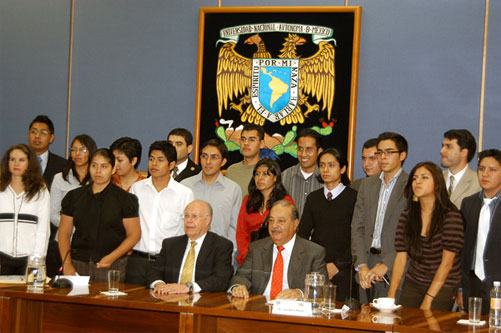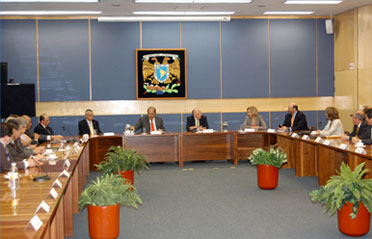
The talk came about in UNAM campus. Dr. José Narro Robles, UNAM rector, welcomed Mr. Slim.
México City, June 21, 2010.
José Narro Robles: Please, seat down. I am pleased of being in here and I m going to make a brief speech to warmly welcome you. I am very pleased in having this meeting.
Welcome to your home, Mr. Slim. Mr. Slim is a distinguished graduate from our engineering school, where he has also lectured, besides having imparted several courses in other schools. To him and his son, Patricio, I say: you are very, very welcome.
I am going to give an explanation for this meeting. Some weeks ago, Mr. Slim asked me in a challenging manner, as he uses to, to have a work meeting, a free dialogue, especially with young people. To get a balanced gathering, I decided to invite older people, like Dr. Martuscelli, by instance.
Our aim is to talk about Mexico, its affairs, themes and problems.
So, you all are in here as outstanding university people, and I m going to start by naming madam Norma Samaniego, who is a chair member of the UNAM trust, although she is not in here in such a representation, just by her own individual merits. Welcome, Norma Samaniego.
It is also in here, of course, Mr. Rolando Cordera, emeritus professor of the Faculty of Economics and member of UNAM directive board. He is in here as a professor and researcher.
I have also invited my own immediate collaborators and some faculty, institute and center directors because their participation could be important since all of them are academicians.
So, in here are Sergio Alcocer, general secretary; Rosaura Ruíz, secretary of institutional development; Ramiro Jesús Sandoval, secretary of community services; Carlos Arámburo de la Hoz, coordinator of scientific research; Estela Morales, coordinator of Humanities; Enrique del Val, coordinator of planning; Jaime Martuscelli Quintana, coordinator of innovation and development, and Luis Raul González Pérez, UNAM general attorney.
In here also are Eduardo Bárzana, director of Chemistry School; Gonzalo Guerrero, director of Engineering School; Adalberto Noyola Robles, director of the Engineering Institute; Leonardo Lomelí, director of Economics School, welcome doctor Lomelí; Jose Manuel Saniger Blesa, director of Applied Sciences and Technological Development Center.
In here it is also Ciro Murayama, university professor, who has been awarded several prizes for young researchers. He has been awarded DUNJA prize, that is, University Distinction for Young Professors.
A distinguished group of graduate and postgraduate students is also in here.
I ask them to stand up as I mention them one by one: Carlos Alberto Balbuena (engineering postgraduate), thanks and welcome, Carlos Alberto; Luis Camacho (law postgraduate); Karina Culebro (law postgraduate); Mario Andrés de Leo (astronomy postgraduate); Jose Luis Navarro (music postgraduate); Beatriz Sánchez Basurto (engineering postgraduate)… I realize that this gathering is biased to engineers, it is well planned.
We also have in here in graduate fellowship students, very distinguished all of them. I ask them to stand up as I mention them one by one: Nancy Arellano Buendía (mechanical-electrical engineering), welcome, Nancy; Irene Cerón Martinez (pharmaceutics-biologic chemistry), welcome, Irene.
Alan Antonio Cisneros Ledesma (law); Miguel Angel González González (mecatronics); Luz Belem Hernández Martínez (mechanical-electrical engineering, welcome; Ramiro Hernández Ramírez (he studies managment in accountability and administration school), it is right? OK.
Francisco Salvador Hernández Pérez (computer engineering); Luis Abel Leon Mercado (psychology), thanks, Luis; Sergio Olguín Plata (civil engineering); José Gilberto Parra Leyva (Biology, School of Sciences).
Aura Rebeca Ramírez Reyes (Design and Visual Communication); Laura Marisela Rosales Lopez (social work); Héctor Iván Sánchez Mendoza (School of Economy, FES Aragon); Omar Valencia (mechanical-electrical engineering), welcome; Leticia Vázquez Mena (mechanical-electrical engineering); Jesús Vergara Gutiérrez (basic biomedics research), welcome, Jesús, and Fausto Ivan Zamudio Herrera (informatics).
I think I have named all of the attendant students. All of them are excellence students of our university.
Before asking Mr. Slim to talk, I am going to suggest two things. First, I propose the sequence for this meeting. Oops! I have missed Dr. Celis; she is already looking at me, as discrete and prudent as she is. Thanks and welcome, Dr. Celis.
I am going to make an introductory speech; then I will ask Mr. Slim to talk as long as he takes; then a question and answers round will be opened.
Since it is foreseeable that senior professors will overwhelm here present students as they use to do in the classroom, we will not allow such a conduct in this gathering. I suggest having one question for each one senior professor or functionary against two from students. So we will have three-intervention rounds up until depleting the scheduled time.
This meeting is planned to end at 14:25 or 14:30 pm if you will.
My introductory speech is simple and it goes in two directions:
First, it is an honor for UNAM to have so eminent and thoroughgoing graduates like Mr. Carlos Slim.
We are proud that Mr. Slim, being what he is, what he symbolizes, having a technical-scientific education plus varied economic-financial talents and his ever-present social commitment, be one of our graduates. We are pleased in having him with us.
Second, we are pleased for having the opportunity to talk with him about all the issues you like, about our university and the world as well.
Mexico is living very important moments. Mexico is a great country and it has many serious problems, but, without a doubt, it is a great country. There is all its history, its culture, its geography, its people, its economy and its big developments, which I just refer to state evidence and reasoning in this field.
For sure, it will be around that, around México, its institutions and its insertion in the world, that we will talk today, welcome all of you.
I would ask to Mr. Slim, then, give us an introductory speech.
Carlos Slim Helú: Good afternoon to all of you. Thanks Rector Narro, I really thank you. It is a pleasure, an honor, and a privilege to be in the university.
I am afraid I am the older of all of us, as a graduate, I mean, 1955 class. What is yours?
Answer: age old or class pertaining?
Carlos Slim Helú: Class, I mean…
Answer: 1958…
Carlos Slim Helú: I belong to the 1955 class, preparatory school; 1957 in engineering school. I thank our rector to be invited. Thanks for being in here with all of you.
In fact, that meeting was brought about in a bit different way. It was David Ibarra’s 80th anniversary. David Ibarra, as you know, uses to be very provoking in expounding ideas. So, we, I mean rector Narro, Carlos Tello, Rolando, and Enrique, stood chatting after dinner.
It was in this chat that the idea of a gathering came about after a comment about a UNAM meeting which has reached out one hundred conclusions, if I recall well. Then I said: “Well, one hundred conclusions are equal to none; if you have one hundred priorities, there are no priorities at all.” That was the reason.
MR. CARLOS SLIM KEYNOTE ADDRESS IN UNAM, JUNE 21, 2010.
I am going to take advantage of seizing the microphone to make a little bit extensive speech, not as extensive as it would appear at its starting. Let me start by doing a little bit provoking introduction.
Since the rise of man or Homo habilis, about two and a half million years ago, all human societies and social changes have been drove by two fundamental factors: technology and communications.
During these two and a half millions years, five glaciations and concomitant one hundred meter sea-level on-average variations did occur. Since then, many societies have arisen and extinguished themselves. We don’t know if some kind of inter-glacial civilization did exist. Yet, it is clear that at the end of the last glaciation, about 12,000 years ago, human civilization began.
Perhaps human civilization began about 8,000 years ago, once the ice melted away. It is estimated that the last glaciation lasted about 120,000 years. Then water receded into the oceans, while, surely, portentous storms dropped down on earth. Climate was hostile, yet it began to become milder, gradually. Then many earthly paradises began to flourish. Abundant fresh water, mild climate, flora and fauna favored human life. Eventually, human groups stopped to be nomadic to become sedentary.
I don’t conceive agriculture as someone’s invention. Our ancestors discovered it in a bountiful natural environment. It was such an environment that made them sedentary in many places, in Euphrates, Tigris, Nile and Yang Tse rivers, and in the Valley of Mexico as well. Small human groups, amounting about 40 or 50 people, did live by collecting fruits and hunting. Eventually they began to gather themselves to become sedentary.
Roughly speaking, human civilization has run through four steps.
The first one goes from the collecting-hunting man to the ascent of the Homo habilis, and it lasted about two and a half millions years.
For those inclined to paleoanthropology, there is a very interesting field work by Richard Leakey (Louis Leakey’s son) in Turkana Lake, showing fossil evidence –the Turk Ana boy– suggesting that the Homo sapiens could be born there, having about 190 thousand years. Abundant fossil evidence has been found there, and systematic scientific work is on the making.
In that era, all of our ancestors were hunters, anthropophagi, scavengers, etc., and they used to wander from here to there. It was until agriculture’s discovery that those groups began to gather themselves and become sedentary.
Estimations about the number of people living then vary from eight million to ten million persons, and they could be gathered in groups about 40-50 people, yet all of that is mere assumption. It seems clear, however, that there were a lot a people gathered in small groups. That seems to be the reason for human surviving in a context of mass starvation.
With agriculture our ancestors became sedentary. Agrarian society brought about big civilizing leaps.
Agrarian society crises deeply differed from ours. Our ancestors did not use to say: “Technology and productivity is speeding up; machines are diabolic because they create unemployment”, etc.
Nobody went into such a mess. In the primitive small group, everybody did collect fruits. In the face of abundant food, nobody would say: “We should continue to be nomadic in order to avoid unemployment.” That was an elementary society, so there were no diagnose problems.
That is the way human civilization began in several places. Agrarian society did last about 10 thousand years and it had paradigms of its own. These paradigms differed from the preceding ones and, above all, from ours, 180 degree dissimilar.
Agrarian societies evolved with technology and communication. Technology, however, had appeared before, when fire was discovered and, above all, when humans began to imitate flora reproduction. So, our ancestors began to cultivate, plow and irrigate land; they began to use water and fire power and invented clothes. By observing the course of stars, they began to organize society accordingly, as it is well known. Advancement was uneven. Some groups lived in the Stone Age while others went into the Bronze Age, yet advances diffused themselves by communication. Some groups learnt from others.
So, by instance, the first globalization did occur three thousand years ago due to the Phoenician civilization in the Mediterranean Sea, the very origins of our Western Civilization.
Sea navigation stands for the driver of that big civilizing leap because it allowed communication between distant cultures. Cultural, ethnic and commercial exchange flourished because of trade, so creating the basis for further progress.
That is why I underline both technology and communication as the main factors of civilization. One hundred or two hundred years ago, backwardness was the rule for many human settlements along the world because of isolation. Even today we see isolated backwardness spots in Amazonia and some places of Africa.
Agrarian society paradigms, as I was saying, completely differed from the preceding ones. For agrarian society, social control was critical, and social control meant social immobility. Class differences were also critical, and the ruling classes could only govern by maintaining the rest in ignorance.
Political power was monolithic and theocratic. Those having the political power were supposed to descend from divinities. They kept political, religious, military and economic power.
It was not by chance that Egyptian Pharaoh, Aztec Tlatoani, and Peruvian Inca claimed to descend from divinity. The Japanese Emperor gave up his divine pretensions after World War II. Even today, the Jordanian King claims to be Muhammad’s offspring.
Agrarian society needed monolithic power and that religious power, by instance, didn’t get independent from political power to avoid rupture and conflict, etc.
Economy, however, was stagnant, zero sum. Climate variations counted more than human labor. Egyptians assumed an alternating pattern of seven good years and seven bad ones, as the Bible asserts.
Freedom and democracy were unknown. Slavery was a matter of convenience because the economy rested upon human exploitation. Conquest wars were recurrent to accrue land and slave labor, etc.
In such a society, justice and freedom were wholly banished as obstacles to efficient social functioning.
Obviously, there also were great moments, cities and luminous epochs: the Greek golden age; the Phoenician commercial expansion through the Mediterranean Sea and beyond, so creating a rich culture; the Roman engineering which did introduce the arch and the vault; the Renaissance, a great moment for arts, science, philosophy and thought in general, etc.
Yet, as great as they were, those moments and achievements did not change the social functioning. Society continued to be monolithic and dependant upon slavery, while social immobility remained to be its main feature.
Social rigidness inhibited print’s social effects because of widespread illiteracy during XVI, XVII, XVIII plus an extended period of XIX centuries. Literacy began to diffuse itself up until the end of the XIX century and ensuing years.
With the industrial revolution, society began to transform itself. Since then, technology has been at the core of constant change. Technology did innovate food processing, weapon manufacturing, architecture, road construction, irrigation, water supply, communications, navigation, etc. Suddenly, a mutating process broke up. Changes were so radical that society became substantially transformed.
Industrial society had two steps. The first one is related to the steam engine. Railroad substituted horse speed; steamship substituted sailboat. The steam engine is introduced into industry and agriculture. As a result, productivity increased twenty or thirty times. Eventually, countries adopting such a technology became developed ones.
In the second step the industrial revolution accelerated itself by the introduction of the internal combustion engine and electricity at the turn of the twentieth century. Things began to be moved at both sound and light speed.
Since the industrial revolution, chiefly since its second step, society has been guided by entirely new constantly changing paradigms. We are already living into the postindustrial society, the age of knowledge, in fact a fourth civilization, the technological society which is moving things and processes at light speed through telecommunications.
The knowledge society is guided by entirely new paradigms: democracy, freedom, creativity, innovation, plurality and diversity. I am not playing wishful thinking; I am talking about the effective features and paradigms of that new society. They count for the fittest conditions for a global society based upon competitiveness, competence, productivity, human rights, environment, etc. This is a 180-degree different society in respect to the agrarian society. Rulers don’t descend from divinity and nobody is able to exert monolithic power, any longer. Instead, we already have democratically-elected governments and separation of powers.
Between that new society and the preceding one there was an intermediate step, which I would conceive as a “natural” outcome of vertiginous change. I am talking about dictatorships and totalitarian regimes. They substituted divinity for nationalism or the people, in whose name they did erect tough dictatorships. It was a transition.
XIX Century’s dictators were seen as “natural” because they abode the monolithic power of preceding centuries. Some countries still suffer them, yet dictators rule amid growing opposition and adverse global environment.
Slavery has extinguished itself because it has become useless, not because of Spartacus-like heroic rebellions. Former African colonies evolved as independent countries because colonialism turned to be obsolete, not because African peoples had defeated German, British and French armies.
The Twentieth Century transformation was impressive, yet often it lacked wise leadership, so we have had and still have million human deaths because of war and other calamities.
There were also costly social experiments. Lab experiments are essential for the advancement of scientific knowledge. On contrary, social, political and economic experiments are cruel; they led to war and destroy human life on a large scale.
The transformation of the two past centuries can be viewed as the transit from a primary agrarian society to a secondary one. It lasted about 200 or 250 years. Secondary society means the ability to add value to primary goods, so transforming them into manufacture. Nowadays we are living into a tertiary or service society: digital, information or knowledge society, you name it.
Tertiary society means that most of a given country’s working population is service-employed. We should consider that total working population is about 40 percent of total population. The United States have about 12 percent of its working population in both primary and secondary sectors. The rest is employed in service sector.
Most of the countries have become service societies; its good production has become more efficient because of to technology. Modern machinery and equipment has enlarged productivity by the tens in respect to one hundred years ago. Such is the picture in mines, highways, dams and factories all along the world nowadays. The work done by 100 workers in the past is nowadays done by a single one.
Technology has also transformed the relationship between people and machinery. In the past, workers were adhered to machines, like in Charles Chaplin’s film “Modern Times”. Nowadays, operators control one or more machines through digitalized monitors.
In contrast to the agrarian society, the knowledge society is not aimed to maximize labor and minimize consume, neither profiting from exploiting physical human force. Its aim is to maximize the use of machinery and equipment by qualified labor force. Nowadays machines run 24 hours a day, while working hours and physical effort tend to decrease.
In contrast to agrarian society’s slave or servant labor force, poverty is no longer profitable nowadays. Poor people should be enrolled into the market, not by social justice ideal or ethical command, just because of economic demand. What modern society needs is educated, qualified and healthy people; I mean human capital able to produce income, make decisions and increase its own consumption as part of the market.
I began to realize this during the 1990’s while talking with Alvin Toffler. He clearly explains that any civilizing change means crisis (Jean Jacques Servan-Schriber had explained this in The American Challenge, 1965). Toffler explained me that the transition from the agrarian society to the industrial one in the United States produced the Civil War between industrial North and pro-slavery South. As a result, the United States embraced a new paradigm. Such has been the pattern for many other societies who have suffered wars.
The transition from nomadic groups to sedentary societies seems to be occurred smoothly. In contrast, the current transition towards the knowledge society has exhibited leadership problems. It seems that China has managed itself to hit the target.
I hope the outline above be useful to see Mexico’s current situation and future. During 50 years, from 1933 to 1982, Mexico’s economy grew 6.2 percent on average, in disregard of bad or good governments, high or low inflation, recession or war. At the base of that growth was the transition from rural society to an urban and industrial one; that is the same phenomenon that the advanced countries experienced during the XIX century, and China is experiencing at the present time.
Rural and subsistence China is being surpassed nowadays. It was Maimonides who said: “Give a man a fish and you feed him for a day; teach a man to fish and you feed him for a lifetime.” Giving a man a fish is like condemning him to subsistence. Nowadays we could aptly say: Teach a man to commercialize the fishes he catches and he will enter to modernity.
The Chinese have a severe policy; freedom is limited and local in reach; yet they are transiting from rural society to a postindustrial and ultramodern one –a knowledge society– by forming human capital at a large scale, both creating knowledge of its own and sending students abroad. They are accruing about six or seven million professionals, 500,000 or 600,000 engineers each year. They are really focused.
During the last 30 years or so, China has been growing between 7 and 10 percent and getting about 25 or 30 million persons out of poverty each year to enroll them into modernity. China is nowadays the world factory with low labor costs, certainly. Labor force is still exploited, yet a big change is on the make. The current global crisis is impelling China to develop its own domestic market after many years of neglect.
As I was saying, Mexico’s economy steadily grew during 50 years. Certainly, the economy was protected by tariffs and other instruments –less than it is said, by the way. It is also true that many Mexican industries were a receptacle for obsolete equipment and machinery from abroad, yet it consistently grew up, and it has been modernized by competitive standards recently. What is to be done? Again, technology is the key for transformation.
Let me make a digression: Homo habilis’ brain weight was about 600 cubic cm; Homo erectus’ was about 900 and then 1,200. Our modern brain weight is about 2,000 cubic cm. It is supposed that evolution has made its own work. But mutation has also occurred. A mix of evolution and mutation has taken place. And evolution is adaptation frequently. Because of mutation, our brain can expand itself four times in a two-year period. In contrast, gorilla’s brain remains stagnant during 14 years. Here present doctors know more than me, of course. But it is a fact that a newborn infant’s brain weights 230 cubic cm; two years later he is able to think with a brain weighting 1,200 cubic cm, and at 14 years old he is able to perform complex reasoning. A newborn Gorilla’s brain weight is almost equal to ours as newborn infants, yet it slowly grows just to 450 cubic cm at the age of 15.
Mutation is at the core of human advancement and technology. By now, modern technology has advanced much, and we are just at its beginning. Yet we don’t know how to steer the change, and I am including the advanced countries, mainly the United States, because their mental habits and institutions keep deeply rooted in the industrial society. That is why the current crisis has occurred.
I am afraid I have overextended myself… Let me back to Mexico’s economy. After the Stabilizing Development period (1959-1970), the Mexican economy entered into a deteriorating course. In 1976, the external debt grew up to 20 billion dollars from 5 or 7 billion dollars at the end of Ortiz Mena’s Treasury administration. In 1982 the external debt grew up to 80 billion dollars as the fiscal deficit totaled about 14 percent in respect to GDP. The interest rate grew up to 20 percent, so disjointing the economy; compare it to the current 5-7 percent.
As a result of the 1982 financial crisis, Mexico’s foreign creditors were able to introduce a set of policies and rules, some good, whose main aim was to collect the external debt, not only in Mexico, rather in all of the Latin American countries. That was in the eighties, very hard years for all of us. I have brought a little book with me, The Washington Consensus, to abound on this in the answer-question round.
In financial terms, our current situation is fortunate if we consider our economic potentiality. What is needed to unravel it? Such was the question we made in that dinner. Obviously, both physical and legal safety is needed. Although localized in some hot spots, insecurity is one of our biggest problems. We are called to avoid deterioration. Without physical and legal safety there is no freedom. Legal reliance is a basic condition for foresightedness; I mean all of us, not only investors.
After security the crucial thing, human capital formation, it comes. As we see it, human capital formation starts by nurturing pregnant women and giving perinatal care. A well-nurtured pregnant woman will give birth to a healthy child; a healthy child will be safe of many diseases and his brain will be normal. Nutrition during his first two years is critical. Early education is also very important. Healthy and educated people stand for the best labor offering. We should improve human capabilities beyond loading bulks, pushing wheelbarrows, driving cars.
If you see a building labor, you will not see loading laborers; what you will see are crane, trip and loading operators, qualified abilities. So, human capital is critical. Physical capital is critical too. No country can attain development without infrastructure.
I am just repeating something that Rolando Cordera, here present, is recalling right now, I guess, the Chapultepec Agreement. What we need is investment to attain sustained growth and employment. Some policy changes are needed. We could consider them in the next round. The real thing is investment to create jobs. Politicians love to talk about employment, yet the job posts they use to create usually are inefficient, customary and social-assistance biased. Politician-created jobs are just a public resources-handling matter. The point I want to make is that jobs can only be created by employers.
Small and medium-size firms stand for the biggest employers in all of the countries. We should consider that services count for the main economic activity for all of the cities. Then, we should secure that our services be the best. By instance, we could provide high-quality health service for Americans. The U.S. health-care system costs about 17-18 percent of GDP and counting without having attained universal coverage –it is already bankrupt. If American patients were attended in Mexico, U.S. health-care costs would diminish about 70 percent. In fact, Mexico would be the solution for them.
We should promote health tourism by linking our health services to U.S. Medicare. In fact, such a link already abides for medical emergencies. That is what I call high-quality services. We should extend them to all of the medical conditions. In the same vein, we could link tourism to many other high-quality services.
Micro, small and medium-size firms are called to satisfy a big part of such a huge potential demand. Big firms grow up from smallness. Unfortunately, small firm’s mortality is bigger. We should ameliorate it in the same way we have diminished infant mortality. Redundant and onerous regulation should be eliminated. Government should allow firms to get established without any requirement. Once established, a firm should be required to confirm its owner identity through his own phone, power or water-consume bill, plus other basic data (how many employs he has, their age, etc.)
We have not been deft in riding globalization. Globalization is a fact of life. We have no option. Both big and small countries are opened to it. Small countries are wholly opened; big countries, like China and Brazil, are opening themselves according to its own needs. Since our economy and population has a considerable scale, we could fix certain rules for investors: who would be welcomed, what we expect from them, how he would manage his business, etc.
Today’s news says we are going to abolish tariffs, eager as we are to wholly opening the economy… in 2013. What we need, instead, is fostering productive investment to create profitable jobs.
My speech has overextended itself. Let us to talk if you will.
Thanks.
QUESTION-ANSWER ROUND
Remark-question number one: Good afternoon, I am pleased to be in that gathering with you, Mr. Slim. Our theme is very important and UNAM could contribute to enrich it, especially with you, having showed your ample vision about the civilizing process and human development. You have said that science and technology are keys for human development.
We have taken for granted that fostering science and technology is a public commitment. We all fully agree with that and we are expecting a neat definition for increasing public support for us, rather we also expect private support. I fully agree about the importance of human capital to foster development. It is that aspect that highlights the link between education and production to employ the educated young into small and medium-size firms to make them more profitable and socially responsible.
Now, strategic areas matter, growth course, by instance. We think that basic knowledge development, which irradiates to health, energy, telecommunication, water, disaster prevention, environment sustainabilty, food production, etc., stands for a strategic area. All of these problems demand both scientific approach and qualified personnel.
How to educate human resource able to work in the productive sector while generating and applying fresh knowledge?
Between postgraduate and productive sector there is a big gap. We should close it by linking UNAM excellence to growing enterprises.
That is both a remark and a question. ¿How we could near these both entities?
Remark-question two: Good afternoon, thanks to be allowed to be in here. My question approaches the scientific side. Developed countries heavily invest in science. Even Brazil invests more than Mexico. Mexico is laggard in this aspect. While we celebrate our bicentennial deeds, European countries are advancing protein knowledge.
Developed countries conceive science as investment. Mexico has scientific human resources, Mario Molina, Francisco Bolívar, you name them. Many more are in the list, yet many of them fly to other countries. My question is as follows: if you think that human capital is critical for Mexico’s development, ¿how science teaching could fit into?
Question and remark number 3: Good morning. I would like, in the name of my law postgraduate fellows, to thank your honorable presence in your own university.
My remark is about what you have called the new or tertiary society, as some theorists have called it, whose main features are technology and innovation. Knowledge society is also a new model which we are just envisaging without being well adapted to it. My question is as follows: What is the role of telecommunications in respect to economic development in that new society and how law making could contribute to it?
In respect to small and medium-size firms, which create most of jobs, you have suggested to eliminating onerous regulation. Could you elaborate on that point? Thanks.
Carlos Slim Helú: Thanks you, I am going to start by answering the last one question. Small and medium-size are suffering high-rate mortality. What impair them most are burdensome regulation, authority’s corruption and lack of financial capital. All of these factors push them to informality or death. In respect to financing, we are already running a chirographical small-credit program from 15,000 to 100,000 pesos each, having accrued about 25,000 credits. In respect to regulation, I fully favor large deregulation, which I see as inevitable. In measuring country’s competitiveness, the World Economic Forum measures legal requirements and respites for opening a business. When legal requirements are burdensome, firms tend to go to informality. We should allow ordinary firms to freely establish themselves and then notify their opening to authority by simple means.
Small and medium-size firms setting up should be eased by derogating exhausting requisites and giving them credit access. A family small-firm should be exempted of accounting experts and other intricate things.
Now, tertiary society is not a theoretical thing. An economy employing 85 percent of its working population in service sector is not a theory, it is a fact. Because of increasing productivity, goods production tends to demand lesser labor force. Because of machines, equipment and highly-productive technology, Agriculture increasingly demands lesser labor force. U.S. agriculture employs about 2 percent of total U.S. working population. That is a fact.
Then, we already know what the new society it is. What we have to do is taking a stand in the most convenient way to us. Each country has its own peculiarities and rules. The conclusion of the Barcelona Agreement in 2004 is that each country needs its own recipe according to both size and development step.
In respect to the role of telecommunications, they stand for the nervous system of the new civilization. What we need is competition, investment, development and universal-access promoting rules. Since telecommunications are increasingly used in health, education, business and recreation services, regulation should secure universal access to them.
Agrarian society rested upon men and land exploitation. The new society, instead, rests upon wellbeing management; it is a generous civilization being sustained upon human wellbeing. Educated people exert both consume power and service access, so activating a feedback process for economic development. China’s economy has become sustainable because it includes to modernity 10 percent of its population each single year. Other people’s wellbeing is the big thing of that new society.
I have no doubt that in the medium and long term, things will be beneficial. I don’t know the upcoming problems, yet I am sure that culture, entertainment, study and knowledge opportunities will grow.
Pre-payment service has been a breakthrough innovation in telecommunication access. We feel very happy about this because, in a certain way, mobile-phone pre-payment is our own idea, our own project. 85 percent of Latin American population has a mobile phone at least, some users have more than one, including kids and the elder, above Canada. That is penetration.
The next step is universal broadband access. At its beginning, broadband service was very expensive, about 1,500 dollars a single connection; nowadays it costs about 100 dollars as a world average. Decreasing prices is a benefit of technology. Service costs tend to diminish consistently. Nowadays, a kilobyte costs a hundredth in respect to eight years ago. 56 kilobytes rated 189 pesos before; five mega will cost the same price next year. What is needed? What we need is deep penetration, complete service, including video. By offering a 149 pesos package, in a single year Dish has grown more than it did during the past 40 years.
Brain drain, I am not very afraid about it. There have been some Mexican drained brains, like Mario Molina, who did award Nobel Prize, and he is already in Mexico back. Had he stayed in Mexico, he wouldn’t be awarded, perhaps. What we have to do is to withhold or bring brains back.
Developed countries heavily invest in research and development, so they have many Nobel awarded science men in many fields. We can not say to our graduate “Don’t go to study abroad”. At the extent they keep their own roots in Mexico, they will remain Mexican, even if they get Nobel awarded. They can go abroad and come home as they develop their own work. The important point is that we get able to offer better conditions for highly-qualified scientists. So, pushing investment and economic activity is the essential thing.
We run a fellowship program covering about 15,000 or 16,000 grants. We have met many well-qualified young graduates without a job or having unfit ones in respect to their own qualification, which is very sad. We have to solve that problem, and the only way to solve it is by forming human capital and improving health. Again, the key word is investment for increasing economic activity.
I am going to answer both first and second question. As the new civilization moves onward, the State economic activity will lessen. Civil society and entrepreneurs are called to perform a bigger responsibility.
I am going to make a weird analogy. Modern firms are alike ancient armies. Ancient armies used to conquer and raise taxes. Modern firms are aimed to conquer new markets to raise profits and royalties from the market itself. These are global enterprises.
Domestic firms are like defensive armies. They invest and create jobs in order to withhold profits in their own country. I am not meaning to say that we should banish foreign or global firms. On contrary, we should attract those convening us the more.
In the scientific part, we should consider that technology is global, and science is even more global than technology. We should mediate if developing basic science is a good thing for us. What we need is to develop abilities to assimilate, adapt and develop science and technology.
We are not going to be the biggest science developers. We don’t originate science and technology. We should, however, be able to absorb them from all over the world in order to be able to adapt and innovate them.
Our university has many good things, and I am not able to talk about other ones. By instance, the Engineering Institute has a good relationship with both building firms and public authorities, especially in coping with natural disasters. It has closely worked with Mexico City government in responding to earthquakes. It assisted Comisión Federal de Electricidad during the Grijalva river flood. As president of Centro Historico I asked the Engineering Institute for technical help to inject water into the valley basin to stop sinking. Comision Nacional de Agua lacks a technical norm for injecting water into the basin. What we have underground is a big tank from which we are already extracting 20 cubic meters per second. We have to solve that problem by tertiary treatment.
We are already engaged in the Atotonilco Waste Water Treatment Plant to treat 40 cubic meters per second. This water is already wasted in irrigation. What we are aimed to do is to introduce primary and secondary water treatment to bring about 15-20 cubic meters per second to Mexico City, while improving irrigated land and crops there. We are also building the East-Outflow System, yet a louver work is sluggish because of huge hydrostatic pressure. Engineers are now measuring underground water volume. We don’t exactly know how big it is, surely it is huge, and we could bring back it to the valley.
So, we and the Engineering Institute are working together in several projects. We should extend collaboration to other works.
We are already working in the City of Health with emphasis in genomics, a frontier field requiring high research and development. As we enter to modern and expensive health-conditions age (cancer, diabetes, kidney diseases, hearth conditions, etc.), Genomics will be the key to lowering health-care services. Health conditions are already mutating, so we have to decide how to focus them.
I hope not to sound so harsh in recalling that, at the time I was a university student, we were very good in studying topology. At that time, students just choose agreeable fields, independently of social benefit. Now students and researchers are called to embrace what our society really needs. That is the way to create joint projects.
In fully agree that both sides are responsible for failure in creating joint projects. Yet I would like to stress that business use to make a lot of research & development, many more than it is recorded because of undiscerning accountant criteria. It is a cost or an asset? Our university could help in distinguishing them.
I fully agree that scientific research needs more money from all of us, but I think we should focus on applied sciences rather than on basic ones. Of course, basic-science talents should be encouraged, yet what we need is applied science, technology and innovation. We should work hard and together in theses strategic areas. The state should continue supporting, of course. The university, however, could do a lot by just orienting its own budget to promote private support.
We have worked together with Instituto Politécnico Nacional in hydrometallurgy, and talked about with the national university.
The Engineering Institute has worked well in big works. Its support has been indispensable. We could extend cooperation to other institutes but perhaps I don’t know what they are already doing. We would be happy if they be as indispensable as the Engineering Institute it is.
Now, I don’t deem that Mexico is backward in science. Mexico did adopt XIX century’s science in the course of the ensuing century. On the other hand, some countries have excelled in the arts, others in science, and others in philosophy. Germany had Mozart and Beethoven almost at the same time. Italy had Leonardo, Michelangelo, Botticcelli, etc. Instead, England had Newton, and the United States have Silicon Valley, etc.
Creating another one Silicon Valley could be expensive and redundant, I am afraid of. Riding on it to take further steps could be gainful. See Linux, which is Windows’s competitor, and it was created by a Mexican. He also is Intel’s competitor. Intel is the most innovative firm in the whole world. All platforms, even Apple, are based on it. Yet, Intel’s most aggressive competitor is a Mexican one.
Technology serves as a bridge, rather than widening gaps. The Chinese have proved it. They build bridges between them and the most advanced technology to profiting from it. Science and technology are running fast, some big firms are in deep troubles, while others have bankrupted. Think about Canadian Nortel, which went bankrupt after been in the lead. Motorola, long-standing radio communication leader, is already in big troubles. Lucent, after having introduced the transistor and the mobile phone, went to a merger with Alcatel; nowadays they both are fighting for survival. Ericsson and Nokia tell a similar story. The Chinese, on the contrary, are technologically surpassing these once billionaire firms. Then, I fully agree what you have remarked, that is, to deeply link firms to scientific research, including researchers stays in business.
At the time the mining school was created, during the XVIII Century, in-detail provisions were made to support mine stays, including a priest. Stays were six-months long, I guess. Academic formation was very close to work places then. So, we have a lot to do to get academy and business close.
José Narro Robles: There is a lot of pending questions, so we are going to end the list. For the rest I would ask to send us their papers in written form.
Carlos Slim Helú: … and their answers too.
José Narro Robles: No, otherwise that meeting would be nonsense. We are going to give participants an e-mail address to send us theirs own papers. Questions should be concrete to save time. I am going to read pending questioners names:
Rosaura Ruiz, Mario Andrés de Leo, Beatriz Sánchez, Estela Morales, José Luis Navarro, Karina Culebro, Alán Antonio Cisneros, Ciro Murayama, Luis Abel león, José Gilberto Parra Leyva, Miguel Ángel González, Héctor Iván Sánchez Mendoza and José Saniger.
Doctor Ruiz, please…
Rosaura Ruiz: Thanks, Mr. Rector. First of all, I congratulate you for taking that initiative and thanks to Mr. Carlos Slim for his support to UNAM. Since we are mutually provoking each other, I am going to disagree with you: without basic science there can be no applied one.
Mexico’s scientific production is too small, about 0.75 percent of world production, against U.S. 38 percent, to say. Our scientific community is tiny, yet highly valuable. We are a part of the world scientific community and our participation could be bigger and more focused on problem solving, according to our own potential. After all, almost all of the basic knowledge has been applied in solving practical problems.
You have talked about evolution, which I like much because it happens to be my own specialized field, human evolution and evolution in general. I am glad to meet an outsider knowing it well.
Mexicans’ scientific illiteracy worries me much. Main scientific theories are little known off walls. Both basic and applied science has a big work to do in closing that gap. Obviously, specialists know more than non-specialists about their own fields. You know the Engineering Institute well and how Mexican engineering has contributed in solving practical problems. Yet, science has also contributed to education.
Without science, Mexican education, particularly higher education, would be meager. We are already working together with Secretaría de Educación Pública in improving elementary education. Higher education main problem is small matriculation; elementary education main problem, instead, is low quality. For the first time in history, UNAM is directly working with SEP…
Carlos Slim Helú: Such a commitment… it stands for basic or applied science?
Rosaura Ruiz: It stands for applied science, the kind you like, yet what we are teaching is basic science.
Carlos Slim Helú: I agree teaching basic science, but if you have a limited amount of money, you should choose strategic areas, even in basic science.
Rosaura Ruiz: I fully agree, of course.
Carlos Slim Helú: I mean basic, pure or applied science.
Rosaura Ruiz: My question is as follows: I have heard your broad proposal for Mexico’s development many times. What is your own suggestion for improving education? A crucial resource is information technology. UNAM and SEP are already creating together a site to link a lot of UNAM content to preschool, elementary and high-school professors. A big obstacle is lack of connectivity by Mexican schools. What do you suggest to solve that problem?
Carlos Slim Helú: Unfortunately, since two or three years ago, the government has assumed the connectivity process. You have read it in the news. We are now expecting how it will do it. I am afraid it is a flaw. If government wants Telmex out of the process, let third parties, not government itself, to perform it…
Rosaura Ruiz: Lack of connectivity remains to be a fact.
Carlos Slim Helú: What we are encouraging is digital education right now. We are going to place Wi-Fi networks in all of UNAM centers, Mexican universities and public places. We and MIT are running an innovation and digital education program since ten years ago. Thanks to that program we both have designed a 100 dollars computer machine. We also are increasing broadband penetration and have multiplied users one-hundred times since 2002 year. That is connectivity.
In 2002 year we had 27 percent (66,600 clients) of the market. We already had almost seven million clients. We have grown one-hundred times during a five-year period.
Our mobile-phone market did grow 67 percent during 17 years. Our broadband users are growing more than 90 percent per year, from a smaller base, yet.
My own view about education goes beyond instruction. It starts by feeding pregnant women to beget weightier child, about 15-20 percent more weight on average. Perinatal care comes next. We already have installed perinatal equipment in 450 hospitals, just for a start. My own daughter has outlined an early-education program to stimulate child’s senses and mental abilities (math, logic and a lot of abilities which have been largely studied, as you have said). It includes a handbook for guiding mom’s relationships with social security institutions. The program is already functioning through workshops, info distribution and so on, and it has been linked to Social Security and DIF.
In respect to elementary-school teachers, we proposed to Zedillo’s administration, ten years ago, to deliver both a computer and internet connection to each one. In respect to computer use, I don’t assume a generation gap to exist. I have seen computer-deft old people. Retirees have both free time and money to buy equipment, etc.
There is pyramidal-education program to digitally train newer teachers, yet there has been no advance in spite of available money. President Fox did announce it three times and the secretary of education did it many more times. It seems that it have started to run recently.
We did start by creating Casas Telmex, a few of which have been created. Then we run Telmex Digital Library program to lend laptops instead of books. We have lent 80,000 laptops in schools from a 100,000 stock. Our aim is to have fully digitally-connected classrooms and we have donated equipment, installation, etc.
Yet it is true that many schools have no computers and many health centers are disconnected, as you have said. That problem is in government’s hands by now.
Information technology will be very important. Its income is about two or three times bigger than phone service’s. Very big firms are profiting by adding value. After seeming obsolete, IBM veered to information technology and did hit the target. Sometimes you are added, sometimes you add. We are looking for Mexican firms able to add value, not just to be added. When you add, you create human capital.
I am afraid I have entered into unknown territory. I do understand networks for sure. Call centers are needed. We have started in training young people in Inttelmex (Telmex Training Center), about 1,000 boys for the first year. Our aim is to create human capital to be employed and well-paid by digitalized firms and government. Once employed, so-trained people could develop its own abilities, including content creation. I would like we all talk about it with Javier Elguea and my own daughter.
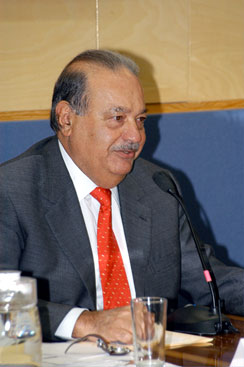
José Narro Robles: Two questions more for that round…
Carlos Slim Helú: Excuse me.
José Narro Robles: I am just carefully recalling that this coordinator is still on command. Mario Andrés de Leo, please; Beatriz Sánchez, next.
Mario Andrés de Leo: Thanks, I would like to thank Mr. Slim’s forbearance in hearing us, Telmex grants for UNAM students, the Mesoamerica Health Project and his support for the arts.
I am an astronomy postgraduate student, so I am very interested in underlying astronomy as a priority. Astronomy has had many uses through history. As you have mentioned, it helped sedentary groups to transit to nomadic society and so on. Whether we want it or not, these monolithic…
Carlos Slim Helú: We should be aware of meteorites…
Mario Andrés de Leo: And eclipses too. Maya priests had absolute power because of astronomy knowledge. Besides, astronomy irradiates knowledge to scientific development, basic science, optics, physical material structure, data transmission, etc. We Mexicans have led astronomy since ancient times. Maya, Olmeca, Mixteca, and Zapoteca societies had ample astronomy knowledge. During XIX and XX centuries, Mexican astronomers did lead the field…
Carlos Slim Helú: Teotihuacans too.
Mario Andrés de Leo: Of course. Practically all of Mexico archeological sites show astronomy evidence. We have had great astronomers: Enrique Erro, Guillermo Haro, Manuel Peimbert, Arcadio Poveda. During the last years, however, our level has come down. Our biggest telescope is about forty years old. Yet, UNAM have one of the best observatories in the Northern hemisphere, San Pedro Mártir, Baja California.
Having a 10 meter diameter telescope is not an economic problem for the Chinese. They even have the technical means to build one. We have obtained money from the U. S. and Korea to build one, yet we are at a half way because Mexico has refused to contribute its share. Besides, the federal government just allots 0.3 percent of GDP to basic science, while the European Union allots 3 percent. The government has promised to allot 1 percent to basic science during several years, yet we haven’t had seen the money.
So, my question is: What do you suggest to encourage basic science by government and private firms? Basic science irradiates to scientific and technological development. In view of your own organizing capabilities in many fields, have you have thought about creating a basic-science foundation?
José Narro Robles: Beatriz, please…
Beatriz Sánchez Basurto: Thanks for giving us that opportunity, Mr. Slim. I am very worried about Mexico and have some suggestions to make.
Mexico’s education is laggard. Many small and medium-size firms have bankrupted, and that worries me much. On the other hand, we have accumulated scientific research not being absorbed by industry. By instance, we have made advances in high-pressure food conservation without discernible interest by firms. Japan and Spain have advanced that technology.
I am the owner of a 75 hectare ranch, which remains bare because of lack of financial capital. In respect to construction, Germans have developed permeable asphalt to drain rain water down into aquifers.
My question is: How to avoid small and medium-size mortality? How our scientific research could be implemented by industries? Thanks.
José Narro Robles: Thanks, we are going to listening Mr. Slim.
Carlos Slim Helú: We should make sure that useful scientific findings be also profitable, competitive, etc. In respect to food-processing technology, you should talk with food-processing firms. If your innovation works, it will have a good chance for be adopted. Chileans are already using nitrogen-conservation technology from New Zealand, I guess.
If the mountain won’t come to you, you must go to the mountain. You should have a public relation man, a good one in selling ideas to the right people. If you have developed avocado-conservation technology, you should meet avocado farmers. They use to lose avocado by the tons. If your innovation works and is profitable, someone will adopt it.
In respect to small and medium-size firms, I have already stated my view. We have to diminish firm mortality by financial capital and avoiding overcapacity.
In respect to German asphalt technology, you should talk with the Engineering Institute. Now, this technology is not adequate for Mexico City because clayish underground layers absorb rain water, so impeding it to drain down into the aquifer. However, it could be apt for other soils. Now, water is not a scarce resource. If just 3 percent of world water is fresh water, as it is said, it would be enough for human consume. Water can be recycled and treated. All we have to do is managing it well.
I apologize in advance about I am going to say: once you have hit a useful finding, you should analyze its off-lab costs. If nobody comes up asking for it, you should go out to meet interested guys since they hardly will read your papers. That is the only useful way you could create links with business.
In respect to astronomy, I like it much. Salvador Mosqueda was my teacher and we had an observatory in preparatory school. We should study the outer space, of course. I think that Big Bang is an anthropocentric theory and that our destructive ability is still limited. Instead, our planet could be destroyed by aerolites. Doctor Sarukhán introduced Arcadio Poveda to me and we both did outline support for Chicxulub aerolite. At that time, Canadian astronomers had a stake in leading the project because they had the money. Their problem was that the aerolite was ours, so we led the investigation at 600 meters deep-down earth. That was about seven or eight years ago.
The long-petitioned telescope will be approved soon, it seems, as rector Narro has told me.
In respect to your interest about a basic-science foundation, our own foundation reach is ample; we don’t need a specialized one. I repeat: let firms and UNAM do things together.
José Narro Robles: Estela Morales, your turn.
Estela Morales: First of all, I thank Mr. Slim for his support to UNAM and our country through many programs. Your exposition has been both interesting and stimulating for us since the telecom business you lead is a global leader. I specially appreciate the point you has made on information technology, knowledge and human capital formation –a university’s concern. You have clearly linked these three points to high-wellbeing standards and sustained development.
The public sector has failed in applying knowledge. Now, your insistence on education as a requisite for economic success is very important.
My question concerns to all of us. How to lead a participative global change? Globalization is a fact; human participation, however, is uneven. There are both active and passive actors. State participation has been inarticulate. Unemployment is a big problem, not only for Mexico. Developed countries have arrived to globalization in a sequential way, step by step, success by success.
Mexico, instead, has taken big leaps by making big holes at the same time. These big holes cannot be filled by assistance policies, whatever their support for the poor. What we need is a state policy, not as a regulatory one, but as coordination among all of the actors. Education and technology should have permanent budget.
I thank your participation.
José Narro Robles: José Luis, please.
José Luis Navarro: Thanks, good afternoon. Mr. Slim has rightly outlined our own context and a course ahead through three axes: economic development through education to attain social common wellbeing, technology and both basic and applied science.
Our country, however, has big differences. The National Music School, to which I proudly belong, zealously preserves ancient music and it also promotes fresh artistic ideas and teaching practices. Some quarters, however, seem to be reluctant to adopt new technologies for teaching and learning.
How do you think, Mr. Slim, we could profit from these technologies, besides learning to use and adopt them in our own university and open fields, without obstructing normal activities. Technologies do not substitute, just accomplish teaching.
José Narro Robles: Thanks. Karina Culebro, please.
Karina Culebro: I thank the opportunity to be here in. Mr. Slim: you have already answered the question I had; I mean how to attain economic development. You have mentioned health, education and economic development seen as foreign trade. You have mentioned China’s paradigm, which we Mexicans could imitate. The Chinese posture goes like this: “If you want sell microphones to me, we invite you to produce them here in and we will buy you”. That is a good idea. I also want to stress the role of commercial firms in taking that way to establish digital culture in Mexico.
José Narro Robles: Mr. Slim, go ahead.
Carlos Slim Helú: Thanks. We have to attain digital culture. I am a digital illiterate, although Blackberry helps me much. I have seen many times the following group scene: when an info-doubt arises, someone gets the answer immediately by using his digital equipment. Having digital equipment is like having an encyclopedia, entertainment and many more resources at hand, and you can distribute information at light speed. And we are just starting on.
Digital education is critical. Globalization is a fact; we should decide how to place our own country on it. Full open trade could be a fact in some future. By now I would not adopt the Chinese model because of huge differences in size. I would look at Brazil, which is doing what we did thirty years ago. Imported mobile phones pay 35 percent tax in Brazil –a cap authorized by World Trade Organization. In the face of such a big tax, I am not able to export mobile phones to Brazil. So, we have decided to produce mobile phones there. The Brazilian model has been successful in this aspect. Many foreign manufacturing firms have plants there. They come to Mexico for other purposes. Perhaps we will have full open trade in some future.
Globalization is too old. Science, thought, music and culture are global since many years ago. The new globalizing trends are finance and trade. Finance is almost wholly global. Trade has considerable room to move on. We should identify strategic areas and choose the relative amounts of foreign and domestic investment to develop them. Some areas could be fully opened; others could be partially opened, etc.
By instance, computer imports are tariff-free, which is good. However, second-hand computer imports are not allowed, which is foolish. Why are we impeded to import 100 dollars computers? Many poor people could get benefited from them, at least to dismantle them and knowing the stuff they are made. Many boys could become techies.
In respect to commercial openness, a case-by-case strategy seems to be promising. Abolishing all of trade barriers in 2013 is nonsense. We also should single out free-trade partners. Free-trade agreements with South America and Central America could be reciprocally gainful. We should also push for free labor mobility according to ability standards, as in Europe. The migratory issue in North America is very complicated.
In respect to using technology in education, I don’t know if you were talking about the school of Music or the university as a whole.
We shouldn’t be afraid of using technology in music. Fear usually comes from ignorance. There was a time when people refused to enter into churches because of fear the vault could fall down over them, by reason of which altars were placed in the outside. Even nowadays many people fear traveling by plane because of fear of crashes. Many people refrain to enter into dark rooms. The least we should do is to know technology and to get informed about how it is used in research and music in other countries. We are not going to invent warm water. Of course, technology is useful to store and use ancient music.
I appreciate your remark about linking academic research and economic production. Human capital formation is becoming a qualitative problem rather than a quantitative one in Mexico. Many people is now demanding 8 percent of GDP for education, a big increasing from the current 4.5 or 5 percent, which is already big, yet education has not improved itself. Quantitative and qualitative dimensions should be matched themselves. We should start by pregnant mother and child nutrition, health and early education. There are many institutions and non-profit foundation in support of education and health.
I strongly assume that employment stands for the instrument to overcome poverty and attain wellbeing. Social programs and gifts only serve as temporary relief. Job creation should be strategically managed to avoid creating non-growth jobs. Rural, small and medium-size firms and construction jobs are needed.
Investment stands for the key for growth. Liquidity is nowadays abundant while interest rates are very competitive, a situation entirely new to me, as I recall. Developed countries interest rates are near to zero, so we could attract a lot of investment. With cheap and abundant money all projects become viable. Ten-year Mexican government bonds interest rate is about 7.30-7.40 percent, so the government is accruing a lot of investment. We could profit from that opportunity to finance all the needed infrastructure, housing, etc., before developed countries crisis becomes worse.
José Narro Robles: We are going to listening Alán Ortiz Cisneros…
Alán Ortiz Cisneros: Good afternoon, fellow professors, distinguished academicians, Mr. Rector, Mr. Slim. As a scholarship student, I thank benefactor Fundación Carso. Without its support, I wouldn’t be here in. And I am also grateful for having met Andrés Bustamante (“Ponchito”).
I want to go back to Mr. Slim’s interesting introductory speech about successive paradigms though history. I doubt that ancient social immobility has really been superseded; I brood if economic status has substituted divine one.
I use to wander if water is either a product or a good. I think we are the object of a social experiment at a global scale. I ruminate about the Palestine-Israel conflict, the Nobel Peace Award for Barack Obama, and many happenings more. We ask where that experiment is going up. Mr. Slim has underlined that we already live in a service society. In my view, we are already living in a consumerist society. I experience that in my own home. I got off internet past week and I felt life-disconnected. I am not criticizing big companies like Telmex, Grupo Carso and others. I just underline their specialty in creating needs. Internet and mobile phone have become new needs.
The point I want to make is that technology is a means, not an end by itself. We have lost the real aims. Mexico’s problems can be summarized in two words: vision and visibility.
Most of Mexicans have visibility, not vision. Projects are not viable because of lack of planning. We students should observe, analyze and criticize, but the important thing is proposing new ideas. I am studying to be a lawyer –unavoidable evil, you know. Where the Mexican State is it? It performs a lot of functions, some essential and some not. Justice, law making and printing money stand for essential functions.
Technology development runs untimely in respect to law. TV signals are not regulated in some Northern states. Dynamic law-making is needed.
Justice is an essential function too. President Calderón’s judicial initiatives are on the right track. Yet the State has become a sheriff protecting many delegated functions to private actors. I agree with Mr. Slim regarding evolution, adaptation and mutation as humankind main features. Yet, mutation seems to be exclusive for private actors. In the social and law levels we only see adaptation, not evolution.
Small and medium-size firms need easier legal terms. Our problem is both excessive and useless legislation. We use to promulgate laws for everything; they, however, remain unfulfilled. We have many useless institutions, like Profeco and CNDH, by instance. In respect to small and medium-size firms, public action limits itself to charging fines. Financing is needed, yet the state is absent.
We have schools and public support for them. Our problem is lack of education. Training has substituted it. Education shouldn’t be privatized. Private education gives training, not education. Even legal education has become a training matter. Students tend to assume that studying law is equal to memorizing codes.
Mr. Slim: What was your motive behind your success as an entrepreneur? What is your advice to us and the “nini” generation?
José Narro Robles: We commit ourselves to keep your answer in secret, Mr. Slim. Doctor Ciro Murayama, please…
Ciro Murayama: Thanks, good afternoon. Mr. Slim’s account about economic evolution is suggesting. We could approach it through work and employment too. Such an approach could be useful in approaching domestic market encouraging, which Mr. Slim has underlined as a priority. Consumption depends upon domestic market…
Carlos Slim Helú: I’d talk about both domestic economy and domestic market since the last one could be provided by imports.
Ciro Murayama: Yes, of course.
Carlos Slim Helú: Domestic economy, I mean…
Ciro Murayama: Domestic economy needs production, of course.
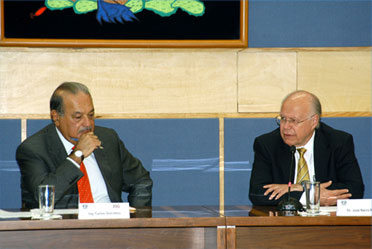
Carlos Slim Helú: Domestic economy is linked to market economy.
Ciro Murayama: Sure, of course. Let me underline production, which is linked to workers and wages. In fact, successful economic models tend to increase wage aggregation in respect to GDP. Let me assume that our economy is a tertiary one: How we could meet the employment challenge? Subsistence economy is becoming smaller. Agriculture jobs are gradually decreasing. So, the sum of subordinate workers is growing up. Subordinate workers not only include highly-trained productive labor force; it includes those distributing goods and services. So, we should distinguish small and medium-size firms from workers. Salesmen being hired by big firms hired are usually named “small businessmen”, while they actually are dependent workers. Reforma newspaper’s street vendors are called “small businessmen”.
Have you have envisaged a model for creating quality jobs, not only highly-qualified ones? I am not alluding to Warren Buffet-style’s philanthropy. I am thinking, instead, about an entrepreneurial model. Ford did create one by doubling wages at a decisive technological transition…
Carlos Slim Helú: In fact, Ford did double wages to stop labor rotation…
Ciro Murayama: Right, yet he profited from technological advancement to increase wages and create an industrial model resulting in middle classes expansion. We should think alike. Workers should be treated not as businessmen. How do you think about quality jobs in that economic era? Thanks.
José Narro Robles: Luis Abel León Mercado is pending for that round.
Luis Abel Léon Mercado: Good afternoon, I am glad in being here in with all of you fellows. I am afraid education has been overstated. There are three questions I’d like to pose: First, It seems that growing technology use implies educational revolution. I ask Mr. Slim how to train people for that new technological era. Mechanized agriculture greatly differs from plow labor. Mechanized agriculture demands new training ways.
Second, had we had many talented people, I’d not be worried about brain fly. How to transform scientific and engineer formation into trading goods?
Third, communication and technology had gone hand-in-hand historically. As Mr. Slim has said, our technology pace is not laggard, yet we need more openness. Think about Brazil and China. Why there is not Mexican manpower in both these countries? Why we have not a closer cooperation with them? One reason for that is absent State. How private actors could fill that gap? As we know, many private firms use to send employees to train abroad. How do you think about it, Mr. Slim?
José Narro Robles: Mr. Slim, please go ahead.
Carlos Slim Helú: Technology encloses many educational applications. Past education, elementary school above all, was less good than the current one. Past education rested upon learning by heart. Current education, instead, encourages thinking, research, examining. Past elementary education required you learning Aztec emperor names, birth dates and deeds by heart. You were also required to memorize verse and other texts.
There are many uses for technology in education. The first step is internet navigating, not as a goal by itself, just as a means, as Alán has correctly stated. Mixing up means with ends is a common error. By instance, macroeconomic stability (low inflation and low fiscal deficit) is just a means for growth, yet it has been conceived as a goal. We have lasted about 20 or 25 years in such a mess. The real goal is sustained development, social wellbeing, middle-class growth, etc.
Main current economics did assume that healthy public finance stood for automatic economic growth; imbalances were corrected by market forces. We know nowadays that such a condition is not enough. It is a means, not an end by itself. Technology is also an instrument for many goals, by instance knowledge and information access. Internet navigation for accessing information is like reading a book.
Elementary-school teachers should manage internet, of course. Ignoring it is like ignoring print word during the print era.
Information technology has become critical for higher-education mass-access. I am talking about all of the universities, mainly public ones. At least they adopt distant education, they will no be able to enroll growing applicants. In pursuing that goal, information technology stands for the fittest instrument.
Teachers would change their transmitting function by a conducting one: they’d coordinate the screen-broadcasted content being transmitted by the best teachers in all fields. All students, including the remotest ones, could have access to the finest content by the finest teachers. Examination could be performed by technology too. Such is the way for solving the enrollment growing problem at very low costs. So, technology will help us to improving educational quality, enlarging both access and enrollment, and lowering costs.
In respect to Dr. Murayama’s remarks about domestic market growth, quality jobs and worker-businessman overlapping definition, let me start by answering the last one question. Of course, a newspaper salesman is not a businessman, at least his provider supplies him extra copies for a marginal gain, or he links his main activity to others of his own, like selling cigarettes, by instance.
Well, quality-job creation is the important thing. The main requisite is job-seeker abilities, which means education. Unlike Alán, I’d not harshly distinguish educated people from trained one. Trained people are usually able to be employed in many fields. The other main requisite is investment for economic activity. We should single out strategic areas, perhaps, or creating a job program. Small and medium-size firms stand for a strategic area. Some credit lenders are supporting big retail-stores’ small providers, like Wal Mart ones. That is a case for small and medium-size financing.
Another strategic area is house-building because it creates many jobs, besides fostering family savings by creating family patrimony.
I want to underline that social and economic laggard stand for growth opportunities. Mexico’s housing deficit is about five million homes. That is a big opportunity. The Mexican building industry builds about 400,000 homes per year. It could build 800,000 per year for the next 10 or 15 years. That is another strategic area for job creation.
As I have said, money and resources are available. If government lack them, let’s making public-private partnerships. That arrangement works as follows: public works are long-term financed by private investors. By instance, a public university or a hospital is financed by private capital at 20 years, to say. Then government pays a monthly payment for it during a 20 years period. Fee highways can also be granted to private investors to maintain and operate them in exchange for a fixed payment. There are many ways by which government could encourage infrastructure building while keeping healthy public finance.
Saving funds are in trouble because of deficient –almost negative– returns for holders. Returns are negative because they are invested in public bonds. A workable solution is that the government invests public saving in long-term infrastructure-building programs, instead of paying out meager returns for them. So, public saving could help to finance infrastructure while obtaining bigger returns. Agriculture economy could be also stimulated in such a way.
In respect to brain fly, let me consider health services. We could create medical centers in border cities or tourist centers to attend American patients at 60-70 percent lower cost than U.S. Centers ownership wouldn’t be a problem. They could be owned by big American health firms, even. The crucial thing is that they be installed here in Mexico. Doctors fly would be stopped since they could be employed in Mexico at high wages.
We need concrete job programs. Unfortunately, many development institutions have been ruled out, development bank, by instance. Nafinsa seems to be unfocussed. Brazil’s development bank, BNDES, instead, is playing a critical role. Current available cheap money stands for development bank’s big opportunity.
Investors are eager to invest. Many of them participate in big public works. A highway construction takes about six o seven companies. We built the foreign relations building in Centro Histórico without a legal framework. Its bidding was legally flimsy, yet four or five banks did participate.
In respect to social immobility, I think modern society greatly differs from those of the past. Hindu castes, feudal nobility, slave societies were socially stagnant. That is not the case for Mexican modern society. Think about UNAM whose enrollment accrues more than 300,000 students each single year. Registration fee is very cheap. Public health and education count for the main social-mobility instruments.
Perhaps contemporary big firms do create needs, yet the consumer is not defenseless; he is able to distinguish real form false needs. You can choose buying junk foods, colorful watches, bewildering cars, etc. On the other hand, as society develops, new needs arise. You are able to decide which needs fit your own wellbeing.
About thirteen years ago, when I was in a hospital bed, I realized that doctors used to take upgrading courses to increase their own income. Of course, some of their needs were superfluous, but most of them (children education, vacations, books, computers, etc.) were legitimate.
Distinguishing vision from visibility has a point. Both of them are needed. I have talked about past times just to see social-process functioning, which help us to see the future, like Alvin Toffler has done.
Cold you repeat your thought about essential and not essential State’s functions, Alán?
Alán Ortiz Cisneros: Telecommunications (internet, television, media, etc.) are being developed by private companies, which is good. What is the role for the State in that respect?
Carlos Slim Helú: The State is required to regulate (organizing, legislating, law abiding, law reinforcing, providing security, etc.), not controlling every activities; it should respect and foster freedom, democracy, plurality and diversity.
Alán Ortiz Cisneros: With regard to recent past, many public enterprises were sold to private investors during the eighties; then a private-capital boom began.
Carlos Slim Helú: Regulating private firms is one thing; seizing them is another. By performing its regulatory function, the State gets able to channeling wealth production while raising taxes from consumers, workers and firms, either domestic or foreign ones. In such an arrangement, bankruptcies got paid out by firms themselves, not by tax payers.
The State should guide the economy by specifying desirable economic goals and being able to foster some activities while discouraging others. By instance, Brazil charges high tariffs to certain imports in order to get them domestically produced.
Now, health and education remain to be essential public functions, like justice. In respect to U.S. TV signals, like CNN, you can watch them all over the country. By technical reasons, however, Northern states viewers enjoy a broadest menu.
With regard to your point about social adaptation rather than social evolution, I think that society is improving itself as a whole. Of course, some individuals tend to evolve faster than others.
With regard to the education-or-training dilemma, I think that education mainly depends upon student’s effort. Those eager to get educated will succeed. On the other hand, education is not limited to learning; it involves relationships with many people and activities. UNAM have people from all over the country and many places of the whole world. Now, callings and talents are varied. Some people are more spirited than others, etc. Calling is linked to talent. Your performance will get better when working in the field you like more. Team work also matters.
José Narro Robles: Now the third round… I ask you to be concise. José Gilberto Parra Leyva, please…
José Gilberto Parra Leyva: Globalization is a fact; the question is how to profit from it; each country should embrace it according to its own peculiarities. What about agriculture, meat industry, fishing and forestry? We have visited state-of-the-art forestry sustainable projects in Michoacán, which include ecotourism facilities, solar energy, community jobs, etc. How these projects could be replicated in other places of Mexico?
José Narro Robles: Thanks. Now Miguel Ángel González, please.
Miguel Ángel González: I am worried about the neglected rural sector. What do you suggest to improve it?
José Narro Robles: Thanks. Iván Sánchez Mendoza, please.
Iván Sánchez Mendoza: By considering small and medium-size firms high-mortality rate (about 2-3 life years for 95 percent of them), what kind of strategic support would you deem for them? Second: how to achieve sustained employment? Third: how to efficiently use both human capital and intensive labor force? Fourth: what technology sectors we should develop?
José Narro Robles: Thanks, Iván. Doctor José Saniger, please…
José Saniger: I suggest creating a strategic alliance between Grupo Carso and UNAM. If it already exists, I’d suggest to reinforcing it to continuing both human and physical capital formation, quality-services development, and prospective studies. I’d also suggest creating Carso-UNAM educational-technology and health laboratories. Thanks.
José Narro Robles: Mr. Slim, please.
Carlos Slim Helú: Thanks. Since many years ago, we and UNAM have set together about many projects. About 3,500 or 4,000 UNAM students are recipient of Telmex scholarships, including those managed through Fundación UNAM.
As I have said, we are supporting the Chicxulub meteorite project and have proposed to install Wi-Fi networks in all of UNAM centers. As to my knowledge, UNAM authorities will make a decision about it next week. Am I right? We both have made a lot of projects together, and we are glad of it. According to the original fellowship idea, each scholarship student should stand behind or to bond a grant for a new student when graduated. We proposed, instead, unconditioned grants, except academic performance, of course, and graduate reciprocal responsibility to UNAM.
We always have stood ready for giving support. Even more, at the time the grant program was accorded, I made a 40 million dollars contribution to UNAM. I don’t remember the actual amount; we have never kept account of. The Centro Histórico project included UNAM projects, including digitalization of San Agustín Library and English language and computer courses there. Are English courses operating still?
About five years ago, we outlined a plan to digitalize Hemeroteca Nacional through Fundación UNAM, but Google put its own stake to controlling information, which its own business, and the plan was entrusted to it. Digitalization, however, has not been done yet.
We have also contributed to several UNAM projects by invitation, and we will continue doing so. By instance, Arcadio Poveda invited us to contribute to the telescope project when I thought it was already done.
We’d be glad in keeping cooperation. We maintain a close and ample relationship with Rector Narro. When invited to support Pumas soccer team, we did accept, and Arturo Elías did perform the job very well. He rescued the team from bankruptcy, Pumas won two championships and defeated Real Madrid.
With respect to the questions about employment, service economy and Mexico’s global role, let me consider the following: We are now living in a new civilization, the service society, with globalization as its paradigm. Mexico’s function into it should be according to its own interests and cultural diversity. I assume that we all agree on this. So, the point is deciding how we should get inserted into this new society. Nobody is forcing us to play a definite role. Decision is ours, yet we should make it in an active manner, not waiting for events coming to us.
In this new civilization, primary goods no longer stand for the decisive terms of exchange, although its relative position in respect to manufactured goods could improve. Manufactured goods relative position will diminish because of automated production, so the differential margin between primary and industry goods will lessen. Commodities-producing countries will improve.
That picture seems to refute Malthus and Club of Rome prediction about primary goods scarcity because of growing population. In fact, primary goods growing demand comes from new modern consumers. Subsistence population demand is small because subsistence people use to consume its own output. They do not offer neither demands consume goods.
Growing demand comes from about 50-80 million people entering into modernity each single year in China and India, mainly. At a lesser scale, Brazil and Mexico are also contributing to growing demand. Migrant workers remittances are playing an important role in this process. Agriculture production has become very important. I mean modern agriculture production, not subsistence one. So, we should conceive plans to improving our own primary-goods production, not only food stuff. In spite of up-and-down prices and bare speculation, countryside gains will improve.
Now, figure out how many people is pending to entering into modernity, 3,000 or 3,500 million, I guess. That figure is bigger when considering durable goods growing demand.
The countryside should be strengthened, of course. It harbors about 22 percent population. By modernizing it, we could create many jobs there.
Obviously, exporting goods is better than exporting labor force to the U.S. Don’t worry about brain fly only; think about rural migrant workforce, which counts for the boldest people we have. To maintain their own families, they use to risk their own physical and moral integrity. We should absorb them through employment to produce export goods and services here in Mexico.
With regard to biodiversity, we have signed an accord with World Wide Fund for sustaining biodiversity in six Mexican areas: Sea of Cortez, Chihuahua Desert, Monarch Butterfly, Mesoamerican Reef, Lacandona Forest and one more. The Mexican team includes Mario Molina, José Sarukhán, Julia Carabias and Exequiel Ezcurra, the best specialist we have. They were the responsible for setting up the Mexican agenda, which has been upheld by WWF. The main idea is transforming sustainability into an asset.
Human capital is good, yet not-educated workforce is not bad; in fact is very good, creative and versatile, and it learns quickly. We have proved it in many building works employing many non-qualified workers. We have recently built a singular building, a museum with an unusual structure and many hand-made parts, fully made in Mexico, from structural calculus to workforce. Mexico has a lot of problems; workforce, however, is not one of them.
José Narro Robles: This meeting has come to an end. It has been rich, useful and suggesting. Many questions and possibilities are now on the table. So, I hope this gathering be just the first one of many to come with Mr. Slim.
I’m grateful to all of you and especially to Mr. Slim for sharing with us his own working time, knowledge, experience and views, which have been very useful to us. In the name of UNAM I’m grateful to him. Through his own foundation and Fundación UNAM, he has made many good things for our own university. He has been generous every time we have asked him for help. Perhaps we have not asked him enough. I commit to abet myself.
Thanks and good afternoon.