“All crises are opportunities”
MIGUEL JIMENEZ / AMANDA MARS June 8, 2008
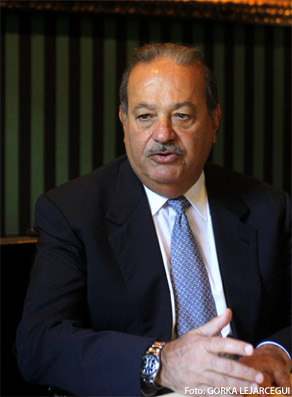
Carlos Slim Helú (Mexico City, 1940) is passionately fond of his family, business and baseball. He says that Alex Rodriguez, one of the Yankees’ stars, was the youngest player to reach 500 homeruns, and that the boy can beat the all-time record. All the great ones, Ted Williams, Babe Ruth… Slim can refer by memory the historical statistics of the American king of sports and keeps a little piece of paper with all the records. His eyes also sparkle when he tells that a Jamaican just set the 100-meter record in 9.72 seconds; or remembers that Tarzan, Johnny Weissmuller, was the first one to swim 100 meters in less than a minute, more than 80 years ago.
“Competition has made us (Telefonica and Telmex) better”
“Felipe Gonzalez and I do not talk about business; we talk about the new society”
“It would be a mistake to open Mexico’s oil richness to other enterprises”
“It is not important NOT to make mistakes, but the mistakes to be small”
“I am concerned for the rampant speculation in commodities”
The iPhone is a great product, very attractive for part of the market”
Because the only records he is not interested in, he says, are multimillionaires’. A telecommunications empire (Telmex), infrastructures, oil platforms (Carso) and finance (Inbursa), among others, antagonize with him. He has been launched to the second position among the richest man in the globe, between two Americans, with a fortune valued in $60 billion dollars, according to Forbes. A few days ago he took part in the annual conference of the Círculo de Economía (Economy Circle) in Barcelona and had lunch in Madrid with the Instituto de la Empresa Familiar (IEF, Family Enterprise Institute). Then he escaped to see Goya’s exhibition in the El Prado Museum.
Question. Warren Buffett used to say that great companies are built by people who love their business and earn money in the way, but that money does not impulse them as much as the desire for success. Do you share that point of view?
Answer. I think that happens in any vocation. It happens to the artist, who is interested in creating; it happens to the sportsman, who is interested in good results or to the businessman, the doctor, the lawyer, the politician, the religious… It is something that goes with human condition.
Q. Have you always been like this, or when you started money was more important as a motivation?
A. No, of course not, on the contrary. Look, my parents’ house is better than mine, much better. It is bigger, more spacious, and more valuable. When you go after the material value, you are on the wrong way.
Q. Why don’t you have a bigger house?
A. Because I have been living in my house for 36 years now, I never moved and I am going to stay there until I ‘kick the bucket’. It is warmer for meeting the children.
Q. What memories do you have of your parents? What did they teach you?
A. Everything: values, role models, knowledge, wisdom, common sense… The importance of the family is total.
Q. Did your father also teach you to do business?
A. Yes, in some way, though he died when I was still very young.
Q. You started your first investments when you were 12.
A. Yes, even earlier.
Q. What investments?
A. Well, I do not remember clearly, but from a savings bonus to a checking account, which I later realized was not worth it because it did not make any profit. I also bought some stock when I was very young. Thirty actions, I remember, from the Banco Nacional de México (Mexico’s National Bank).
Q. Was it a good investment?
A. Sure, sure. I kept reinvesting in them for a while.
Q. What is the worst investment you remember?
A. I don’t have a special recollection of anyone. I have made bad investments in my life, of course. It is not important NOT to make mistakes, but the mistakes to be small. The problem is when you make big mistakes, and several of them, but if they are small… If you don’t make mistakes it is because you don’t make decisions.
Q. What would you say is the secret of your success?
A. I think that the family I was born and raised in, my marriage, my children, my friends… But I think that success is not economic. To think of success as a material issue is not right.
Q. In the Círculo de Economía, you said that you consider companies as modern armies that conquer markets. Do you feel like a great General?
A. No, it was a metaphor. Probably, the bellicose instincts of human beings are now displayed on other fields like sports, business or professional work. You compete with other media and even with colleagues of your own media, in sports, you are in competition with other teams and in business you compete with other companies. Competition always makes you better. To make things better, you need to be in competition. Even in politics, democracy is a political competition.
Q. Does it also motivate you to compete in rankings as those where you appear as the second richest person in the world, behind Warren Buffett and before Bill Gates?
A. No, that is not competition.
Q. So how does it feel when you appear in those classifications?
A. Nothing
Q. Doesn’t it provoke you any feelings? As pride, for example?
A. Nothing, neither feelings nor emotions. Pride is individual, internal; it is not about recognition or applause from others. It is the internal feeling you have for the things you do.
Q. Which of your companies you like the most?
A. Which one of your children you love the most? We like everyone, and when one has problems, we devote more to it. There are many things that satisfy us; for example, the Foundation. I am not even as honorary in the Administration Boards.
Q. How does the present financial crisis affect your enterprises?
A. Those crises will affect everyone. We have historically tried to have financially healthy enterprises, so the crises do not lead us to make painful personnel and structure adjustments. When you have the adequate, lean operation, you are prepared. But the expectations are not really encouraging and there will be some problems to face, not only for enterprises, but also for the society in general.
Q. You have made most part of your fortune by taking the risk of investing in moments of crisis.
A. I think that is when less risk lays.
Q. Do you consider this crisis also as an opportunity?
A. All crises are opportunities. Unfortunately, this crisis is delicate, because it is the financial system what is in trouble, and this will impact real economy, over the society.
Q. Which sectors would you run away from?
A. Run away? As much as running away… What concerns me, not personally, but globally, is the rampant speculation in commodities that has created a speculative bubble not only with regard to oil, but also food. That speculation should be avoided. Just as there have been granted credits with a very little guarantee, the subprime, there is a rampant speculation in commodities and oil with very little guarantee. It should be required a greater guarantee to operate and avoid the consequences of the speculative bubble that is affecting the world so much.
Q. You are always referred as a candidate to buy companies in Spain.
A. In some cases, it is probably in good faith, and in others, maybe to create more competition in offers. When we are entering something it is made public, we formally register.
Q. Are you interested in investing in Spain?
A. Yes, of course, we are interested in the telecommunications sector. At that time, we demonstrated we were interested in mobile telephony when 10 mega were tendered out. But it was like a beauty contest. We proposed to the authorities that the concession would be offered depending on who could offer better prices to the customers, but they considered first those who invested more in rural areas. For a new company, its capacity of investment in rural areas is minimal. We thought it was more interesting to offer smaller prices to the customers, but it was not possible.
Q. Before that contest, there were others you did not take part in and other opportunities to purchase.
A. You are saying when the second and third license came out? In that time, we were not yet in our international expansion outside Mexico, not that long ago. Actually, we went out, mostly when Telefonica entered Mexico.
Q. Your possible entry to Spain to the telecommunications business is observed when your group is much diversified. Couldn’t you enter other sectors as well?
A. This is what we are strongest and most experienced at.
Q. Back to the military metaphor, your rival army in Latin America is Telefonica. What is your opinion of it?
A. It is an extraordinary company that has grown substantially. Competition has made us better. We (Telefonica and Telmex) would not have improved so much all by ourselves. We compete in many countries, and what they are learning in Latin America they are applying it in Europe.
Q. It caused quite a commotion when you revealed that President Aznar proposed President Zedillo a merger between Telefonica and Telmex.
A. And he did. Aznar called Zedillo and Zedillo said that Telmex was a private company, that he had nothing to do with it. Zedillo called me to know who they need to talk to. There were some meetings to see what the proposal was. Alierta met with Jaime Chico, Director of Telmex. But our idea was that Telmex should remain Mexican.
Q. Telefonica complains about the little competition and liberalization of the sector in Mexico.
A. We compete with Telefonica in 15 countries or more. We have entered in many countries with small participations, like Uruguay, Paraguay, Chile or Jamaica. When we entered Peru, they had 70 percent of the market. But when you have a license and you build your network, you compete with the one next to you. In Mexico, where we have reached 68 percent of the mobile share, we actually started at 0 percent. The monopoly was held by other company, our competitor. No competition means when they do not let you in.
Q. But also when you find barriers. For a long time you have refused to grant Telefonica fixed telephony interconnection.
A. There was a discussion, because the law says that the company has to be mostly Mexican. Telefonica publicly says that its affiliate is 100 percent Spanish that is not mostly Mexican. And, even as we think that law must be changed, our position is that it contravenes the law. But if the authorities instruct us to do it, we will do it. And we have. There is interconnection already, but what needs to be done is changing the law, because the law is being broken.
Q. Telefonica has a legal structure to observe the law.
A. Any structure is false, because it is not true that Telefonica has a Mexican partner holding the majority for control and decision-making. But we agree that it should be allowed to be 100 percent foreign as in mobile telephony. Foreign investment should be allowed in Mexico within the entire telecommunications sector, as well as in other countries.
Q. Are you afraid they now steal your market share?
A. We already have 600 competitors in Mexico for Telmex. We believe there must be competition and convergence. This is an ever increasing business with decreasing prices and competition makes us better.
Q. You got ahead of Telefonica by announcing the launching of the iPhone, though not exclusively.
A. They have modified their strategy and are no longer signing exclusively. The original business model they first launched did not work very well and they have been correcting it. The iPhone is a great product, very attractive and holds a certain market segment, especially because this will already be a third generation telephone, a more advanced product than the former one.
Q. The OCDE (Organization for Economic Cooperation and Development) says that Mexico is one of the countries with highest telecommunications prices.
A. Well, that is not so. Prices in Mexico are lower than in Spain, and I don’t think that Spain is the most expensive country in the world, though it is very expensive. In mobile, Mexico stands on the OCDE’s lowest. It is shown in some high-quality and more updated statistics.
Q. In fixed telephony, Telmex holds a great control over the market.
A. When Telmex was privatized, it worked as a monopoly on long distance for six years, but local service is open since 1990. Nowadays there is telephony, broadband and paid television services. The main competitor of fixed telephony is mobile. Telmex, today, holds 82 or 84 percent of the telephony market, but on mobile, it holds less than 20 percent, Telmex alone. In paid television, Telmex does not have anything, in broadband, the cable companies started it and they were able to provide it before us, but we have been growing and we are close to 60 percent. Besides, they have been providing three services at a time (voice, broadband and television) for one year and a half, almost two, and we have not got the authorization to provide the triple play yet. If Telefonica enters these markets, good for them, because this is a business that requires high investment and Telefonica will be able to make it.
Q. You are giving Telefonica a warm welcome to your fief…
A. And we would also like to be in your fief…
Q. Which paths do you see to enter Spain?
A. If you would widen the spectrum. The United States are opening lower frequencies. If you would let us, we would enter here tomorrow. In order to lower the prices and to encourage competition, you could open the spectrum in Europe.
Q. Have you thought about entering as a virtual mobile operator?
A. No, not much. Because you depend on the price you are sold and it is your competitor who sells you.
Q. You have met with the Instituto de la Empresa Familiar (Family Enterprise Institute). How is your relationship with Spanish businessmen?
A. I have good friends here. I am surprised by their talent. They are many, they are very good and they are expanding everywhere. Encouraging Spanish enterprise abroad has been an intelligent state policy started by Felipe Gonzalez. Not only they become more competitive, but there is an important development of human resources. I am also surprised by the importance of the family enterprise in Spain. I strongly believe in it. It is not thinking about the trimester, the options or the salary, but it has a more solid long-term vision. It makes fewer mistakes because it is more careful. And, although it is sometimes criticized for the lack of professional administrators the family enterprise employs family that has educated in the business since birth, but if they do not work, it calls someone from the outside.
Q. Is Felipe Gonzalez your counselor with respect to Spain?
A. Friends are not counselors.
Q. Does he give you advice?
A. We don’t talk about business; we mostly talk about the new society, the new civilization paradigms. Felipe is a universal guy. More than a politician, he is a statesman. But he is not a businessman; I think business is not his thing. He is not interested in it and we have more interesting things to talk about. We are more interested in challenges on how to solve problems in the countries. That is what I talk about with Felipe.
Q. Which are, according to your judgment, the priorities?
A. All the efforts made to fight poverty by means of charity, condoning debts, occasional food or health support has supposed spending thousands and thousands of millions of Euros. There have been congresses, thousands of specialists, experts meetings… And they have not solved the problem. The way to put an end to poverty is employment; based on good nutrition, quality education and economic activity to promote it. How? By investing in infrastructure, housing, tourist, health and education services, credit granting to micro and small enterprises, where employment is generated. Besides, the times when physical strength was determinant are gone. Now, you need knowledge and for that reason women are in the same conditions as men.
Q. What led you to leave advice on the side and focus in this more philanthropic labor?
A. The foundation has been working for more than 20 years. The companies are already well guided, with great human equipment. And, although the foundation has been working for many years, we have been finding solutions and we want to work exhaustively in all Latin America; for example, in early education. A child with early education can empower better his capabilities. My daughter and I have been working in this for many years, and we want to elaborate manuals so the parents have the tools to stimulate their children’s learning.
Q. Are you optimistic about the capacity for development of Mexico and Latin America?
A. Yes. Even though there are many holes, larger countries are close to break the underdevelopment barrier. I speak, in alphabetic order, of Argentina, Brazil, Colombia, Chile and Mexico. This is more than 80 percent of the population.
Q. In Mexico, the energetic reform is still pending. Do you support the opening of the oil market?
A. It would be a mistake if Pemex and the country share the oil richness with other companies. It is a richness that is just laying there and should be exploited, and it should be an impulse for Mexico`s development. It is sad that in the past years it has not always been like that. Fortunately, President Calderon is considering a national infrastructure fund and great investments with those resources. It is not a problem of sharing richness, but of active investment in exploration and production.
Q. Brazil has allowed entrance of foreign investors and it is being successful in its discoveries.
A. In Mexico, it is very clear where the oil is in deep waters. It is known because the asphalt stain floats on the surface of the sea. If you already know where it is, you have to do it yourself. Oil should be public. Then, for engineering, technology and construction, you should hire the best. Carso is already building oil platforms.
Q. Your general opinion about Calderon seems positive.
A. It is, he is doing well, and the faster he makes the infrastructure investment, the better he will do, and he is taking some counter-cyclic measures to attenuate this situation of deceleration in the world.
Q. There are still significant differences in wealth distribution in Mexico.
A. Wealth distribution is different from income distribution. Wealth has to be effectively managed to create more wealth; and income, or profit, that is the product of wealth, should have a better distribution. Income distribution in Mexico is bad. In fact, one of the elements that determine when the development barrier is broken is the strengthening of the middle classes. Income has two ways of distribution: through well remunerated employment which is the most important, and through efficient public investment in health, education and infrastructures. What should be distributed is the fruit, not the tree.
Q. Your group won’t stop growing. What would you like your conglomerate to be in five years?
A. Last year, two out of three Latin Americans had a mobile phone, and this year I hope for three out of four. What we would like now, besides of remaining present, is that there would be a high penetration of broadband in Latin American countries, to pass from alphabetization to digitalization, and incorporate to the knowledge society; either by the computer and the fixed line, or by the third generation mobile phone. What we want is that everybody has connectivity, computer, broadband and information that allows equity of opportunities.
The right of veto of La Caixa in Inbursa
Question. Grupo Financiero Inbursa has come to an agreement by which La Caixa, becomes its partner by means of Criteria in order to grow in the banking business throughout Latin America. Which markets do you have in mind?
Answer. Well I am not the director or the president, but the objective is to achieve the institution’s growth. The company is much capitalized and has a great growth potential. With La Caixa we can do many things: complement knowledge, resources, synergies…
Q. They have taken just 20 percent. Is it planned to increase that share in the future with other capital enlargements?
A. They get to keep 20 percent as we keep the majority. We love they have 20 percent, and if they want to have more, it doesn’t matter, but we plan to keep the majority.
Q. As they have just taken 20 percent…
A. Just 20 percent? That is plenty…
Q. But, as they have a minority status, is there some stockholders agreement to protect them?
A. The company is valued; it is on the market and subject to regulations, to all the information and to the decision-making procedure. There is a numerous council where La Caixa will take part and council decisions are normally taken by consensus, for conviction, not discussions.
Q. And, haven’t they agreed some protection clauses?
A. Yes, of course, there is protection for some cases, their presence in the council is agreed, I mean, there are some conditions in the agreement.
Q. Does Criteria have capability of veto?
A. Which veto?
Q. Over the strategic decisions.
A. I have not read the agreement, I have not seen the conditions, but there are certain things that can’t be done and affect for example dilution, capital enlargements… More than a veto, it is a mutual agreement. We have had partners for 27 years in some cases, and this is like marriage; it is not about being in dispute, but to be in agreement, not by imposing conditions or strategies. The case is to do things together.
Q. Is there any possibility that you take a share in Criteria?
A. There are no restrictions of any kind, but in the future they will see things that are convenient for both. It has nothing to do with this operation.
Q. But, are you posing the possibility?
A. No. We have not started this; we are not going to think about the next step yet.
Q. The bankization is a pending subject in Latin America.
A. I don’t like to talk about bankization, I would way cardization, that even though the customer does not have anything in the bank, he has the card.
Q. In banking, you have a vast Spanish competition in Mexico.
A. Competition is good. We have a lean structure among the group that allows us to compete. Spanish banks are very strong, very large and very efficient: Santander, BBVA… But there are not only Spanish banks in Mexico, there is HSBC, Citibank and others.
The superlative fortune
Carlos Slim’s enterprise conglomerate generates 6 percent of the Mexican GIP
A. MARS June 8, 2008
If you have been in Mexico, you have most probably been Carlos Slim’s client. If you made a phone call, smoked a Marlboro cigarette, shopped in Sears or carried out a financial operation, you have contributed to the earnings of several of the more than 200 companies that are part of the second richest man in the world’s empire. The engineer, the magnate, the Latin Midas King, a dexterous rider in times of crisis, extends his tentacles to all the ambits of Mexicans’ daily life: from telecommunications, through Telmex and America Movil, to infrastructures and oil platforms, passing through commerce, tourism, finances and a long etcetera loaded with dollars.
No one can compete with Slim in the Mexican telecommunications market. And almost no Mexican –and few Latin Americans- can pass a single day without giving him a Peso. This common claptrap in México, that has lead Professor George W. Grayson to come up with the term “Slimland”, is made real in a conglomerate of enterprises which supposes nothing less than 6.3 percent of the Mexican gross internal product (GIP).
It generates 220,000 direct and 500,000 indirect jobs and leads the magnate –one hundred percent passionate for art and baseball- to amass a fortune of 60 billion dollars (38,500 million Euros), according to an estimate by Forbes, making him hobnob with Americans, in the second position, Warren Buffet and Bill Gates.
The whole Carso shed (by Carlos and Soumaya, his late wife) is constructed by various holdings, like Carso Global Telecom, which groups the control shares of the telecommunications giant Telmex; America Movil, which joins the wireless services and with 159 million cellular customers leads mobile telephony in Latin America, clearly ahead Telefonica; the industrial, commercial and services group Carso; and Grupo Financiero Inbursa, which just agreed its entrance in its capital of Criteria, the society that groups La Caixa investments, with a 20 percent.
Slim first experienced the business world through the eyes of his father, a Lebanese businessman that emigrated to Mexico escaping the at that time mandatory incorporation to the Ottoman Army. Julian Slim gave each one of his children a savings book along with their weekly allowance so they could administrate their expenses and earnings, and checked the balance with them periodically.
Therefore, it is not surprising that the first step of the magnate towards his present business was taken at the age of 12, when he bought his first stock, 30 bonds of the Banco Nacional de México. And not too much later, in 1965, when he was 25, he laid the big foundations of his business, with the construction company Carso, a copper mine, a refreshment bottling company and the Inbursa group.
But the leap from richness to superlative richness came on the early 80’s, when Slim gave example of one of his commandments: -“all times are good for those who know how to work and have the tools to do it”- and rode like nobody the debt crisis in Mexico. He turned it into gold. In a certain moment, he has confessed to have bought some companies at 1.5 percent of their accounting value. For example, he paid 5 million dollars for 100 percent of British American Tobacco and sold it in 40.
At that time, Mexican finances were practically paralyzed; those were the times of the banking nationalization and the resulting capital escape. The engineer was the only one who invested, with a voracious hunger, at sometimes inexplicable prices. Between 1981 and 1986 he acquired the cigarette maker Cigatam, partner of Philips Morris; Bimex; Reynolds Aluminum and 23 percent of Hulera el Centenario. And added Seguros de México, Frisco mining and Nacobre enterprises, as well as Sanborns coffee shops, along with its affiliate Dennys and the tire company Euskadi, among a long list of companies.
With an already accountable enterprise package, the master strike, the one that granted him the title of telecommunications magnate, Telmex victory came in 1990. Grupo Carso was formed with the privatization of the giant state operator it now manages, along with South Western Bell, France Tèlècom and several Mexican investors.
Slim’s control over Mexican telecommunications market is overwhelming and polemic, his competitors criticize supposed monopoly practices that the group has always denied; they affirm it holds 92 percent of the local telephony market, but Slim’s group emphasizes that only 48 percent of the really profitable zones.
But being the second richest man in the world in a country with 50 million of its inhabitants living in poverty can turn into a pinch in the conscience. His philanthropic vocation was crystallized more than 20 years ago with his first foundation, Carso. Now, like Gates, the founder of Microsoft, Carlos Slim has withdrawn from the administration councils of his companies –directed by his three sons- to devote to his social activity functions, which he carries out, mainly through Impulsora del Desarrollo y el Empleo en America Latina (IDEAL, Development and Jobs Impeller in Latin America), the Telmex Foundation, and the Carso Foundation, among others. He has committed to destine up to 10,000 million dollars for philanthropic projects in the next four years. The fact is that everything in relation with Carlos Slim, whose last name is a synonym of thin, moves in big figures.
The empire
- Carso Global Telecom holds the majority of the control shares of Telmex, which operates telecommunications services in Mexico, as well as in Argentina, Brazil, Colombia, Chile, Ecuador, the United States, Peru and Uruguay.
- America Movil holds the majority of the control shares of America Movil, wireless services leader in Latin America, with operations in Argentina, Brazil, Colombia, Chile, Ecuador, El Salvador, the United States, Guatemala, Honduras, Nicaragua, Paraguay, Peru, Uruguay and Mexico.
- Grupo Carso has operations in the industrial, services, commercial and production areas of consumption goods, through CICSA, Condumex, Nacobre, Frisco, Sears, Sanborns, Calinda Hotels, Cigatam and Promotora Musical.
- Grupo Financiero Inbursa, includes Banco Inbursa, Seguros Inbursa, Casa de Bolsa Inversora Bursatil, Afore Inbursa and Operadora Inbursa, among others.
- US Commercial Corp., with actions of CompUSA.
- Impulsora del Desarrollo y Empleo de América Latina. (IDEAL) is an enterprise oriented to the identification, feasibility research, financial organization, implementation and operation of long term infrastructure projects, that does not take the construction risk and is organized to service the physical and human capital, through the development of highways, ports, energy generation and distribution; and water treatment, collection and distribution.
A decalogue to success
- To have simple structures, organizations with minimum hierarchical levels, human development, and internal formation of executive functions. Flexibility and celerity in decisions. To operate with small enterprise advantages, which make big enterprises big.
- Maintaining austerity in prosperous circumstances, strengthens, capitalizes and accelerates enterprise development, and also avoids bitter drastic adjustments in times of crisis.
- To be always active in modernization, growth, training, quality, simplification and improvement of the productive processes. Increase productivity, competitiveness; reduce expenses and costs always guided by the highest international references.
- The company must never limit to its owner or administrator’s standard. Do not feel big in our little corral. Minimal investment in non profitable assets.
- There is no challenge we cannot reach by working together with clarity of the objectives and knowledge of the tools.
- The money that goes out of the company evaporates. For that reason, we reinvest the profits.
- Enterprise creativity is not only applicable to business, but also to solve many of the problems in our countries; which is what we do through the Group’s Foundations.
- Firm and patient optimism is always fruitful.
- All times are good for those who know how to work and have the tools to do it.
- Our premise is and has always been to keep in mind that we don’t take anything when we go; we can only do things while we are alive and that a businessman is a richness creator who temporarily administrates it.